
The prime numbers between 1 and 500 are all whole numbers greater than 1 that have exactly two positive divisors: 1 and themselves. In this range, there are 95 prime numbers. The smallest is 2, and the largest is 499.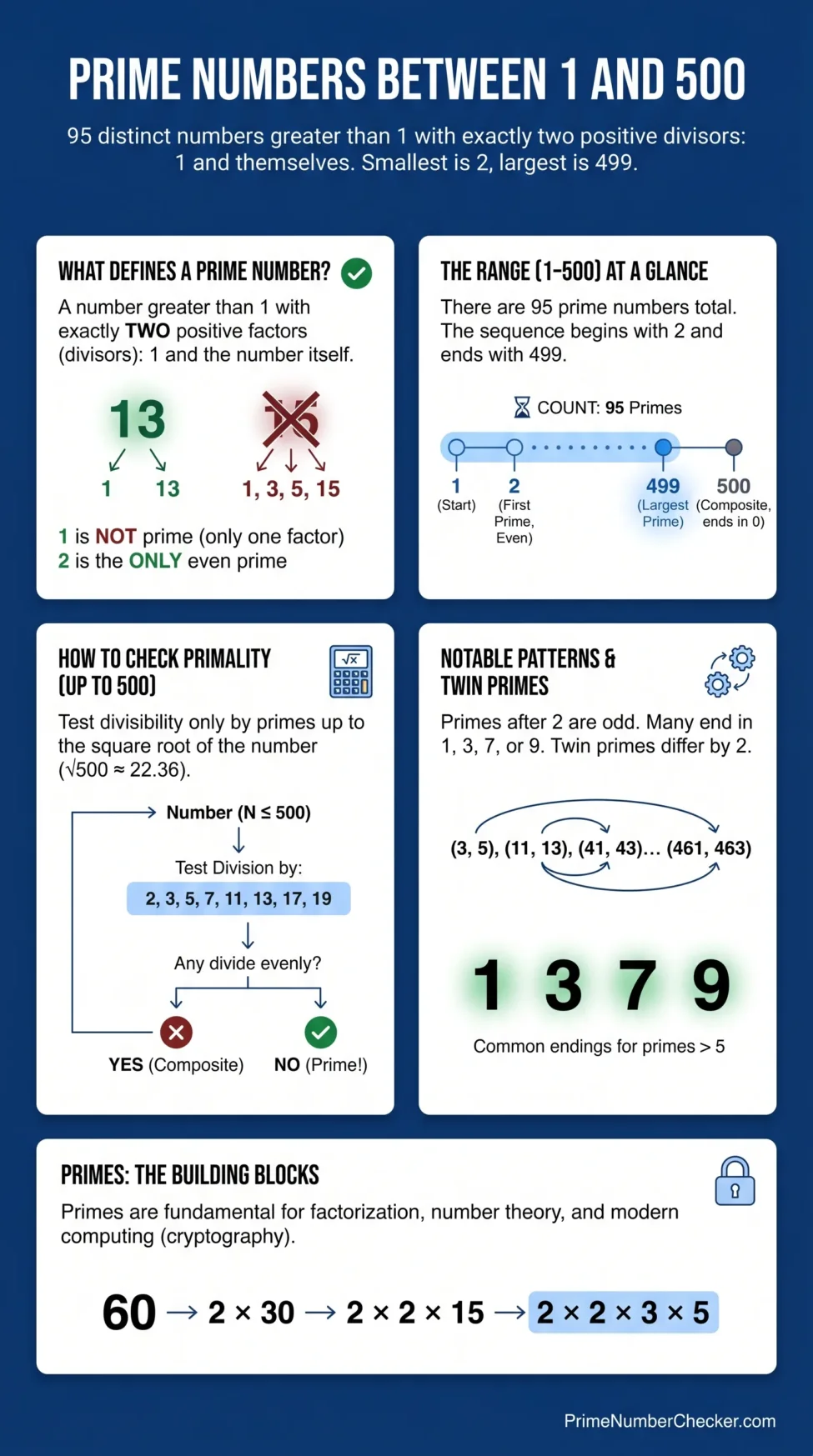
A prime number is not prime because it looks unusual or because it is hard to divide mentally. It is prime because no smaller whole number, other than 1, divides it evenly. That simple rule separates primes from composite numbers.
Here is the full list:
2, 3, 5, 7, 11, 13, 17, 19, 23, 29, 31, 37, 41, 43, 47, 53, 59, 61, 67, 71, 73, 79, 83, 89, 97, 101, 103, 107, 109, 113, 127, 131, 137, 139, 149, 151, 157, 163, 167, 173, 179, 181, 191, 193, 197, 199, 211, 223, 227, 229, 233, 239, 241, 251, 257, 263, 269, 271, 277, 281, 283, 293, 307, 311, 313, 317, 331, 337, 347, 349, 353, 359, 367, 373, 379, 383, 389, 397, 401, 409, 419, 421, 431, 433, 439, 443, 449, 457, 461, 463, 467, 479, 487, 491, 499
What Makes These Numbers Prime?
A number is prime when it has exactly two positive factors. For example, 13 is prime because its only positive divisors are 1 and 13. But 15 is not prime because it can be divided by 1, 3, 5, and 15.
This is why 1 is not included. The number 1 has only one positive divisor: itself. It does not meet the definition of a prime number. It is also not composite. It sits outside both groups.
2 is the only even prime number. Every other even number greater than 2 is divisible by 2, so it has more than two divisors. That is why the list after 2 contains only odd numbers.
Prime Numbers from 1 to 500 by Range
| Range | Prime Numbers | Count |
|---|---|---|
| 1–100 | 2, 3, 5, 7, 11, 13, 17, 19, 23, 29, 31, 37, 41, 43, 47, 53, 59, 61, 67, 71, 73, 79, 83, 89, 97 | 25 |
| 101–200 | 101, 103, 107, 109, 113, 127, 131, 137, 139, 149, 151, 157, 163, 167, 173, 179, 181, 191, 193, 197, 199 | 21 |
| 201–300 | 211, 223, 227, 229, 233, 239, 241, 251, 257, 263, 269, 271, 277, 281, 283, 293 | 16 |
| 301–400 | 307, 311, 313, 317, 331, 337, 347, 349, 353, 359, 367, 373, 379, 383, 389, 397 | 16 |
| 401–500 | 401, 409, 419, 421, 431, 433, 439, 443, 449, 457, 461, 463, 467, 479, 487, 491, 499 | 17 |
How to Check Whether a Number Between 1 and 500 Is Prime
To test a number in this range, you do not need to divide it by every smaller number. You only need to test possible divisors up to its square root. This works because if a number has a factor larger than its square root, it must also have a matching factor smaller than its square root.
For numbers up to 500, the square root of 500 is a little more than 22. That means you only need to test divisibility by prime numbers up to 22:
2, 3, 5, 7, 11, 13, 17, and 19
For example, to check 499, you test whether it is divisible by 2, 3, 5, 7, 11, 13, 17, or 19. It is not divisible by any of them, so 499 is prime.
This is also why a prime checker is useful for quick verification. After you understand the rule, you can use the Prime Number Checker to test any number directly and confirm whether it is prime without doing each division by hand.
Why Some Numbers Near 500 Are Not Prime
Several numbers close to 500 may look like possible primes, but they fail because they have hidden divisors.
- 489 is not prime because it is divisible by 3.
- 493 is not prime because 493 = 17 × 29.
- 495 is not prime because it is divisible by 5.
- 497 is not prime because 497 = 7 × 71.
This matters because prime testing is not about guessing from appearance. A number can look random and still be composite. The only reliable test is divisibility.
Patterns in the Prime Numbers Between 1 and 500
Most primes are odd, but odd does not mean prime
Every prime after 2 is odd. But many odd numbers are still composite. For example, 9, 15, 21, 25, 27, 33, and 35 are all odd, yet none of them is prime.
Oddness is only a filter. It removes even composite numbers, but it does not prove primality.
Many primes end in 1, 3, 7, or 9
After 5, a prime number cannot end in 0, 2, 4, 5, 6, or 8. Those endings make the number divisible by 2 or 5. So primes greater than 5 often end in 1, 3, 7, or 9.
But this is not a full test. For example, 91 ends in 1, but it is not prime because 91 = 7 × 13.
Prime gaps slowly become less predictable
The gap between nearby primes changes as the numbers grow. Sometimes primes are close together, such as 461, 463, and 467. Other times there is a longer stretch with no primes.
This uneven spacing is one reason prime numbers are studied far beyond basic arithmetic. They look simple at first, yet their distribution has deep links to number theory and modern computing.
Twin Primes Between 1 and 500
Twin primes are pairs of prime numbers that differ by 2. Between 1 and 500, examples include:
- 3 and 5
- 5 and 7
- 11 and 13
- 17 and 19
- 29 and 31
- 41 and 43
- 59 and 61
- 71 and 73
- 101 and 103
- 107 and 109
- 137 and 139
- 149 and 151
- 179 and 181
- 191 and 193
- 197 and 199
- 227 and 229
- 239 and 241
- 269 and 271
- 281 and 283
- 311 and 313
- 347 and 349
- 419 and 421
- 431 and 433
- 461 and 463
These pairs help show how primes can appear close together even though the overall list becomes thinner as numbers grow.
Prime and Composite Numbers in This Range
The range from 1 to 500 contains primes, composite numbers, and the special case of 1. A composite number has more than two positive divisors. For example, 84 is composite because it has many divisors, including 2, 3, 4, 6, 7, 12, 14, 21, 28, and 42.
This contrast helps explain why primes matter. A prime number cannot be broken into smaller whole-number factors. Composite numbers can. In multiplication, primes act as the smallest factor pieces used to form larger whole numbers.
For example:
- 60 = 2 × 2 × 3 × 5
- 210 = 2 × 3 × 5 × 7
- 500 = 2 × 2 × 5 × 5 × 5
Each factorization uses prime numbers. That is why prime numbers are central to divisibility, fractions, least common multiples, greatest common factors, and many later topics in mathematics.
Why the List Stops at 499, Not 500
The number 500 is not prime. It is even, so it is divisible by 2. It also ends in 0, so it is divisible by 5 and 10. Its prime factorization is:
500 = 2 × 2 × 5 × 5 × 5
Because 500 has more than two positive divisors, it is composite. The largest prime below 500 is 499.
Why Prime Numbers Below 500 Are Useful
Prime numbers between 1 and 500 are useful because they are small enough to study by hand but large enough to reveal real prime behavior. They are often used in school exercises, coding practice, divisibility lessons, and number theory examples.
They also help users learn practical habits:
- checking divisibility before guessing
- using square roots to reduce work
- separating prime numbers from odd composite numbers
- recognizing common factors
- understanding prime factorization
Once this range feels familiar, larger ranges become easier to understand. The same rule still applies: a prime number has exactly two positive divisors.
FAQ About Prime Numbers Between 1 and 500
How many prime numbers are there between 1 and 500?
There are 95 prime numbers between 1 and 500.
Is 1 a prime number?
No. 1 is not prime because it has only one positive divisor. A prime number must have exactly two positive divisors.
What is the largest prime number under 500?
The largest prime number under 500 is 499.
Is 500 a prime number?
No. 500 is composite because it is divisible by 2, 5, 10, and other numbers.
What is the only even prime number between 1 and 500?
The only even prime number between 1 and 500 is 2. Every other even number is divisible by 2.
How can I quickly test a number below 500 for primality?
Test whether the number is divisible by 2, 3, 5, 7, 11, 13, 17, or 19. These are the only prime divisors you need to check for numbers up to 500.