
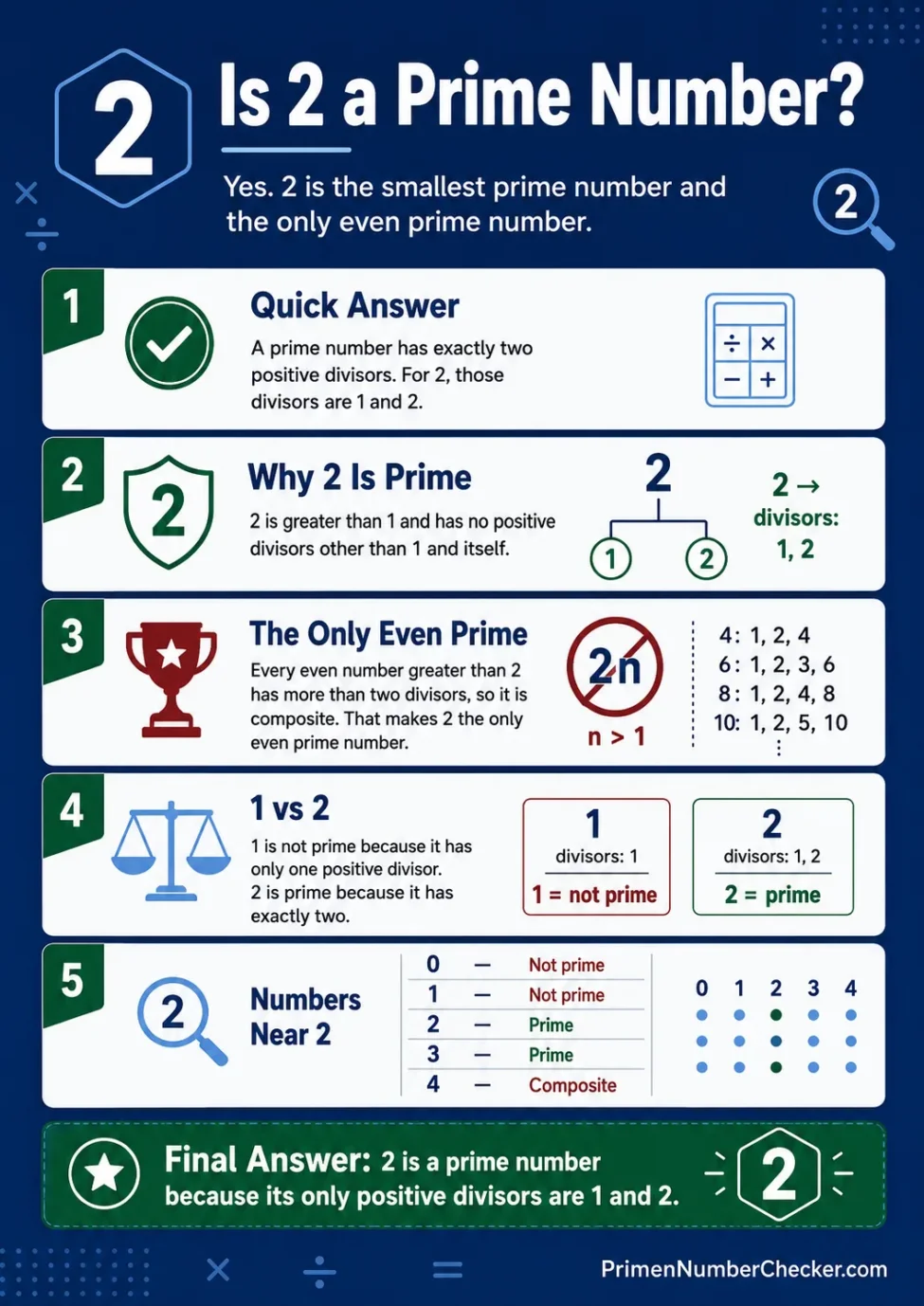
Yes, 2 is a prime number. It is the smallest prime number, the only even prime number, and the first number that fits the modern definition of a prime.
A prime number is a whole number greater than 1 that has exactly two positive divisors: 1 and itself. The number 2 has only two positive divisors: 1 and 2. That is why 2 is prime.
Quick answer: 2 is prime because it can be divided evenly only by 1 and 2. It has no other positive factors.
Why 2 Counts as Prime
The definition matters. A number does not need to be odd to be prime. It only needs to have exactly two positive divisors. Since 2 meets that rule, it is prime.
Here is the full divisor check:
| Number | Positive divisors | Number of divisors | Prime? |
|---|---|---|---|
| 2 | 1, 2 | 2 | Yes |
This is the cleanest way to understand it: 2 has no divisor between 1 and itself. There is no smaller whole number greater than 1 that can divide 2 evenly.
Why 2 Is the Only Even Prime Number
Every even number is divisible by 2. That includes 4, 6, 8, 10, and every larger even number.
But if an even number is greater than 2, it has at least three positive divisors:
- 1
- 2
- itself
For example, 10 is divisible by 1, 2, 5, and 10. Since it has more than two positive divisors, it is not prime.
The number 2 is different. It is even, but it does not have any extra divisor. That makes it a special case: 2 is the only even prime number.
Is 2 Odd or Even?
2 is even because it is divisible by 2 with no remainder. In fact, 2 is the number that defines evenness in basic arithmetic.
This can feel confusing because many people first notice that most prime numbers are odd. But that pattern starts after 2. The prime numbers begin like this:
2, 3, 5, 7, 11, 13, 17, 19…
Only the first one is even. All prime numbers greater than 2 are odd because any larger even number would be divisible by 2.
Why 1 Is Not Prime but 2 Is
One common mistake is to group 1 and 2 together. They behave very differently.
1 is not prime because it has only one positive divisor: itself. A prime number must have exactly two positive divisors. The number 2 has two: 1 and 2.
| Number | Positive divisors | Prime status | Reason |
|---|---|---|---|
| 1 | 1 | Not prime | Only one positive divisor |
| 2 | 1, 2 | Prime | Exactly two positive divisors |
This distinction keeps prime factorization clear. If 1 were treated as prime, the same number could be written with endless extra 1s, which would break the clean structure of factorization.
How to Check Whether 2 Is Prime
To test a number for primality, you check whether it has any positive divisors other than 1 and itself. For 2, the test is very short.
- 2 is greater than 1.
- 2 is divisible by 1.
- 2 is divisible by itself.
- There are no other positive divisors.
So the result is clear: 2 is prime.
For larger numbers, checking by hand takes more work. You can use the Prime Number Checker to test any whole number and see whether it is prime, composite, or outside the prime number range.
What Makes 2 Important in Prime Numbers?
2 is not just the first prime. It also separates prime numbers from the usual even-number pattern.
In number theory, 2 appears in many basic ideas:
- Even and odd numbers: 2 is the base of even divisibility.
- Prime factorization: any even composite number has 2 as one of its prime factors.
- Divisibility tests: checking whether a number is even often starts by testing divisibility by 2.
- Twin primes: 3 and 5 are twin primes, but 2 sits just before that odd-prime pattern begins.
This is why 2 deserves special attention. It is simple, but it shapes how we understand many later prime numbers.
Is 2 a Composite Number?
No. 2 is not composite.
A composite number is a whole number greater than 1 that has more than two positive divisors. Since 2 has exactly two positive divisors, it is prime, not composite.
Do not classify 2 as composite just because it is even. Evenness and compositeness are related for numbers greater than 2, but 2 itself is the exception.
Simple Examples Around 2
Comparing 2 with nearby numbers makes the idea easier to see.
| Number | Status | Reason |
|---|---|---|
| 0 | Not prime | Prime numbers must be greater than 1 |
| 1 | Not prime | Only one positive divisor |
| 2 | Prime | Exactly two positive divisors |
| 3 | Prime | Divisible only by 1 and 3 |
| 4 | Composite | Divisible by 1, 2, and 4 |
FAQ About 2 as a Prime Number
Is 2 the smallest prime number?
Yes. 2 is the smallest prime number because it is the smallest whole number greater than 1 with exactly two positive divisors.
Is 2 the first prime number?
Yes. The list of prime numbers starts with 2, followed by 3, 5, 7, 11, and 13.
Why is 2 prime if it is even?
2 is prime because it has exactly two positive divisors: 1 and 2. Other even numbers are not prime because they are divisible by 1, 2, and themselves.
Is every prime number odd?
No. 2 is prime and even. Every prime number greater than 2 is odd.
Is 2 a factor of every even number?
Yes. Every even number is divisible by 2. That is why larger even numbers are composite, while 2 remains the only even prime.
Final Answer
2 is a prime number. It is prime because it has exactly two positive divisors: 1 and 2. It is also the smallest prime number and the only even prime number.