Skip to content

What Is a Prime Number

    A prime number is a whole number greater than 1 that has exactly two positive divisors: 1 and itself. That short definition gives the full answer. A number like 2, 3, 5, or 7 is prime because nothing else divides it evenly. A number like 4, 6, 8, or 9 is not prime because at least one extra divisor appears.
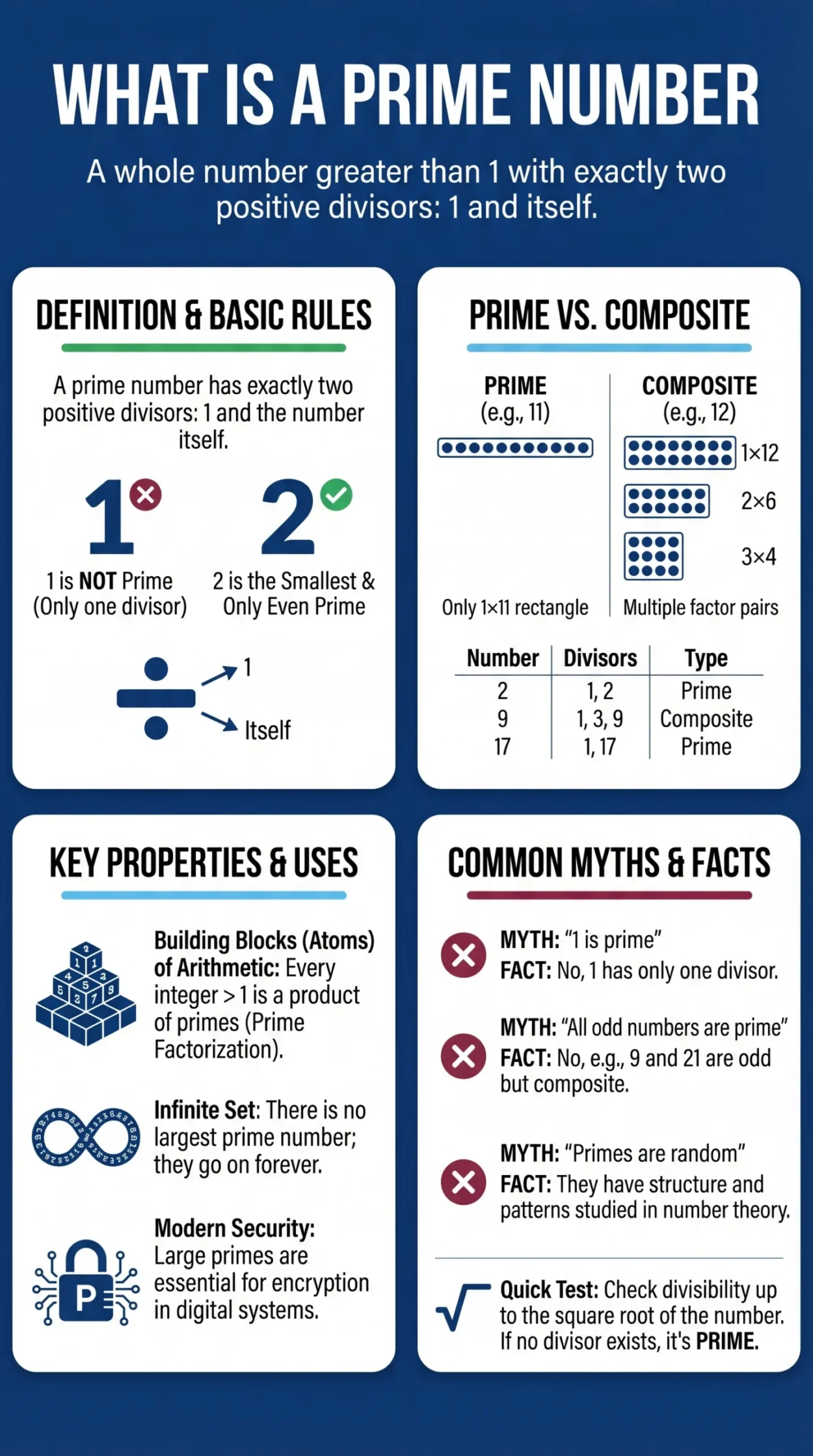
    What Is a Prime Number infographic

    Prime numbers matter because they are the basic pieces of whole numbers. When a number is not prime, it can be broken into prime factors. That simple idea connects prime numbers to divisibility, factorization, number patterns, and even modern encryption.

    Prime number and tool connection: A page like Prime Number Checker fits naturally with this topic because primality is really a question about divisors. If no divisor other than 1 and the number itself exists, the number is prime.

    Prime number definition

    A prime number is a positive integer greater than 1 with exactly two positive divisors. Those divisors are always 1 and the number itself.

    This definition is precise, and it also explains why prime numbers stand apart from other integers. Every whole number greater than 1 falls into one of two groups:

    • Prime numbers: exactly two positive divisors
    • Composite numbers: more than two positive divisors

    So the idea is not about whether a number is odd, large, or hard to divide in your head. It is only about the count of its divisors.

    Why 1 is not a prime number

    This is one of the most common points of confusion. The number 1 is not prime because it has only one positive divisor: 1.

    A prime number must have two positive divisors. Since 1 does not meet that rule, it is excluded. It is also not composite. That makes 1 a special case.

    Important: saying “a prime number is divisible by 1 and itself” is only safe when you also say greater than 1. Without that part, the definition becomes incomplete.

    Why 2 is special

    The number 2 is the smallest prime number, and it is also the only even prime number.

    Every other even number is divisible by 2, so it must have at least three positive divisors: 1, 2, and itself. That makes every even number greater than 2 composite.

    How prime numbers work

    A useful way to think about primes is through exact division. If a number can be divided evenly by any whole number other than 1 and itself, it stops being prime.

    Take 13. You can divide 13 by 1 and 13 with no remainder. But 2, 3, 4, 5, and the rest do not divide it evenly. So 13 is prime.

    Now take 15. It is divisible by 1 and 15, but also by 3 and 5. That means 15 has extra divisors. So 15 is composite.

    Prime vs composite

    Prime and composite are opposite ideas for integers greater than 1. This is where many short pages stop too early, but the distinction matters because it shapes how factorization works.

    Prime and composite examples
    NumberPositive divisorsTypeReason
    11NeitherIt has only one positive divisor
    21, 2PrimeIt has exactly two positive divisors
    91, 3, 9CompositeIt has more than two positive divisors
    171, 17PrimeNo extra divisor exists

    A visual way to understand primes

    You can also picture factors as ways to arrange dots into equal rows and columns. A composite number can form a rectangle in more than one way. A prime number cannot. It only makes a 1 by n rectangle.

    For example, 12 can be arranged as 1×12, 2×6, and 3×4. That shows several factor pairs, so 12 is composite. But 11 only gives 1×11. That is why 11 is prime.

    Examples of prime numbers

    The first few prime numbers are:

    2, 3, 5, 7, 11, 13, 17, 19, 23, 29

    Notice what is missing. Not every odd number is prime. Numbers like 9, 15, 21, and 25 are odd, but they are composite because they have extra divisors.

    Prime numbers from 1 to 20

    The prime numbers from 1 to 20 are 2, 3, 5, 7, 11, 13, 17, 19.

    The numbers 4, 6, 8, 9, 10, 12, 14, 15, 16, 18, and 20 are composite. The number 1 is neither prime nor composite.

    Why prime numbers matter

    Prime numbers are not just a school topic. They sit behind a basic fact of arithmetic: every integer greater than 1 can be written as a product of prime numbers.

    For example:

    • 12 = 2 × 2 × 3
    • 18 = 2 × 3 × 3
    • 35 = 5 × 7

    This matters because prime factors give the most reduced form of a whole number. In that sense, primes play a role similar to atoms in arithmetic: larger numbers are built from them.

    Prime factorization connection

    Once you know what a prime number is, prime factorization becomes much easier to understand. A composite number can be broken into smaller and smaller factors until only primes remain.

    That link is useful for topics such as:

    • greatest common factor
    • least common multiple
    • divisibility rules
    • coprime numbers
    • simplifying fractions

    This is one reason prime-number sites work best when the article and the tool support each other. The article explains the logic. The tool tests specific numbers using that same logic.

    Infinite primes

    Prime numbers do not stop. There is no largest prime number. Mathematicians have known for more than two thousand years that there are infinitely many primes.

    That fact makes primes feel simple and mysterious at the same time. The definition is short, but the pattern of primes across the integers is not regular in any easy way.

    Modern use

    Prime numbers also appear in modern computing, especially in encryption. Large primes help protect digital systems because prime-based arithmetic works well for creating hard-to-reverse steps.

    You do not need cryptography to understand primality, but it is a good reminder that prime numbers are not only theoretical.

    How mathematicians check whether a number is prime

    For small numbers, primality is often checked by testing divisibility. If no whole number other than 1 and the number itself divides evenly, the number is prime.

    Why checking up to the square root works

    This idea often gets skipped, even though it explains how many prime-checking tools work.

    If a number n has a factor larger than its square root, then it must also have a matching factor smaller than its square root. So when you test divisibility, you do not need to check every number up to n – 1. You only need to check up to the square root of n.

    Take 29. The square root of 29 is a little more than 5. That means only 2, 3, and 5 need to be checked. None divides 29 evenly, so 29 is prime.

    That is the practical side of the definition. A prime checker turns the divisor rule into a quick test.

    What a prime checker is really checking

    A prime checker is not using a different definition. It is simply checking whether any extra divisor exists. If one appears, the number is composite. If none appears, the number is prime.

    Common mistakes about prime numbers

    “1 is prime”

    No. 1 is not prime because it has only one positive divisor.

    “All odd numbers are prime”

    No. Many odd numbers are composite. For example, 9 = 3 × 3 and 21 = 3 × 7.

    “A big number is probably prime”

    Size does not decide primality. Some large numbers are prime, and some are composite. Only the divisor structure matters.

    “Prime numbers are random”

    They do not follow a simple repeating pattern, but they are not arbitrary. Number theory studies their structure, spacing, and behavior in great detail.

    Quick summary

    A prime number is a whole number greater than 1 with exactly two positive divisors. That is why 2 is prime, 1 is not prime, and every even number greater than 2 is composite.

    Once that idea is clear, several related topics become clearer too: factors, divisibility, composite numbers, prime factorization, and primality testing.

    FAQ

    What is a prime number in simple terms?

    A prime number is a whole number greater than 1 that can be divided evenly only by 1 and itself.

    Is 1 a prime number?

    No. The number 1 has only one positive divisor, so it does not meet the definition of a prime number.

    Is 2 the only even prime number?

    Yes. Every other even number is divisible by 2, so it has more than two positive divisors and is composite.

    What is the smallest prime number?

    The smallest prime number is 2.

    How can you tell if a number is prime?

    You check whether any whole number other than 1 and the number itself divides it evenly. If no extra divisor exists, the number is prime.

    {
    “@context”: “https://schema.org”,
    “@type”: “FAQPage”,
    “mainEntity”: [
    {
    “@type”: “Question”,
    “name”: “What is a prime number in simple terms?”,
    “acceptedAnswer”: {
    “@type”: “Answer”,
    “text”: “A prime number is a whole number greater than 1 that can be divided evenly only by 1 and itself.”
    }
    },
    {
    “@type”: “Question”,
    “name”: “Is 1 a prime number?”,
    “acceptedAnswer”: {
    “@type”: “Answer”,
    “text”: “No. The number 1 has only one positive divisor, so it does not meet the definition of a prime number.”
    }
    },
    {
    “@type”: “Question”,
    “name”: “Is 2 the only even prime number?”,
    “acceptedAnswer”: {
    “@type”: “Answer”,
    “text”: “Yes. Every other even number is divisible by 2, so it has more than two positive divisors and is composite.”
    }
    },
    {
    “@type”: “Question”,
    “name”: “What is the smallest prime number?”,
    “acceptedAnswer”: {
    “@type”: “Answer”,
    “text”: “The smallest prime number is 2.”
    }
    },
    {
    “@type”: “Question”,
    “name”: “How can you tell if a number is prime?”,
    “acceptedAnswer”: {
    “@type”: “Answer”,
    “text”: “You check whether any whole number other than 1 and the number itself divides it evenly. If no extra divisor exists, the number is prime.”
    }
    }
    ]
    }