
Are Decimals Prime Numbers
Primality applies to integers greater than 1, so non-integer decimals are outside the category; decimal notation such as...
Are Negative Numbers Prime
Negative integers are not prime under the standard definition, though advanced algebra uses related ideas such as prime...
Composite Numbers Explained
Composite numbers are integers above 1 with more than two positive divisors; factor tests and common patterns distinguish...
Is 0 a Prime Number
Zero is not prime because primes must be greater than 1 and have exactly two positive divisors; it...
Is 1 a Prime Number
The number 1 is neither prime nor composite because it has only one positive divisor, preserving unique prime...
Is 2 a Prime Number
Two is prime because its only positive divisors are 1 and 2, and it is the sole even...
Largest Prime Number
There is no largest prime, but record searches identify the largest currently known examples, often among numbers of...
Prime Number Examples
Examples span single-digit, two-digit, odd, twin, and larger primes, paired with non-examples and divisor checks that explain each...
Prime Numbers for Kids
Child-friendly definitions, number examples, factor pairs, and short practice questions show how to separate prime and composite numbers.
Prime Numbers vs Integers
Prime numbers form a subset of the integers: negative integers, zero, one, and positive composites are integers but...
Prime Numbers vs Natural Numbers
Every prime is a natural number, but natural numbers also include 1 and composite values; examples show how...
Prime vs Composite Numbers
Prime numbers have exactly two positive divisors, while composite numbers have more; examples and square-root checks show how...
Prime vs Even Numbers
Even numbers are divisible by 2, while primes have exactly two positive divisors; the number 2 is the...
What Is a Prime Number
A prime number is an integer greater than 1 with exactly two positive divisors; examples, non-examples, and factorization...
14 articles in Prime Number Basics
Short answer:
A prime number is a whole number greater than 1 with exactly two positive divisors: 1 and itself.
That is why 2, 3, 5, 7, and 11 are prime, while 4, 6, 8, 9, and 12 are not. A prime number cannot be broken into smaller whole-number factors except by using 1 and the number itself.
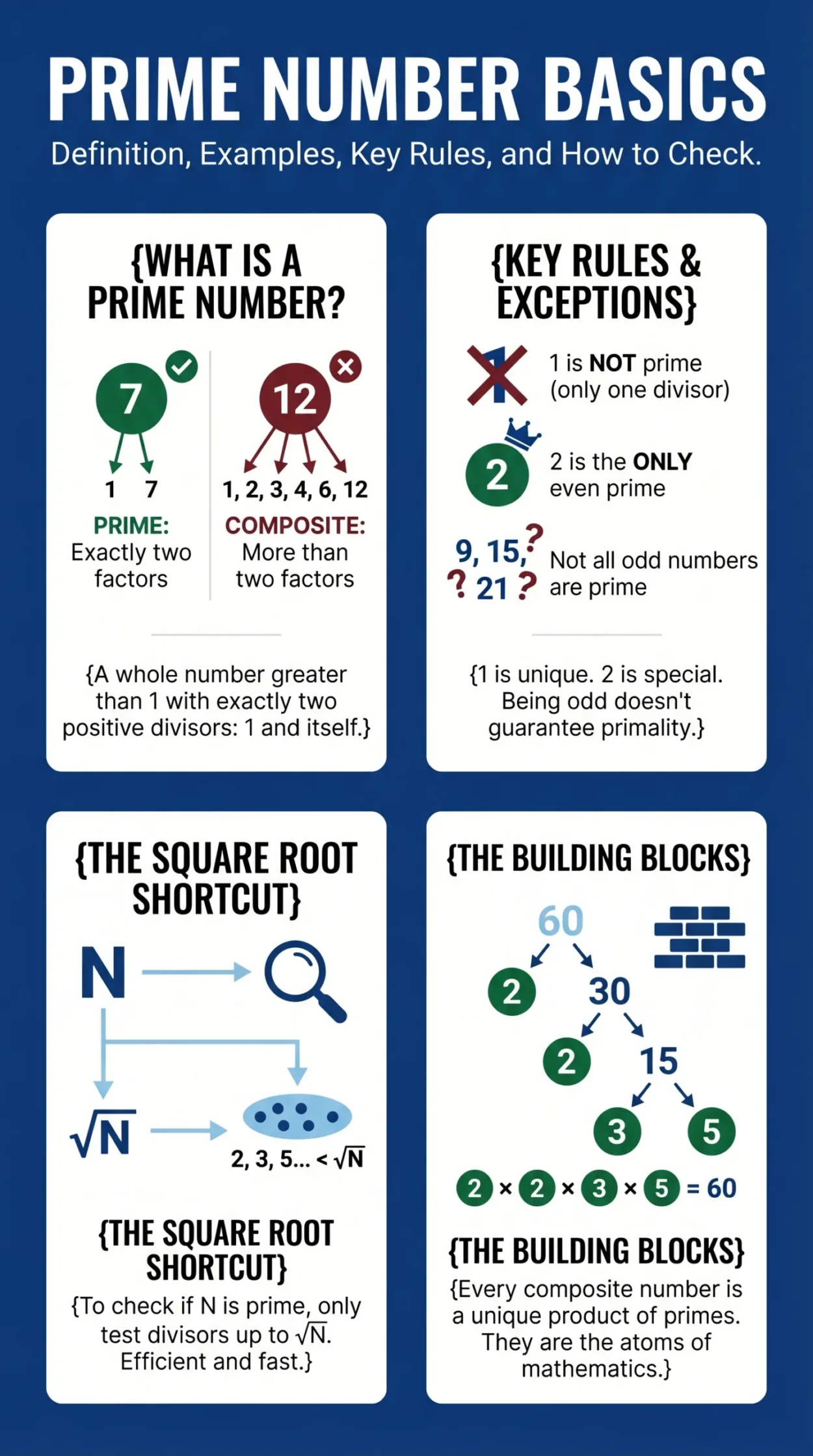
Prime numbers look simple at first. Then they start to reveal why they matter. They help us sort numbers, explain factorization, and test whether a number has any hidden divisors. Once the definition is clear, the rest becomes much easier to follow.
Definition of a prime number
A prime number is a positive whole number greater than 1 that has exactly two positive factors. Those two factors are always 1 and the number itself. If a number has any extra factor, it is not prime.
So the definition depends on divisibility. If another whole number can divide a number evenly, that number is no longer prime. It becomes composite.
Prime: exactly two positive factors.
Composite: more than two positive factors.
Neither prime nor composite: 1.
Prime numbers and composite numbers
The contrast is straightforward. A prime number stays indivisible except by 1 and itself. A composite number does not. For example, 13 is prime because only 1 and 13 divide it evenly. But 15 is composite because 3 × 5 = 15.
This difference matters because every whole number greater than 1 falls into one of these two groups. That simple split is one of the first big ideas in number theory.
| Number | Type | Why |
|---|---|---|
| 2 | Prime | Only 1 and 2 divide it evenly. |
| 9 | Composite | It has 1, 3, and 9 as factors. |
| 17 | Prime | No whole number other than 1 and 17 divides it. |
| 21 | Composite | It can be written as 3 × 7. |
Examples of prime numbers
The first few prime numbers are 2, 3, 5, 7, 11, 13, 17, 19, 23, and 29. They do not appear at fixed intervals, and there is no short pattern that generates all of them. Still, each one passes the same test: it has exactly two positive divisors.
Small examples in plain language
- 2 is prime because it can only be divided evenly by 1 and 2.
- 3 is prime because 2 does not divide it evenly.
- 5 is prime because 2, 3, and 4 all fail.
- 7 is prime because no smaller whole number other than 1 divides it.
- 11 is prime for the same reason.
Now compare those with non-prime numbers. 4 fails because 2 × 2 = 4. 6 fails because it is divisible by 2 and 3. 9 fails because 3 × 3 = 9.
Useful pattern:
Most prime numbers are odd, but not every odd number is prime. Numbers like 9, 15, 21, and 27 are odd, yet each one is composite.
Main rules behind prime numbers
Prime numbers are not random lucky numbers. They follow exact rules. These rules make the definition easier to use, especially when you start checking larger values.
The rules in plain language
A prime number must be greater than 1
This is the first filter. If a number is less than or equal to 1, it is not prime. That removes 0, negative numbers, and 1 right away.
A prime number has exactly two positive divisors
This is the full definition. If a number has only 1 and itself, it is prime. If it has more than those two, it is composite.
Two is the only even prime number
2 is special. Every other even number is divisible by 2, so it automatically has at least three positive factors: 1, 2, and itself. That is why no even number greater than 2 can be prime.
A number ending in 5 is not prime unless the number is 5
If a whole number ends in 5, it is divisible by 5. So 15, 25, 35, 45, and similar numbers are composite. The only exception is 5 itself.
For numbers greater than 5, the last digit can help but does not prove anything
In base 10, a prime number greater than 5 must end in 1, 3, 7, or 9. But that does not mean every number ending in those digits is prime. For example, 21 ends in 1 and 39 ends in 9, yet both are composite.
Why 1 is not a prime number
This is one of the most common questions. 1 is not prime because it has only one positive divisor: itself. A prime number must have exactly two.
There is also a deeper reason. Prime factorization works cleanly because primes start at 2. If 1 were called prime, factorization would become messy. The number 7 could be written as 7, or 1 × 7, or 1 × 1 × 7, and so on forever. Keeping 1 outside the prime list avoids that problem.
Remember: 1 is neither prime nor composite. It sits in its own category.
How to check whether a number is prime
For small numbers, the usual method is trial division. You test whether the number can be divided evenly by smaller whole numbers. If no divisor appears except 1 and the number itself, the number is prime.
The square root shortcut
Here is the useful shortcut: you only need to test possible divisors up to the square root of the number. If no factor shows up before that point, there will not be one after it.
Take 29. Its square root is a little more than 5. So you only need to test 2, 3, and 5. None of them divide 29 evenly, so 29 is prime.
Take 49. Its square root is 7. As soon as you test 7, you find that 49 = 7 × 7. So 49 is composite.
Why this shortcut works
Factors come in pairs. If a number had a factor larger than its square root, the matching factor would have to be smaller than the square root. So checking the smaller side is enough.
This is also where tools become useful. Once numbers get larger, manual checking becomes slow and annoying. A calculator or checker does the same logical job faster. If you want to test a number quickly, you can use the Prime Checker and then return to the underlying idea here: the tool is still asking whether the number has any divisor other than 1 and itself.
Prime numbers and factorization
Prime numbers matter because every whole number greater than 1 is either prime or can be written as a product of prime numbers. This is called prime factorization.
For example:
- 12 = 2 × 2 × 3
- 18 = 2 × 3 × 3
- 30 = 2 × 3 × 5
- 60 = 2 × 2 × 3 × 5
In that sense, prime numbers are the smallest pieces that multiplication cannot break any further. Composite numbers are made from those pieces.
This connection is why prime numbers show up so often in lessons about factors, divisibility rules, greatest common factor, least common multiple, and factor trees. Once primes are clear, many other number topics become easier.
A brief historical note
Prime numbers have been studied for more than two thousand years. One famous result from Euclid shows that there is no last prime number. No matter how long the list becomes, another prime exists beyond it.
That idea still matters today. Prime numbers belong to school arithmetic, pure mathematics, and computer science at the same time. Small primes help students learn divisibility. Very large primes also matter in modern cryptography and algorithm design.
Common mistakes people make with prime numbers
- Calling 1 a prime number. It is not.
- Assuming all odd numbers are prime. Many are not, such as 9, 15, and 21.
- Using the last digit as final proof. It only filters candidates.
- Checking too many divisors. You do not need to go past the square root.
- Forgetting that 2 is prime. It is the only even prime.
FAQ about prime numbers
Is 1 a prime number?
No. 1 is not prime because it has only one positive divisor. A prime number must have exactly two positive divisors.
What is the smallest prime number?
2 is the smallest prime number. It is also the only even prime number.
Are all odd numbers prime?
No. Many odd numbers are composite. For example, 9 = 3 × 3 and 15 = 3 × 5.
How do you check if a number is prime?
Test whether any whole number other than 1 and the number itself divides it evenly. For efficiency, you only need to test possible divisors up to the square root of the number.
Why are prime numbers important?
They explain how composite numbers break into factors, support prime factorization, and appear in areas such as number theory and cryptography.