
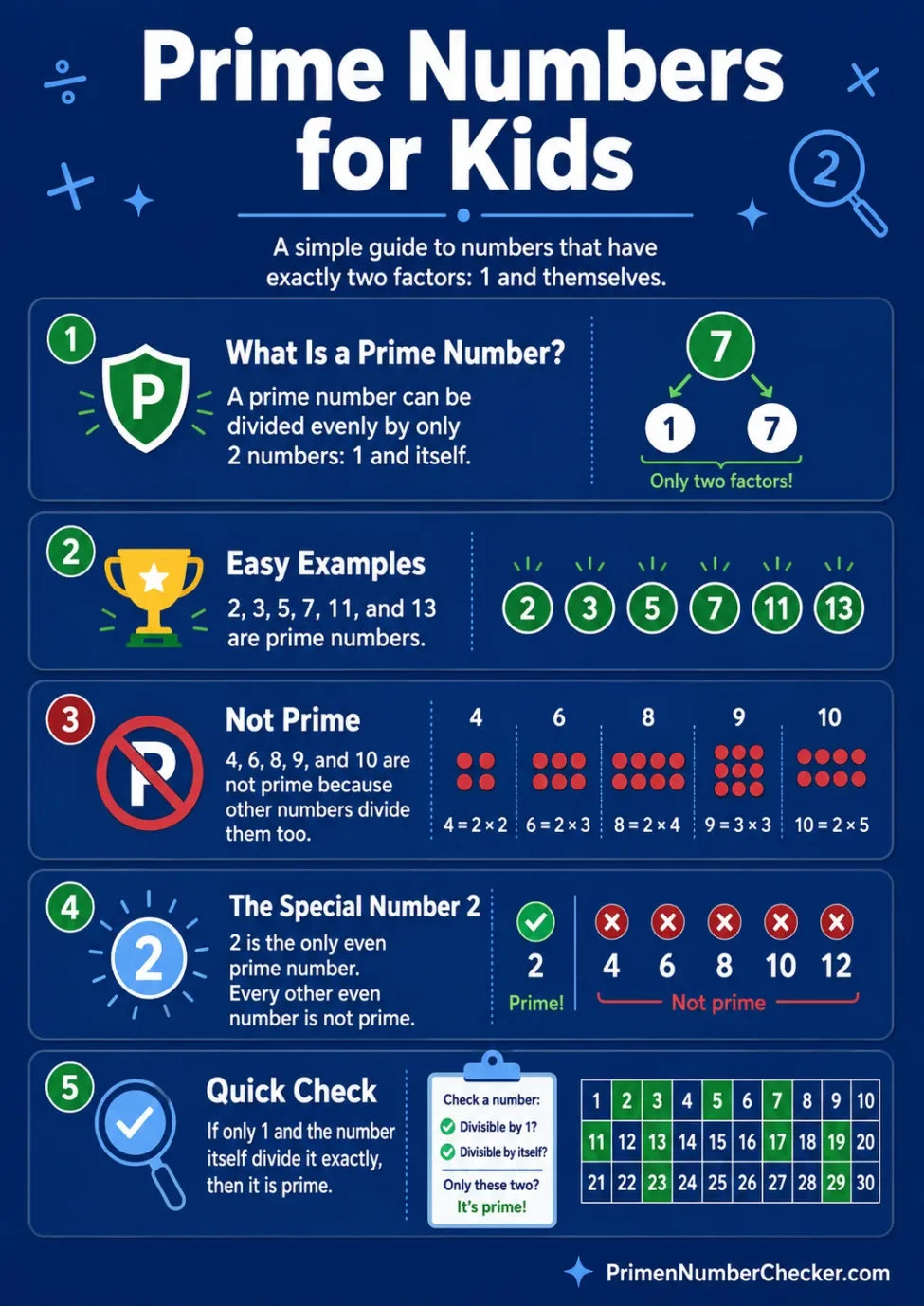
A prime number is a whole number greater than 1 that has exactly two factors: 1 and itself. For kids, the easiest way to think about it is this: a prime number cannot be split evenly into smaller equal groups, except as 1 group of itself.
For example, 7 is prime because only 1 × 7 makes 7. But 8 is not prime because 2 × 4 also makes 8.
What Is a Prime Number?
A prime number is a special kind of counting number. It must be greater than 1, and it must have exactly two factors.
A factor is a number that divides another number evenly. “Evenly” means there is no remainder.
So when we ask, “Is 11 a prime number?” we are really asking: Which numbers divide 11 evenly?
Only 1 and 11 divide 11 evenly. That means 11 is prime.
Prime Number Definition for Kids
A prime number has only two factors:
- 1
- the number itself
That is the whole idea. A prime number does not have extra factor pairs hiding inside it.
Prime Numbers Examples
The first few prime numbers are:
2, 3, 5, 7, 11, 13, 17, 19, 23, 29
Each of these numbers has exactly two factors. For example:
- 2 has factors 1 and 2.
- 3 has factors 1 and 3.
- 5 has factors 1 and 5.
- 13 has factors 1 and 13.
None of them can be divided evenly by another whole number.
| Number Type | What It Means | Kid-Friendly Example |
|---|---|---|
| Prime number | Greater than 1 and has exactly two factors. | 7 has only 1 and 7 as factors. |
| Composite number | Greater than 1 and has more than two factors. | 12 has 1, 2, 3, 4, 6, and 12 as factors. |
| Neither prime nor composite | Does not fit the prime or composite rule. | 1 is not prime and not composite. |
Why Is 1 Not a Prime Number?
This is one of the most common questions kids ask.
1 is not a prime number because it has only one factor: 1. A prime number must have exactly two factors. Not one. Not three. Exactly two.
Important: The number 1 may look simple, but it does not follow the prime number rule. That is why mathematicians place it in its own category.
This rule also helps keep factorization clean. For example, 10 can be written as 2 × 5. If 1 were counted as prime, we could keep adding extra 1s forever: 1 × 2 × 5, or 1 × 1 × 2 × 5. That would make prime factorization messy.
Why Is 2 a Prime Number?
2 is the smallest prime number. It is also the only even prime number.
Why? Because 2 has exactly two factors: 1 and 2.
Other even numbers are not prime because they can be divided by 2. For example:
- 4 = 2 × 2
- 6 = 2 × 3
- 8 = 2 × 4
- 10 = 2 × 5
So after 2, every even number is composite. This is a useful shortcut for kids learning prime numbers.
Prime Numbers vs Composite Numbers
A prime number is like a number that cannot be broken into smaller whole-number multiplication parts. A composite number can be broken down.
For example, 9 is composite because 3 × 3 = 9. It has more than two factors: 1, 3, and 9.
But 11 is prime because no whole number other than 1 and 11 divides it evenly.
A Simple Way to Tell the Difference
- If a number has only 1 and itself as factors, it is prime.
- If a number has extra factors, it is composite.
- If the number is 1, it is neither prime nor composite.
How Kids Can Check If a Number Is Prime
To check if a number is prime, look for factor pairs. If you find a factor other than 1 and the number itself, the number is not prime.
Example: Is 29 a Prime Number?
Let’s test 29.
- 29 is not even, so it is not divisible by 2.
- 2 + 9 = 11, so it is not divisible by 3.
- 29 does not end in 0 or 5, so it is not divisible by 5.
For 29, we do not need to test every number up to 28. Once the possible small factors have been checked, the pattern is clear.
29 is a prime number.
When a child understands the rule, a checker can help confirm larger examples. You can test any number here: Prime Number Checker.
Why You Do Not Have to Test Every Number
Many kids first think they must divide a number by every smaller number. That works, but it is slow.
There is a better idea: factor pairs meet near the square root.
For example, look at 36:
- 1 × 36
- 2 × 18
- 3 × 12
- 4 × 9
- 6 × 6
After 6 × 6, the factor pairs begin to repeat in reverse. That means if a number has a factor, one part of the pair must be small enough to find early.
For kids checking numbers below 100, this often means testing divisibility by 2, 3, 5, and 7 is enough. Since 10 × 10 = 100, any composite number below 100 must have a factor of 2, 3, 5, or 7.
Prime Numbers Under 100
Here are the prime numbers less than 100:
2, 3, 5, 7, 11, 13, 17, 19, 23, 29, 31, 37, 41, 43, 47, 53, 59, 61, 67, 71, 73, 79, 83, 89, 97
There are 25 prime numbers under 100. Kids do not need to memorize all of them at first. It is better to understand why each one is prime.
What Patterns Can Kids Notice?
- Except for 2, prime numbers are odd.
- Except for 5, prime numbers do not end in 0 or 5.
- Some primes are close together, like 11 and 13.
- Some gaps between primes are larger, like 89 to 97.
These patterns help, but they do not replace the definition. A number can look prime and still be composite. For example, 91 looks like it might be prime, but 7 × 13 = 91.
The Sieve of Eratosthenes
The Sieve of Eratosthenes is an old method for finding prime numbers. It is still one of the clearest ways to teach primes.
The idea is simple: start with a list of numbers, then cross out multiples.
How the Sieve Works
- Start with numbers from 2 upward.
- Keep 2, then cross out larger multiples of 2.
- Keep 3, then cross out larger multiples of 3.
- Keep 5, then cross out larger multiples of 5.
- Keep going with the next number that has not been crossed out.
The numbers left behind are prime numbers.
This method helps kids see that prime numbers are not random guesses. They are numbers that survive every divisibility test.
Why Prime Numbers Matter
Prime numbers are not only a school topic. They help children understand multiplication, division, factors, fractions, and number patterns.
They also connect to bigger math ideas later, such as:
- factor trees
- prime factorization
- least common multiple
- greatest common factor
- fractions and simplifying
Prime numbers also appear in computer security. Large prime numbers help protect information online. Kids do not need the advanced details yet, but it is useful to know that primes are part of real technology.
Common Mistakes Kids Make With Prime Numbers
Counting 1 as Prime
1 is not prime because it has only one factor. A prime number needs exactly two factors.
Thinking Every Odd Number Is Prime
Odd numbers are not always prime. For example, 9, 15, 21, 25, and 27 are all odd, but they are composite.
Forgetting About Divisibility
A number may look unusual, but it can still have hidden factors. 39 is not prime because 3 × 13 = 39.
Stopping Too Early
Some composite numbers need more than one quick check. For example, 49 is not divisible by 2, 3, or 5. But it is 7 × 7, so it is composite.
Good Prime Number Examples for Kids
When kids first learn primes, small numbers work best. They are easy to test and easy to picture.
| Number | Prime? | Why? |
|---|---|---|
| 2 | Yes | Only 1 and 2 divide it evenly. |
| 4 | No | 2 × 2 = 4, so it has an extra factor. |
| 7 | Yes | Only 1 and 7 divide it evenly. |
| 9 | No | 3 × 3 = 9. |
| 13 | Yes | It has exactly two factors: 1 and 13. |
| 15 | No | 3 × 5 = 15. |
How Prime Numbers Fit With Multiplication
Prime numbers make more sense when kids already know multiplication facts. That is because primes are about which multiplication pairs can make a number.
Take 18:
- 1 × 18
- 2 × 9
- 3 × 6
18 has several factor pairs, so it is composite.
Now take 17:
- 1 × 17
No other whole-number factor pair works. That makes 17 prime.
A Kid-Friendly Way to Remember Prime Numbers
Prime numbers are numbers that stand alone in multiplication. They do not split evenly into smaller equal groups.
Short memory rule: A prime number is greater than 1 and has only two factors: 1 and itself.
This rule is better than memorizing a long list. Once kids know the rule, they can test new numbers and explain their answer.
FAQ About Prime Numbers for Kids
What is a prime number in simple words?
A prime number is a whole number greater than 1 that can be divided evenly only by 1 and itself. For example, 5 is prime because only 1 and 5 divide it evenly.
Is 1 a prime number?
No. 1 is not a prime number because it has only one factor. A prime number must have exactly two factors.
Is 2 a prime number?
Yes. 2 is a prime number because its only factors are 1 and 2. It is also the only even prime number.
What is the smallest prime number?
The smallest prime number is 2. It is the first number that has exactly two factors: 1 and itself.
Are all odd numbers prime?
No. Some odd numbers are composite. For example, 9 is odd, but it is not prime because 3 × 3 = 9.
How many prime numbers are under 100?
There are 25 prime numbers under 100. They start with 2, 3, 5, 7, 11, and 13, and the largest prime under 100 is 97.