
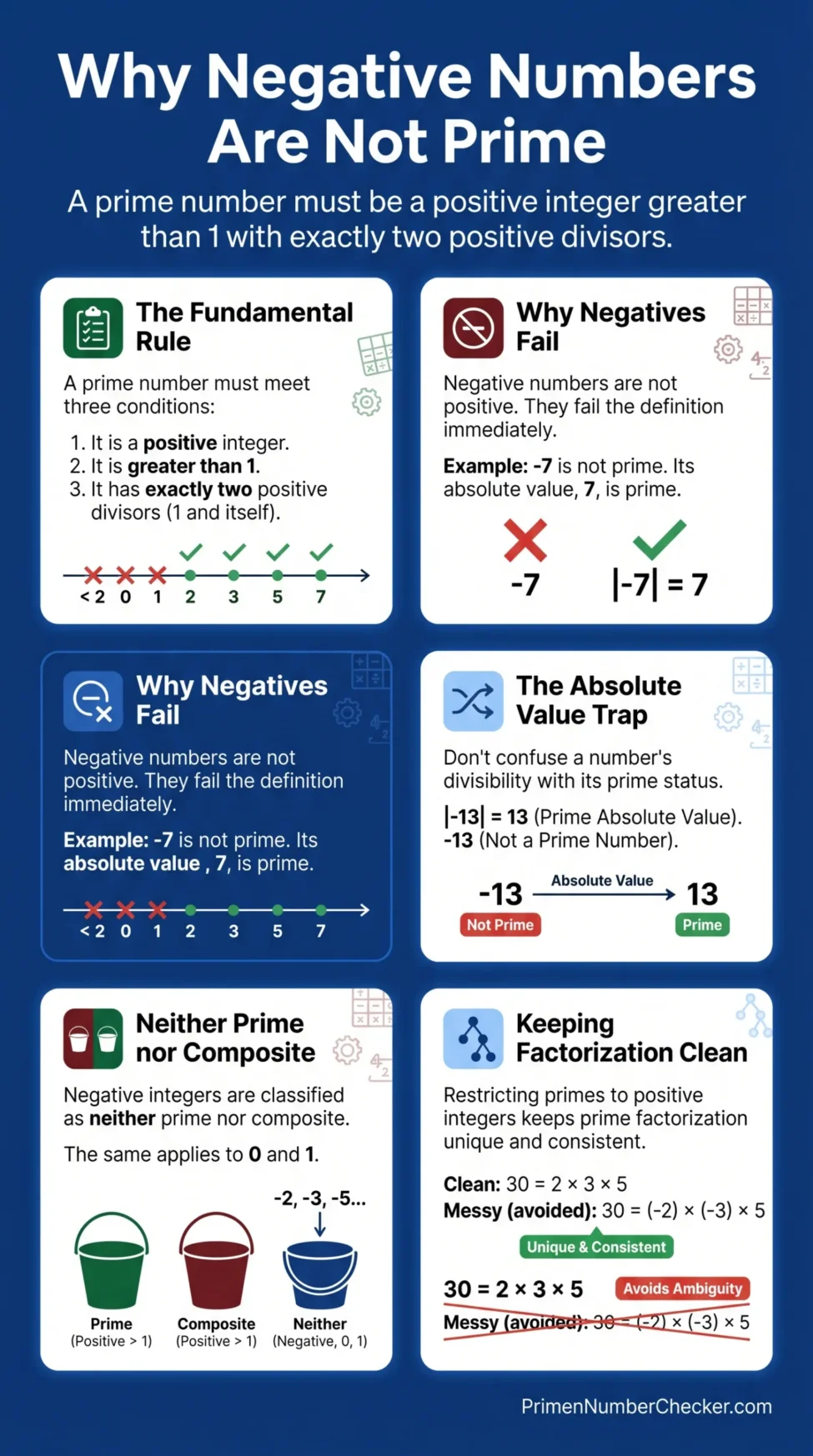
 That one word, positive, is the reason negative numbers fail the test before any divisibility work begins. For example, -7 is not prime. Its absolute value, 7, is prime, but the number -7 itself is not a prime number.
Clean rule: if a number is less than 2, it is not prime. That includes all negative numbers, 0, and 1.
What the Prime Number Definition Requires
A number must pass two conditions to be prime:- It must be a positive whole number greater than 1.
- It must have exactly two positive divisors: 1 and the number itself.
| Number | Prime? | Reason |
|---|---|---|
| -11 | No | Its absolute value is prime, but the number is not positive. |
| -2 | No | 2 is prime, but -2 is negative. |
| 0 | No | 0 is not greater than 1 and has too many divisibility issues. |
| 1 | No | 1 has only one positive divisor, not two. |
| 2 | Yes | 2 has exactly two positive divisors: 1 and 2. |
Why Negative Numbers Can Feel Confusing
The confusion usually comes from mixing two different ideas: divisibility and prime status.Take -13. It is divisible by 1, -1, 13, and -13. Its positive divisors are 1 and 13, so someone might think it behaves like a prime. But the formal definition is not only about the divisor count. It also says the number itself must be positive.Important distinction: the absolute value may be prime, while the negative number is not prime. So |-13| = 13 is prime, but -13 is not.
Negative odd numbers are not prime either
Oddness does not make a number prime. Many positive odd numbers are not prime, such as 9, 15, and 21. Negative odd numbers fail even earlier because they are not positive.So -3, -5, -17, and -101 are all not prime numbers, even though 3, 5, 17, and 101 are prime.Is -2 Prime?
-2 is not prime. This is the most common edge case because 2 is the only even prime number.The sign changes the classification. The number 2 is prime because it is positive, greater than 1, and has exactly two positive divisors. The number -2 has the same distance from zero, but it is not positive. That makes it not prime in standard arithmetic.Why Prime Numbers Are Kept Positive
Prime numbers are used to describe how positive whole numbers break apart into smaller factors. For example:30 = 2 × 3 × 5This factorization stays clean because prime numbers are listed as positive values. If negative primes were included in the usual prime list, the same number could be written in extra ways:30 = (-2) × (-3) × 5That second equation is true, but it adds sign choices without adding a new prime structure. Mathematicians avoid that extra noise by treating -1 as a sign factor and keeping prime numbers positive.The role of 1 and -1
The numbers 1 and -1 act differently from primes. They are called units in more advanced algebra because multiplying by them does not change the size of a factor in the usual sense. For example, 7 and -7 are linked by multiplication by -1.This is one reason modern math keeps a careful separation between positive prime numbers and negative partners such as -7.The Advanced Note: Prime Elements vs Prime Numbers
In elementary arithmetic, the answer is simple: negative numbers are not prime.In abstract algebra, a negative number such as -5 may be discussed as a prime element in the integers, depending on the definition being used. This does not mean -5 is a prime number on a normal prime list. It means -5 has the same divisibility behavior as 5 inside a more advanced system where signs are handled through units.For everyday number theory, education, and online prime tools, the practical rule remains the same:A prime number is positive. Negative values can have prime absolute values, but they are not prime numbers themselves.
How a Prime Number Checker Should Treat Negative Inputs
A good prime-checking tool should not only say “not prime.” It should explain why. If a user enters -29, the correct result is:- -29 is not prime because it is negative.
- 29 is prime because its only positive divisors are 1 and 29.
Negative Numbers, Composite Numbers, and Neither Category
Another common mistake is assuming that every non-prime number must be composite. That is not how the standard categories work.A composite number is also a positive integer greater than 1. It has more than two positive divisors. For example, 12 is composite because it is divisible by 1, 2, 3, 4, 6, and 12.Negative numbers are usually classified as neither prime nor composite in elementary number theory. The same is true for 0 and 1.Quick classification guide
- Prime: positive integer greater than 1 with exactly two positive divisors.
- Composite: positive integer greater than 1 with more than two positive divisors.
- Neither: negative integers, 0, and 1.
How to Decide Prime Status Cleanly
The clean decision path is short:- If n < 2, the number is not prime.
- If n = 2, the number is prime.
- If n is even and greater than 2, it is not prime.
- For odd positive values, test divisibility by possible factors up to the square root of n.