Quick answer
The smallest prime number is 2. It is prime because it has exactly two positive divisors: 1 and 2. It is also the only even prime number.That short answer is correct, but the real value comes from understanding why. Once you see the logic, questions like “Is 1 prime?”, “Why are other even numbers not prime?”, and “How does a prime checker decide?” all become easier.Want to test a number right away? Use the Prime Number Checker to verify whether a value is prime, then come back to this page to understand the result.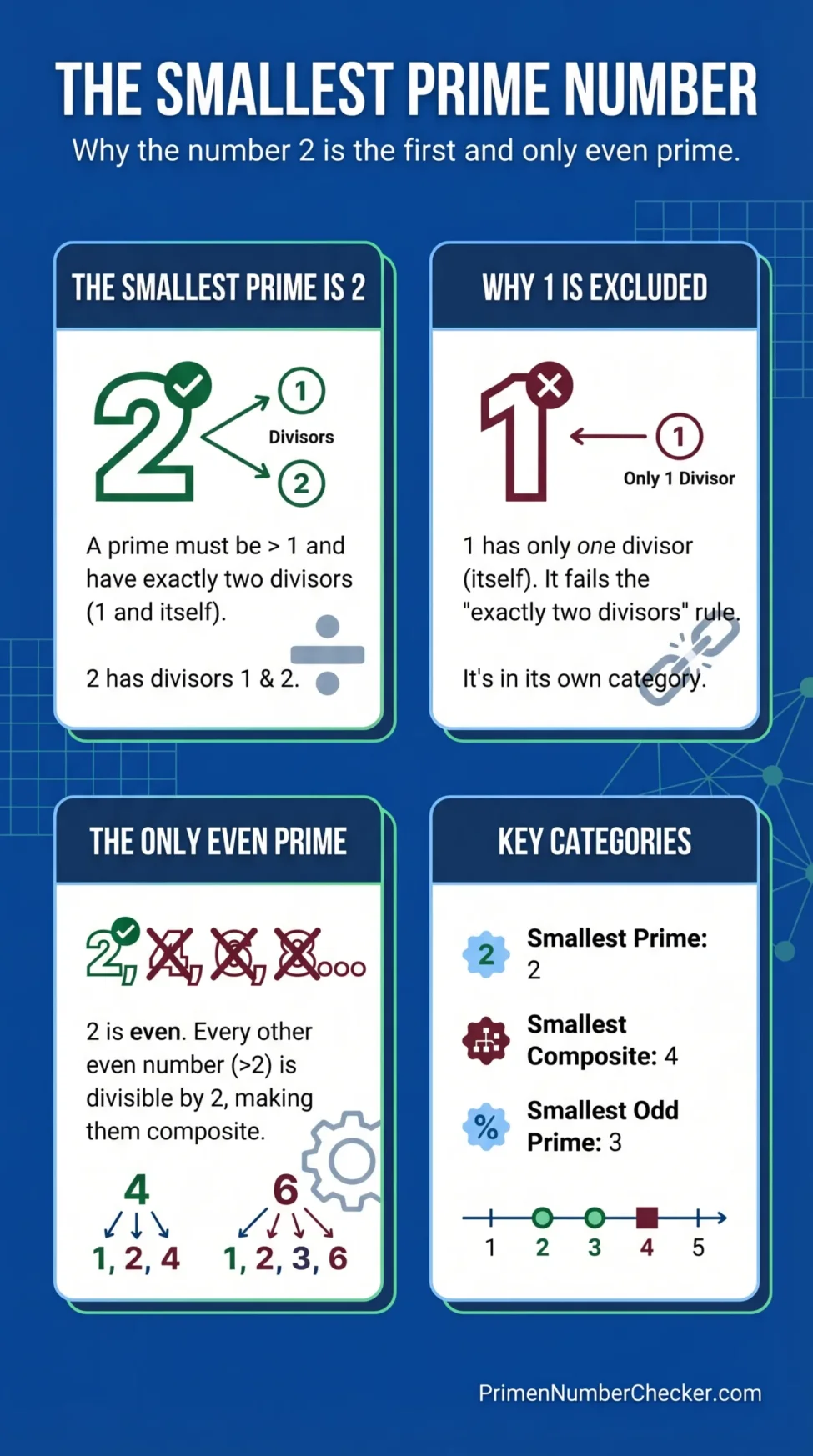
Why 2 is the smallest prime number
A prime number must satisfy one simple rule: it must be greater than 1 and it must have exactly two positive divisors. Those divisors are always 1 and the number itself.Now look at the smallest whole numbers in order.1 has only one positive divisor: 1.2 has two positive divisors: 1 and 2.So 2 is the first number that meets the full definition of a prime.
| Number | Positive divisors | Status | Reason |
|---|---|---|---|
| 1 | 1 | Neither prime nor composite | It has only one positive divisor, so it fails the prime rule. |
| 2 | 1, 2 | Prime | It has exactly two positive divisors. |
| 3 | 1, 3 | Prime | It also has exactly two positive divisors, but it comes after 2. |
| 4 | 1, 2, 4 | Composite | It has more than two positive divisors. |
Why 1 is not a prime number
Many people pause at 1. That is normal. It looks like a number that only “belongs to itself,” so it feels like it should be prime. But prime numbers are not defined that way.A prime number must have exactly two positive divisors. The number 1 has only one: itself. That alone is enough to exclude it.There is also a deeper reason. In number theory, every integer greater than 1 can be written as a product of primes in one standard way. If 1 were treated as prime, that clean rule would break, because you could keep adding extra 1s forever without changing the value.For example:- 6 = 2 × 3
- 6 = 1 × 2 × 3
- 6 = 1 × 1 × 2 × 3
Why 2 is the only even prime number
This is the part many short pages skip too quickly.Every even number greater than 2 is divisible by 2. That means it already has at least three positive divisors:- 1
- 2
- the number itself
What this means for prime number checking
If you use a prime checker, the number 2 is usually the first special case the logic handles.That happens because a checker can reject many numbers quickly:- Numbers less than 2 are not prime.
- 1 is not prime.
- Even numbers greater than 2 are not prime.
Smallest prime number vs nearby number categories
Users often mix these ideas together, especially when moving between educational content and tools. A clear separation helps.Smallest prime number
2. It is greater than 1 and has exactly two positive divisors.Smallest composite number
4. It is greater than 1, but it has more than two positive divisors: 1, 2, and 4.Smallest odd prime number
3. This is why some learners mistakenly answer 3 when asked for the smallest prime. They are really thinking of the smallest odd prime, not the smallest prime overall.Smallest even prime number
2. In fact, it is not just the smallest even prime. It is the only one.Easy memory rule: 1 is too small to be prime, 2 is the first true prime, 4 is the first composite.
A short historical note
Older mathematical writing was not always consistent about the status of 1. Some historical traditions treated it differently from the way we do now. Over time, mathematicians settled on the modern definition because it keeps prime factorization clean and avoids exceptions that make number theory messier.So when a modern math site says the smallest prime number is 2, that is not just a classroom convention. It matches the standard definition used across current mathematics.Why this simple question matters
“Smallest prime number” looks like a tiny fact. But it sits near the start of several bigger ideas:- how prime numbers are defined,
- why 1 is excluded,
- why even numbers are usually composite,
- how primality tests begin,
- and how prime factorization stays orderly.