Short answer: 2 is the only even prime number because every other even number can be divided by 2 as well as by 1 and itself. That gives it more than two positive divisors, so it cannot be prime.
To test examples such as 2, 4, 18, or 97, use the Prime Number Checker and compare the result with the divisibility rule explained below.
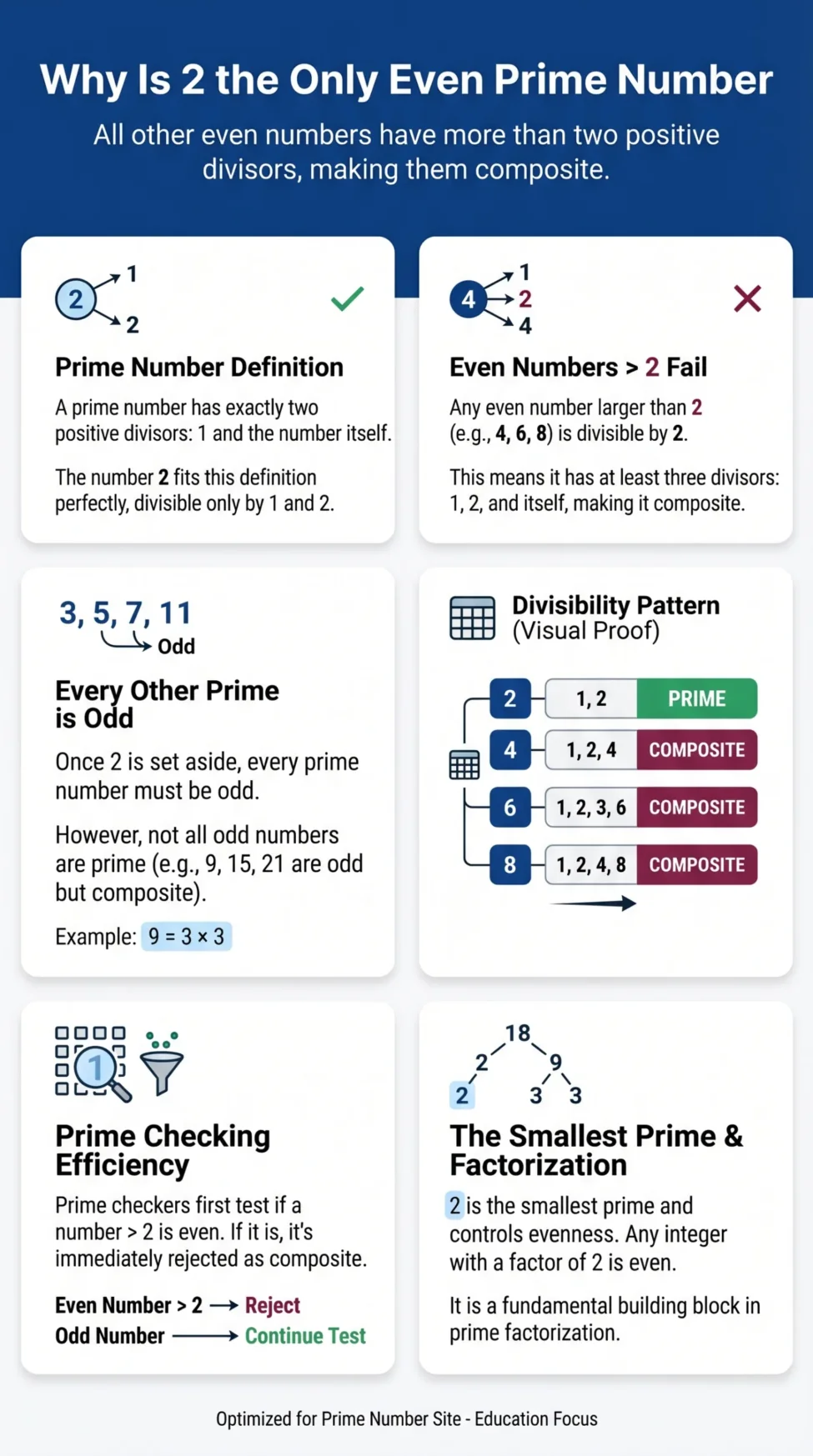
Why 2 is the only even prime number
A prime number has exactly two positive divisors: 1 and the number itself. The number 2 fits that definition perfectly, because it can be divided only by 1 and 2.Now look at any even number larger than 2, such as 4, 6, 8, or 10. Each one is divisible by 2. That means each one already has at least three positive divisors: 1, 2, and itself. Once a number has more than two divisors, it is composite, not prime.That is the whole reason. Simple, but very important.What makes a number prime in the first place
A number is prime when it cannot be broken into smaller whole-number factors other than 1 and itself. This is why prime numbers are treated as the basic units of multiplication. Numbers like 2, 3, 5, 7, and 11 are prime because none of them can be written as a product of smaller positive integers, except in the trivial form of 1 times the number.Composite numbers behave differently. For example, 12 can be written as 3 × 4 or 2 × 6. So 12 has extra divisors and fails the prime test.Why even numbers larger than 2 always fail
Every even number is divisible by 2
An even number is any integer of the form 2n. In plain language, it leaves no remainder when divided by 2. This property is exactly what prevents even numbers above 2 from being prime.If a number is even and greater than 2, then 2 is a proper factor of that number. So the number has:- 1
- 2
- the number itself
Examples make the pattern obvious
| Number | Even? | Positive divisors | Prime or composite? |
|---|---|---|---|
| 2 | Yes | 1, 2 | Prime |
| 4 | Yes | 1, 2, 4 | Composite |
| 6 | Yes | 1, 2, 3, 6 | Composite |
| 8 | Yes | 1, 2, 4, 8 | Composite |
Why 2 still counts as prime
Some people get confused because 2 is even, and even numbers are usually discussed as non-prime. The missing detail is that the rule applies only to even numbers greater than 2.The number 2 is the first even number. It is divisible by 2, but that does not hurt its prime status, because dividing 2 by 2 just gives the number itself. There is no extra factor hiding in the middle. Its divisor list stays short: 1 and 2 only.So 2 is not an exception to the definition of a prime number. It actually matches the definition exactly.What this tells us about all other prime numbers
Once 2 is set aside, every prime number must be odd. That does not mean every odd number is prime. Numbers like 9, 15, and 21 are odd, but they are composite because they have extra factors.So the correct statement is this:All prime numbers greater than 2 are odd, but not all odd numbers are prime.
This is a basic but very useful filter in prime testing. The moment an integer larger than 2 is even, it can be rejected immediately.How this connects to prime checking
When a prime checker tests a number, one of the first questions is whether the number is even. If the number is greater than 2 and divisible by 2, the test ends right there. The number is composite.This makes parity one of the fastest ways to reduce the search space. A checker does not need to test every possible divisor. It can first remove all even candidates except 2, then continue with odd divisors only.That is why the fact that 2 is the only even prime is not just a trivia point. It shapes how prime-testing logic works in practice.Prime factorization and the special role of 2
The number 2 also has a special place in prime factorization because it is the smallest prime and the only prime that controls evenness. Any integer with at least one factor of 2 is even. If no factor of 2 appears, the integer is odd.For example:- 18 = 2 × 3 × 3, so 18 is even
- 45 = 3 × 3 × 5, so 45 is odd
A small historical note
Early mathematicians separated numbers into categories such as even, odd, prime, and composite. The number 2 stood out immediately. It belonged to the even family, but it also met the exact rule for primality. That mix of properties made it unique, and it still holds that position today.Why this topic matters beyond a single fact
Understanding why 2 is the only even prime helps clarify several ideas at once:- what a prime number really is
- how divisibility works
- why parity matters in number theory
- why prime-testing tools eliminate even numbers so early
FAQ
Is 2 really a prime number?
Yes. A prime number has exactly two positive divisors. The number 2 has only 1 and 2, so it is prime.
Why is 4 not prime if it is also even?
Because 4 has more than two positive divisors: 1, 2, and 4. That makes it composite.
Are all odd numbers prime?
No. Many odd numbers are composite. For example, 9 = 3 × 3 and 15 = 3 × 5. Odd only means “not divisible by 2.” It does not mean prime.
Why do prime checkers test evenness first?
Because every even number greater than 2 is composite. This lets the checker reject many numbers immediately and continue only with odd candidates.