
No, decimals are not prime numbers when they are non-whole numbers such as 2.5, 3.14, or 11.6. A prime number must be a whole number greater than 1 with exactly two positive divisors: 1 and itself.There is one detail worth knowing: a number written with a decimal point can still represent a whole number. For example, 7.0 is the same number as 7. Since 7 is prime, 7.0 represents a prime value. But a true decimal value like 7.2 does not qualify.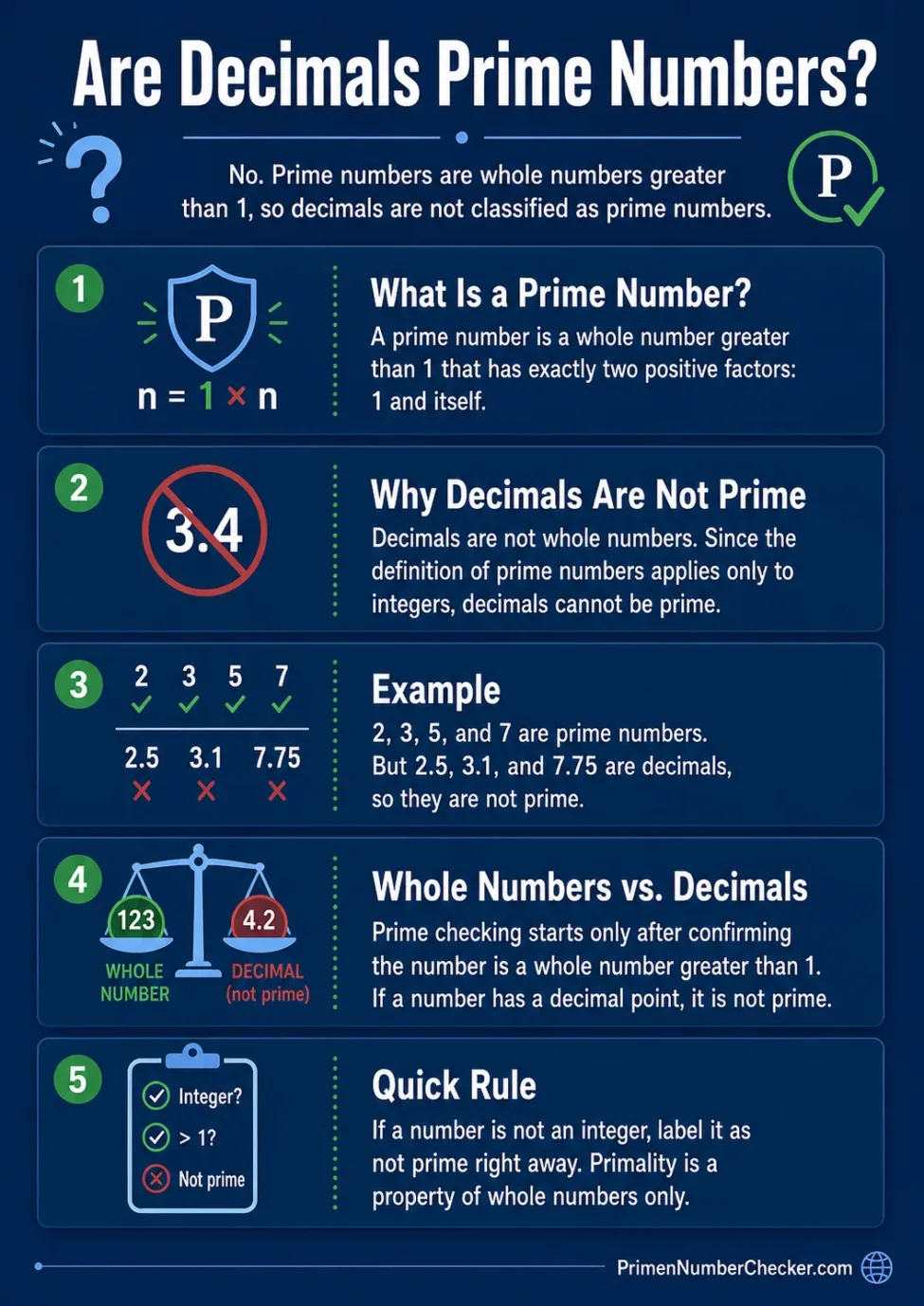
What Makes a Number Prime?
A prime number is a positive integer greater than 1 that has exactly two positive integer factors. Those factors are 1 and the number itself.So the definition has two parts:- The number must be an integer.
- It must have exactly two positive divisors.
The integer requirement matters. Prime numbers belong to the counting-number side of mathematics. Decimals, fractions, and mixed numbers are handled under different number categories.
Why Decimals Are Not Prime Numbers
Decimals are not prime because a prime number must be a whole number. A value like 4.5 sits between 4 and 5. It is not an integer, so it cannot be classified as prime or composite in the usual sense.The prime number test asks a very specific question: How many positive integer divisors does this whole number have? That question does not work cleanly for non-whole decimal values.For example, 5 is prime because its only positive integer divisors are 1 and 5. But 5.5 is not tested the same way. It is not a whole number, so the prime definition stops before factor checking even begins.The decimal point changes the category
A decimal point often means the value is not an integer. Once a number is not an integer, it falls outside the standard definition of a prime number. This is why 2.3 is not prime, even though it is close to the prime number 2.Closeness does not matter. Prime numbers are exact integer values, not approximate positions on the number line.What About Decimals Like 7.0 or 13.00?
This is the part that often causes confusion. The notation 7.0 includes a decimal point, but the value is still exactly 7. The zeros after the decimal point do not change the number.So, 7.0, 7.00, and 7.000 all represent the prime number 7. The same idea applies to 13.0, 17.00, or 101.000.Important distinction: A number with only zeros after the decimal point can represent an integer. A number with a non-zero decimal part, such as 7.1 or 13.04, is not an integer and is not prime.
Notation is not the same as value
Mathematics separates the way a number is written from the value it represents. The expression 7, 7.0, and 07.000 may look different, but they all describe the same value: 7.That is why the better question is not only “Does it have a decimal point?” The better question is: Does the value equal a whole number greater than 1?| Number | Is It an Integer? | Prime Status | Reason |
|---|---|---|---|
| 2.5 | No | Not prime | It is a decimal value, not a whole number. |
| 3.14 | No | Not prime | It is not an integer, so the prime definition does not apply. |
| 7.0 | Yes | Prime value | It equals 7, and 7 has only two positive divisors. |
| 9.0 | Yes | Not prime | It equals 9, and 9 is divisible by 1, 3, and 9. |
| 11.00 | Yes | Prime value | It equals 11, and 11 is prime. |
Decimals, Fractions, and Prime Numbers
Many decimals can also be written as fractions. For example, 0.5 equals 1/2, and 2.75 equals 11/4. These are rational numbers, not integers.Prime numbers are part of the integer system. They are used to study divisibility, factors, multiples, composite numbers, and factorization. Fractions and non-whole decimals can still be useful in mathematics, but they do not have prime status.Can a fraction be prime?
No. A fraction such as 5/2 is not prime, even if its numerator is a prime number. The whole value must be an integer. So 5 is prime, but 5/2 is not prime.The same rule applies to decimals. 0.2 is not prime, even though it can be written using the digit 2. Digits inside a number do not decide primality. The value and its divisors do.Are Negative Decimals Prime?
Negative decimals are not prime. In standard elementary number theory, prime numbers are positive integers greater than 1.That means -3.5 is not prime because it is both negative and non-integer. A number like -7 is also not treated as prime in the standard school definition, even though its absolute value, 7, is prime.How to Decide If a Decimal-Looking Number Can Be Prime
A decimal-looking number can only represent a prime value if its decimal part is zero. This gives a clean way to think about it:- Check whether the number is a whole-number value.
- Make sure it is greater than 1.
- Then test whether it has exactly two positive divisors.
For whole-number values, you can use the Prime Number Checker to test whether the integer is prime. If a decimal has a non-zero part, such as 8.4 or 17.25, it is already outside the prime number definition.