
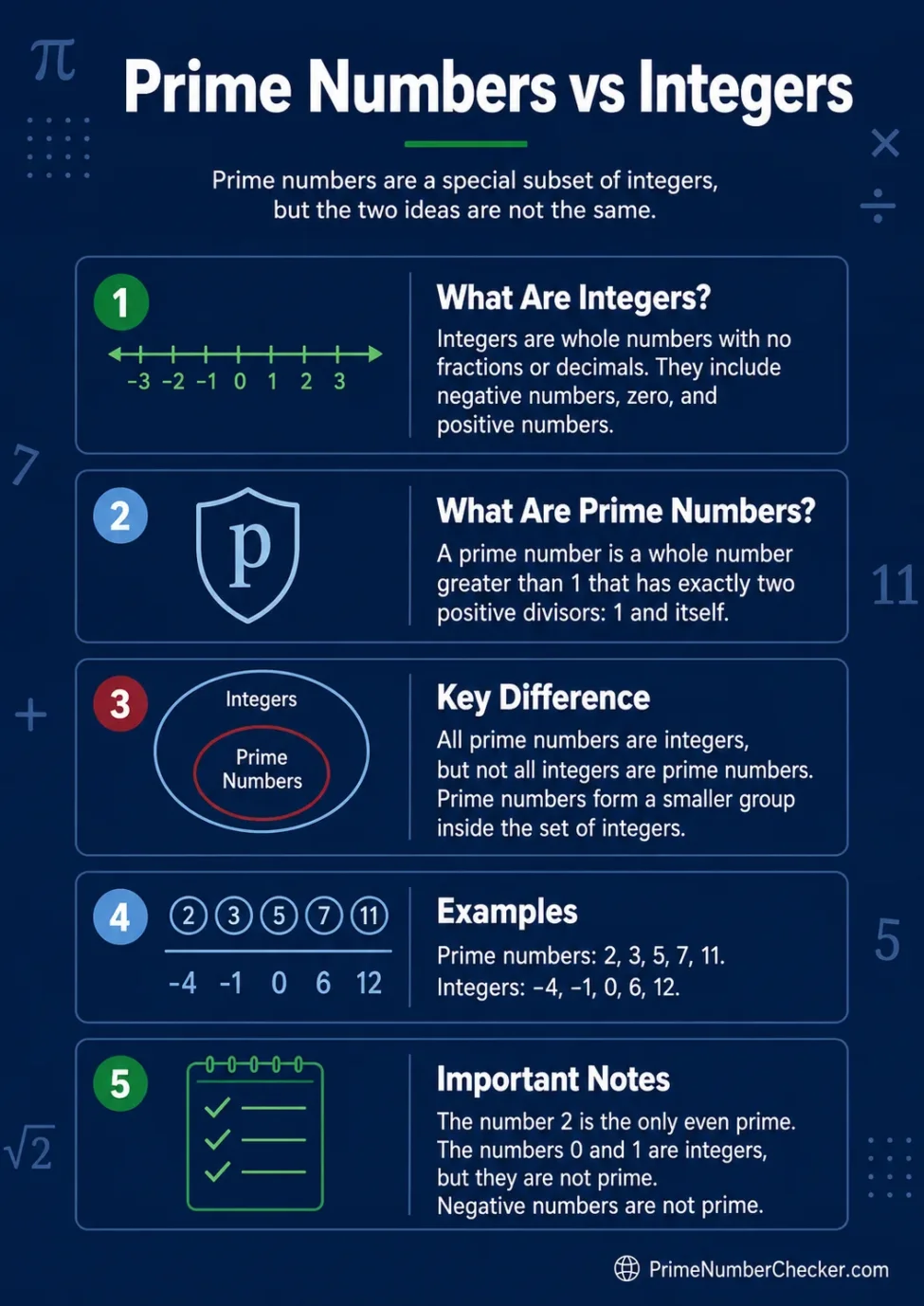
Prime numbers and integers are related, but they are not the same thing. An integer is any whole number with no decimal or fractional part, such as -3, 0, 1, 2, 17. A prime number is a special kind of integer: it must be a positive integer greater than 1 with exactly two positive divisors, 1 and itself.
So the clean answer is this: every prime number is an integer, but not every integer is a prime number. The difference comes from divisibility, not from size alone.
Quick answer: Integers are a broad number category. Prime numbers are a smaller group inside the positive integers.
What Is an Integer?
An integer is a whole number. It can be negative, zero, or positive. Integers do not include decimals, fractions, or mixed numbers.
Examples of integers include -10, -1, 0, 4, 19, 101. Numbers like 2.5, 1/3, and 7.8 are not integers because they contain a fractional or decimal part.
Integers include more than counting numbers
Many students first meet numbers through counting: 1, 2, 3, 4. Integers are wider than that. They also include zero and negative whole numbers. This matters because prime numbers do not use the full integer set.
A number can be an integer and still have nothing to do with primality. For example, -7 is an integer, but it is not considered prime in standard elementary number theory.
What Is a Prime Number?
A prime number is a positive integer greater than 1 that has exactly two positive divisors: 1 and the number itself.
For example, 7 is prime because its only positive divisors are 1 and 7. But 8 is not prime because it can be divided by 1, 2, 4, and 8.
Prime rule: A prime number must pass two tests: it must be a positive integer greater than 1, and it must have exactly two positive divisors.
Prime Numbers vs Integers: The Main Difference
The main difference is scope. Integers are a large number set. Prime numbers are a selected part of that set.
Think of integers as the full group of whole numbers. Prime numbers live inside that group, but only some positive integers qualify. They must meet a strict divisor rule.
| Concept | Meaning | Examples | Prime-related note |
|---|---|---|---|
| Integer | A whole number with no decimal or fraction | -5, 0, 1, 6, 23 | Only some positive integers can be prime |
| Prime number | A positive integer greater than 1 with exactly two positive divisors | 2, 3, 5, 7, 11 | Always an integer |
| Composite number | A positive integer greater than 1 with more than two positive divisors | 4, 6, 8, 9, 12 | Not prime |
Why All Prime Numbers Are Integers
Prime numbers depend on divisibility. Divisibility works cleanly inside the integers because integers can divide other integers with or without a remainder.
For example, when we ask whether 13 is prime, we are asking whether any positive integer other than 1 and 13 divides it evenly. The answer is no, so 13 is prime.
This is why decimals and fractions are not tested as prime numbers. A number like 4.5 may be a valid number, but it is not an integer, so it does not enter the prime number test.
Why Not All Integers Are Prime
Most integers fail the prime test for one of several reasons. Some are negative. Some are zero. Some are equal to 1. Others are positive but have too many divisors.
Negative integers are not prime
Negative numbers such as -3 and -11 are integers, but they are not prime in the standard definition used in school math and number theory. Prime numbers are defined as positive integers greater than 1.
Zero is not prime
0 is an integer, but it is not prime. It does not have exactly two positive divisors. In fact, every nonzero integer divides 0 evenly, so it does not fit the prime rule.
One is not prime
1 is not prime because it has only one positive divisor: itself. A prime number must have exactly two positive divisors. This small detail protects the structure of prime factorization.
Composite integers are not prime
A composite number is a positive integer greater than 1 that has more than two positive divisors. For example, 12 is composite because it can be divided by 1, 2, 3, 4, 6, and 12.
How Prime Numbers Fit Inside the Integer Set
The relationship can be written in plain language:
- Integers include negative whole numbers, zero, and positive whole numbers.
- Prime numbers include only certain positive integers greater than 1.
- Composite numbers are also positive integers greater than 1, but they have extra divisors.
- 0 and 1 are integers, but they are neither prime nor composite.
This is the reason a prime checker starts by treating the input as an integer question first. Before testing divisors, the number must belong to the right type of number.
Need to test a number?
If you want to check whether a whole number is prime, use the Prime Number Checker. It is useful when you already know the number is an integer and want to confirm whether it has only two positive divisors.
Examples: Integer or Prime?
These examples show how the distinction works in practice.
| Number | Is it an integer? | Is it prime? | Reason |
|---|---|---|---|
| -5 | Yes | No | It is negative |
| 0 | Yes | No | It does not have exactly two positive divisors |
| 1 | Yes | No | It has only one positive divisor |
| 2 | Yes | Yes | Its only positive divisors are 1 and 2 |
| 9 | Yes | No | It is divisible by 3 |
| 17 | Yes | Yes | Its only positive divisors are 1 and 17 |
| 4.5 | No | No | It is not an integer |
The Role of Divisors
The real difference between prime and non-prime integers appears when you count divisors.
A divisor is a number that divides another number evenly. For example, 3 is a divisor of 12 because 12 ÷ 3 = 4 with no remainder.
Prime numbers are special because they have a very limited divisor list. A prime number has no hidden smaller factor except 1. That is why prime numbers are central to factorization.
Prime Numbers, Composite Numbers, and Factorization
Once a positive integer is greater than 1, it is either prime or composite. There is no third option in ordinary whole-number factorization.
For example:
- 13 is prime because it cannot be broken into smaller positive integer factors other than 1 and 13.
- 18 is composite because 18 = 2 × 3 × 3.
- 29 is prime because no smaller positive integer except 1 divides it evenly.
This link between prime numbers and factorization is one reason primes matter far beyond basic arithmetic. They help describe how positive integers are built through multiplication.
Common Misunderstandings
“Is every odd integer prime?”
No. Many odd integers are not prime. For example, 9, 15, and 21 are odd, but they are composite. Being odd only means a number is not divisible by 2. It does not prove primality.
“Is 2 an integer and a prime number?”
Yes. 2 is both an integer and a prime number. It is also the only even prime number. Every other even positive integer greater than 2 is divisible by 2, so it has more than two positive divisors.
“Can a decimal be prime?”
No. Prime numbers are defined only among positive integers greater than 1. A decimal such as 2.5 is not prime because it is not an integer.
Why This Difference Matters
The distinction between integers and prime numbers keeps number classification clear. It also prevents common errors, such as calling 1 prime or treating negative numbers as prime.
For a prime-focused site, this distinction is more than vocabulary. It is the first filter in every prime test. A number must be an integer before it can even be considered for primality. Then its divisors decide the final answer.
Important: “Integer” describes the type of number. “Prime” describes a special divisor property inside the positive integers.
FAQ
Are prime numbers integers?
Yes. Every prime number is an integer. More precisely, every prime number is a positive integer greater than 1 with exactly two positive divisors.
Are all integers prime numbers?
No. Integers include negative numbers, zero, one, prime numbers, and composite numbers. Only some positive integers greater than 1 are prime.
Is 1 an integer or a prime number?
1 is an integer, but it is not a prime number. It has only one positive divisor, while a prime number must have exactly two.
Is 0 an integer or a prime number?
0 is an integer, but it is not prime. It does not meet the rule of having exactly two positive divisors.
What is the simplest difference between primes and integers?
An integer is any whole number. A prime number is a positive integer greater than 1 that can be divided evenly only by 1 and itself.
Can negative integers be prime?
In the standard school and number theory definition, negative integers are not prime. Prime numbers are defined as positive integers greater than 1.