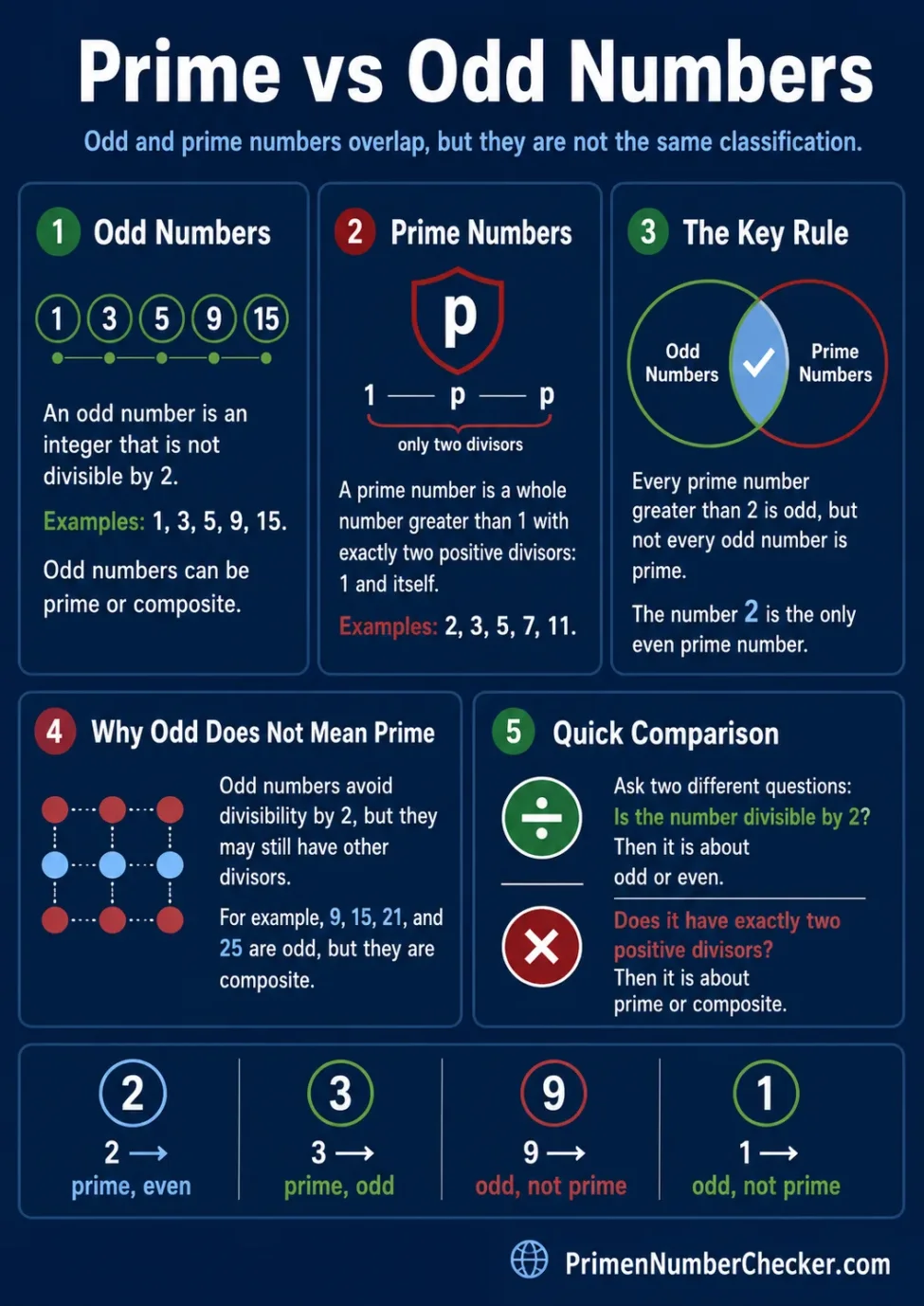
Prime numbers and odd numbers are related, but they are not the same idea. An odd number is any integer that is not divisible by 2. A prime number is a whole number greater than 1 with exactly two positive divisors: 1 and itself.
The overlap is easy to remember: every prime number greater than 2 is odd, but not every odd number is prime. For example, 3, 5, 7, and 11 are both odd and prime. But 9, 15, 21, and 27 are odd numbers that are not prime because they have extra divisors.
Prime vs Odd Numbers
The difference comes from what each term measures. Oddness is about divisibility by 2. Primality is about the total number of positive divisors.
| Concept | Meaning | Examples | What to Watch |
|---|---|---|---|
| Odd number | An integer not divisible by 2 | 1, 3, 5, 9, 15 | Odd numbers can be prime or composite |
| Prime number | A whole number greater than 1 with exactly two positive divisors | 2, 3, 5, 7, 11 | 2 is the only even prime number |
| Odd prime | A prime number that is also odd | 3, 5, 7, 11, 13 | All primes after 2 are odd |
| Odd composite | An odd number with more than two positive divisors | 9, 15, 21, 25 | These numbers are odd but not prime |
The Short Answer
Prime numbers and odd numbers are different classifications. A number can be odd without being prime, and one prime number, 2, is not odd.
So the clean rule is:
- 2 is prime and even.
- Every prime number greater than 2 is odd.
- Many odd numbers are not prime.
This is why saying “prime numbers are odd numbers” is close, but not exact. The exception 2 matters, and the odd composite numbers matter too.
Why Almost All Prime Numbers Are Odd
An even number is divisible by 2. That means every even number greater than 2 has at least three positive divisors: 1, 2, and the number itself.
For example, 10 has 1, 2, 5, and 10 as divisors. Since it has more than two divisors, it cannot be prime.
The number 2 is different. It is divisible by 1 and 2 only. That gives it exactly two positive divisors, so 2 is prime. It is also even, which makes it the only even prime number.
Why Odd Does Not Always Mean Prime
Odd numbers avoid divisibility by 2, but they may still be divisible by other numbers. This is the part many quick explanations miss.
Take 9. It is odd because it is not divisible by 2. But it is not prime because:
- 9 ÷ 1 = 9
- 9 ÷ 3 = 3
- 9 ÷ 9 = 1
So 9 has three positive divisors: 1, 3, and 9. That makes it composite, not prime.
The same logic applies to 15, 21, 25, 27, 33, 35, and many other odd numbers. They are odd, but they break into smaller factors.
Prime Numbers Focus on Divisors
The real test for a prime number is not whether it looks odd. The real test is its divisor count.
A number is prime only when it has exactly two positive divisors:
- 1
- the number itself
This is why 13 is prime. Its only positive divisors are 1 and 13. But 15 is not prime because it has 1, 3, 5, and 15 as divisors.
If you want to test a number directly, use the Prime Number Checker. It helps connect the idea to the actual divisors of the number instead of relying on guesswork.
Odd Numbers Focus on Divisibility by 2
An odd number is any integer that leaves a remainder of 1 when divided by 2. In simple form, odd numbers follow this pattern:
1, 3, 5, 7, 9, 11, 13, 15, …
That pattern tells you only one thing: the number is not even. It does not tell you whether the number is prime.
This is why oddness is a faster property to check, while primality needs more reasoning.
Examples That Show the Difference
3 is odd and prime
3 is not divisible by 2, so it is odd. Its only positive divisors are 1 and 3, so it is also prime.
9 is odd but not prime
9 is not divisible by 2, so it is odd. But 9 is divisible by 3, so it has more than two divisors. That makes it composite.
2 is prime but not odd
2 is divisible by 2, so it is even. But it has exactly two positive divisors: 1 and 2. That makes it prime.
1 is odd but not prime
1 is odd, but it is not prime. A prime number must have exactly two positive divisors. The number 1 has only one positive divisor: itself.
The Most Common Mistake
A common mistake is to think that a number is prime just because it is odd. This works for small examples like 3, 5, 7, 11, and 13, but it quickly fails.
For example:
- 21 is odd, but 21 = 3 × 7.
- 25 is odd, but 25 = 5 × 5.
- 27 is odd, but 27 = 3 × 9.
- 45 is odd, but 45 = 5 × 9.
These examples show the main idea: oddness removes only one possible factor, 2. It does not remove 3, 5, 7, 11, or other possible factors.
How This Helps When Checking Prime Numbers
When testing whether a number is prime, checking whether it is even is only the first filter. If the number is even and greater than 2, it is not prime.
But if the number is odd, the work is not finished. You still need to check whether it has another divisor.
For example, 97 is odd. That does not prove it is prime. To test it, you look for divisors other than 1 and 97. Since no smaller factor divides it evenly, 97 is prime.
Now compare 91. It is also odd, but 91 = 7 × 13. So 91 is composite.
Prime, Odd, Even, and Composite
These number types are connected, but they do different jobs. The cleanest way to understand them is to separate parity from factor structure.
- Parity asks: is the number even or odd?
- Primality asks: how many positive divisors does the number have?
That small separation makes the whole topic clearer.
Even numbers
Even numbers are divisible by 2. Most even numbers are composite, but 2 is prime.
Odd numbers
Odd numbers are not divisible by 2. Some are prime, and some are composite.
Composite numbers
Composite numbers have more than two positive divisors. They can be even or odd.
Prime numbers
Prime numbers have exactly two positive divisors. All primes except 2 are odd.
A Simple Mental Model
Think of odd as a quick label and prime as a deeper property.
An odd number passes only one test: it is not divisible by 2. A prime number passes a stronger test: it cannot be divided evenly by any positive number except 1 and itself.
That is why prime numbers are more selective. Many numbers are odd. Fewer numbers are prime.
FAQ
Are all prime numbers odd?
No. 2 is prime and even. Every prime number greater than 2 is odd.
Are all odd numbers prime?
No. Many odd numbers are composite. For example, 9, 15, 21, and 25 are odd but not prime.
Why is 2 the only even prime number?
Every even number greater than 2 is divisible by 2 and has more than two positive divisors. The number 2 has only 1 and 2 as positive divisors, so it is prime.
Is 1 odd or prime?
1 is odd, but it is not prime. A prime number must have exactly two positive divisors, and 1 has only one.
Can an odd number be composite?
Yes. An odd number is composite when it has more than two positive divisors. For example, 45 is odd and composite because 45 = 5 × 9.
What is the easiest way to tell the difference?
Ask two different questions. For odd numbers, ask whether the number is divisible by 2. For prime numbers, ask whether the number has exactly two positive divisors.