
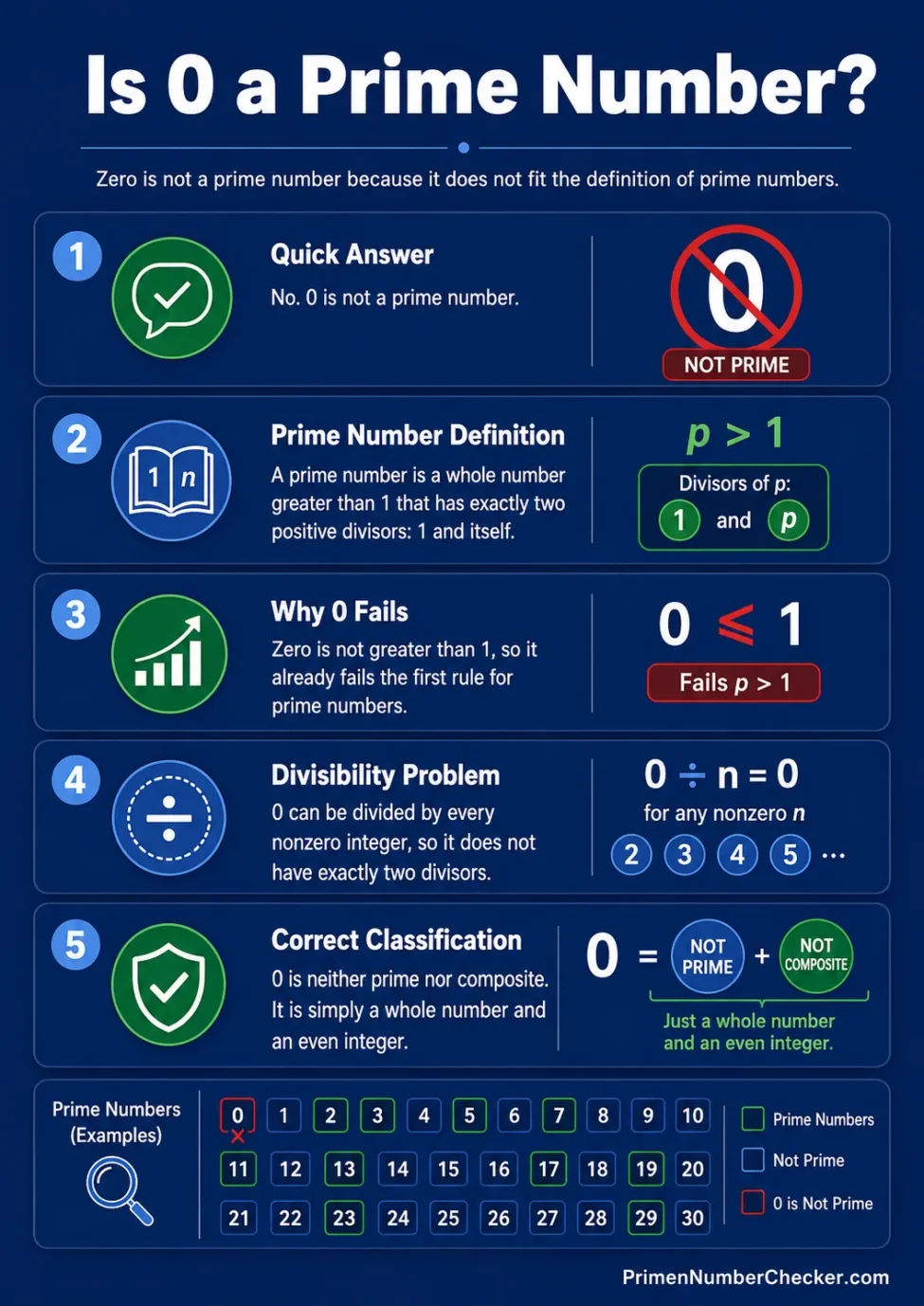
No. 0 is not a prime number. A prime number is a whole number greater than 1 that has exactly two positive factors: 1 and itself.
The number 0 fails the definition in two ways. It is not greater than 1, and it does not have exactly two positive factors. In fact, every positive whole number divides 0 evenly, so 0 has more than two divisors.
Prime Check Result for 0
0
No
It is less than 2 and does not have exactly two positive factors.
To test another value, use the Prime Number Checker. It is most useful when the number is larger and the factors are not obvious.
Why 0 Is Not Prime
The reason is not only that 0 is small. The deeper issue is that 0 does not behave like a prime under multiplication. Prime numbers are used to break larger whole numbers into smaller multiplicative parts. The number 0 does not fit that role.
A prime number must be greater than 1
By definition, prime numbers start at 2. This rule keeps the prime number system clean. So the first prime number is 2, not 0 or 1.
Since 0 is less than 2, it is excluded before any factor test even begins. This same rule also explains why 1 is not prime.
A prime number must have exactly two positive factors
A prime number has exactly two positive factors. For example, 7 has only 1 and 7. That is why 7 is prime.
The number 0 is different. For any positive whole number n, the product n × 0 equals 0. That means 1, 2, 3, 4, 5, and every other positive whole number divides 0 evenly.
So 0 does not have exactly two positive factors. It has infinitely many positive divisors.
| Prime number test | What is required | What happens with 0 |
|---|---|---|
| Size condition | Greater than 1 | 0 is not greater than 1 |
| Factor condition | Exactly two positive factors | 0 has infinitely many positive divisors |
| Prime status | Fits both conditions | 0 fits neither condition |
Is 0 Composite?
No. 0 is not composite either. A composite number is a whole number greater than 1 that has more than two positive factors.
This is a common source of confusion. Since 0 has many divisors, it may look composite at first. But composite numbers, like prime numbers, are usually defined only for whole numbers greater than 1.
So 0 is best described as neither prime nor composite.
Where 0 Fits in Number Theory
The number 0 has a special role in mathematics. It is the additive identity, because adding 0 to a number leaves that number unchanged. For example, 9 + 0 = 9.
Prime numbers are about multiplication and factorization. That is why 0 is treated separately. It is important, but not as a prime.
| Question | Answer | Why |
|---|---|---|
| Is 0 prime? | No | It is not greater than 1 and does not have exactly two positive factors. |
| Is 0 composite? | No | Composite numbers are also greater than 1. |
| Is 0 even? | Yes | 0 is divisible by 2, since 0 ÷ 2 = 0. |
| Is 0 a whole number? | Yes | Whole numbers include 0, 1, 2, 3, and so on. |
Why the Definition Excludes 0
Prime numbers are used to describe how whole numbers break apart under multiplication. For example, 30 can be written as 2 × 3 × 5. Each of those parts is prime.
If 0 were allowed to be prime, this system would stop working cleanly. Since 0 multiplied by any number gives 0, it would not help describe the structure of ordinary positive whole numbers.
This is why mathematicians keep the definition narrow: prime numbers are whole numbers greater than 1 with exactly two positive factors. That definition gives prime numbers their useful role in factorization.
Common Misunderstandings About 0 and Prime Numbers
“0 has no factors.”
This is not correct. Every positive whole number divides 0 evenly. For example, 5 divides 0 because 0 ÷ 5 = 0. The problem is not that 0 has no factors. The problem is that 0 has too many divisors to be prime.
“0 is even, so it must be composite.”
Even numbers are divisible by 2, and 0 is even. But being even does not automatically make a number composite. The number 2 is even and prime. The number 0 is even but neither prime nor composite.
“0 should count as the first prime.”
The first prime number is 2. Counting 0 as prime would break the exact two-factor rule and would make prime factorization less useful.
Simple Rule to Remember
A number is prime only if it is greater than 1 and has exactly two positive factors. Since 0 fails both tests, 0 is not prime.
FAQ About 0 and Prime Numbers
Is 0 a prime number?
No. 0 is not a prime number because a prime number must be greater than 1 and must have exactly two positive factors.
Is 0 prime or composite?
0 is neither prime nor composite. Both prime and composite numbers are normally defined as whole numbers greater than 1.
How many factors does 0 have?
0 has infinitely many positive divisors. Every positive whole number divides 0 evenly.
Why is 2 prime but 0 is not?
2 is prime because its only positive factors are 1 and 2. The number 0 has infinitely many positive divisors and is not greater than 1.
Is 0 divisible by every number?
0 is divisible by every nonzero whole number. For example, 0 ÷ 3 = 0 and 0 ÷ 10 = 0. Division by 0 is undefined, so 0 is not used as a divisor.