
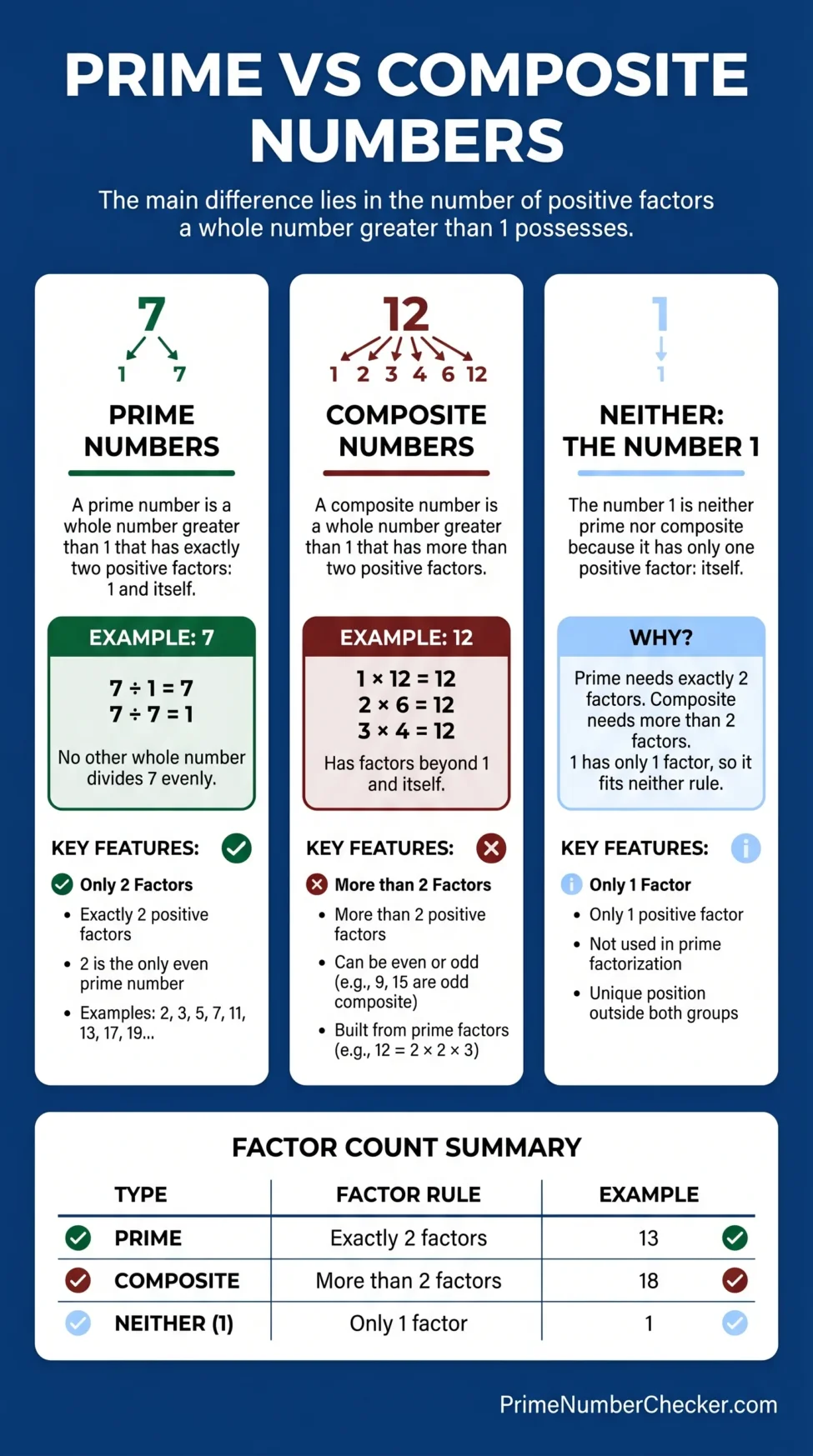
That is the direct difference. Prime means the number cannot be divided evenly by any smaller whole number except 1. Composite means the number can be written as a product of smaller whole numbers.
Quick check: If you want to test a specific number while reading, use the Prime Number Checker. It connects the idea of factors with an instant prime or composite result.
What Is a Prime Number?
A prime number is a positive integer greater than 1 with exactly two positive divisors. Those divisors are always 1 and the number itself.
For example, 7 is prime because the only whole-number divisions that work are:
- 7 ÷ 1 = 7
- 7 ÷ 7 = 1
No other positive whole number divides 7 evenly. There is no hidden factor pair such as 2 × something, 3 × something, or 4 × something. That is why 7 is prime.
Examples of Prime Numbers
The first prime numbers are:
2, 3, 5, 7, 11, 13, 17, 19, 23, 29
Notice that 2 is special. It is the only even prime number. Every other even number is divisible by 2, so every even number greater than 2 is composite.
What Is a Composite Number?
A composite number is a positive integer greater than 1 that has more than two positive factors. In plain terms, it can be divided evenly by at least one whole number other than 1 and itself.
For example, 12 is composite because it has several factors:
- 1 × 12 = 12
- 2 × 6 = 12
- 3 × 4 = 12
Since 12 has factor pairs beyond 1 and 12, 12 is composite.
Examples of Composite Numbers
The first composite numbers are:
4, 6, 8, 9, 10, 12, 14, 15, 16, 18
Some composite numbers are easy to spot because they are even. Others, such as 9, 15, 21, and 25, are odd but still composite. Being odd does not automatically mean prime.
The Main Difference Between Prime and Composite Numbers
The difference comes down to how many positive factors the number has.
| Number Type | Factor Rule | Example | Why It Fits |
|---|---|---|---|
| Prime | Exactly 2 positive factors | 13 | Only 1 and 13 divide it evenly |
| Composite | More than 2 positive factors | 18 | 1, 2, 3, 6, 9, and 18 divide it evenly |
| Neither | Does not fit either rule | 1 | It has only one positive factor |
A number is not prime because it “looks difficult.” A number is prime only when its factor count matches the definition. A number is not composite because it is large. It is composite only when it has extra divisors.
Why 1 Is Neither Prime Nor Composite
1 is neither prime nor composite. This is one of the most common points of confusion.
A prime number needs exactly two positive factors. The number 1 has only one positive factor: itself. So it is not prime.
A composite number needs more than two positive factors. The number 1 does not have that either. So it is not composite.
1 sits outside both groups because it does not meet either factor rule. This keeps prime factorization clean: every whole number greater than 1 can be broken down into prime factors in one clear way.
How to Tell Whether a Number Is Prime or Composite
To decide whether a number is prime or composite, look for factors. A factor is a whole number that divides another number without leaving a remainder.
Start With Small Divisibility Tests
For many numbers, simple divisibility rules are enough.
- If a number greater than 2 is even, it is composite.
- If a number ends in 0 or 5 and is greater than 5, it is composite.
- If the digit sum is divisible by 3, the number is divisible by 3 and may be composite.
For example, 51 is not even and does not end in 0 or 5. But its digits add to 6, and 6 is divisible by 3. So 51 is divisible by 3:
51 = 3 × 17
That makes 51 composite.
Why Checking Up to the Square Root Works
You do not need to test every smaller number. To check whether a number is prime, it is enough to test possible divisors up to its square root.
Here is the reason. If a number has a factor pair, one factor must be less than or equal to the square root, and the other factor must be greater than or equal to the square root.
For example, to test 97, the square root is a little less than 10. So you only need to test prime divisors up to 9: 2, 3, 5, and 7.
- 97 is not divisible by 2.
- 97 is not divisible by 3.
- 97 is not divisible by 5.
- 97 is not divisible by 7.
No factor appears before the square root, so 97 is prime.
Factors, Multiples, and Divisors
Prime and composite numbers are easier to understand when the related terms are clear.
Factor
A factor divides a number evenly. For example, 4 is a factor of 20 because 20 ÷ 4 = 5.
Divisor
A divisor means almost the same thing as a factor in this context. If 5 divides 30 evenly, then 5 is a divisor of 30.
Multiple
A multiple is what you get after multiplying. For example, 28 is a multiple of 7 because 7 × 4 = 28.
Factors go into a number. Multiples come out of multiplication. This small difference helps prevent many mistakes when comparing prime and composite numbers.
Prime Factorization Links Both Ideas
Composite numbers are not random. Every composite number can be split into prime factors.
For example:
- 12 = 2 × 2 × 3
- 30 = 2 × 3 × 5
- 84 = 2 × 2 × 3 × 7
Each result uses only prime numbers. This is why prime numbers matter beyond simple classification. They help explain the structure of composite numbers.
Prime numbers act like the basic parts of multiplication for whole numbers greater than 1. Composite numbers are made by multiplying those prime parts together.
Common Mistakes About Prime and Composite Numbers
Mistake 1: Thinking All Odd Numbers Are Prime
Many prime numbers are odd, but not every odd number is prime. For example, 9, 15, 21, 25, and 27 are all odd composite numbers.
Mistake 2: Calling 1 a Prime Number
1 is not prime. It has only one positive factor, not two.
Mistake 3: Forgetting That 2 Is Prime
2 is prime because its only positive factors are 1 and 2. It is also the only even prime number.
Mistake 4: Treating Large Numbers as Automatically Prime
A large number can still be composite. For example, 121 may look prime at first, but it equals 11 × 11. So 121 is composite.
Prime and Composite Numbers in Modern Use
Prime numbers are not only classroom objects. They appear in computer science, number theory, cryptography, hashing, random number methods, and math contests. Composite numbers also matter because factorization reveals how a number is built through multiplication.
In digital security, large prime numbers help support encryption systems. In education, prime and composite classification helps students learn divisibility, factor pairs, greatest common factor, least common multiple, and prime factorization.
The concept is simple at the start, but it leads into deeper math. That is why a clean definition matters.
Fast Examples
| Number | Type | Reason |
|---|---|---|
| 2 | Prime | Only 1 and 2 divide it evenly |
| 4 | Composite | It has 1, 2, and 4 as factors |
| 9 | Composite | It equals 3 × 3 |
| 17 | Prime | No divisor other than 1 and 17 works |
| 25 | Composite | It equals 5 × 5 |
| 1 | Neither | It has only one positive factor |
A Simple Way to Remember the Difference
Use the factor count.
- Prime: exactly two positive factors.
- Composite: more than two positive factors.
- 1: neither prime nor composite.
If a number greater than 1 has no factor pair other than 1 × itself, it is prime. If it has at least one extra factor pair, it is composite.
FAQ About Prime vs Composite Numbers
What is the difference between prime and composite numbers?
A prime number has exactly two positive factors: 1 and itself. A composite number has more than two positive factors.
Is 1 prime or composite?
1 is neither prime nor composite. It has only one positive factor, so it does not fit the prime rule or the composite rule.
Is 2 prime or composite?
2 is prime. Its only positive factors are 1 and 2. It is also the only even prime number.
Are all odd numbers prime?
No. Some odd numbers are composite. For example, 9, 15, 21, and 25 are odd composite numbers.
How can I check if a number is prime or composite?
Check whether the number has factors other than 1 and itself. For faster testing, try prime divisors up to the square root of the number.
Why do prime numbers matter?
Prime numbers help explain how whole numbers factor into smaller parts. They also appear in number theory, computer science, and encryption methods.