
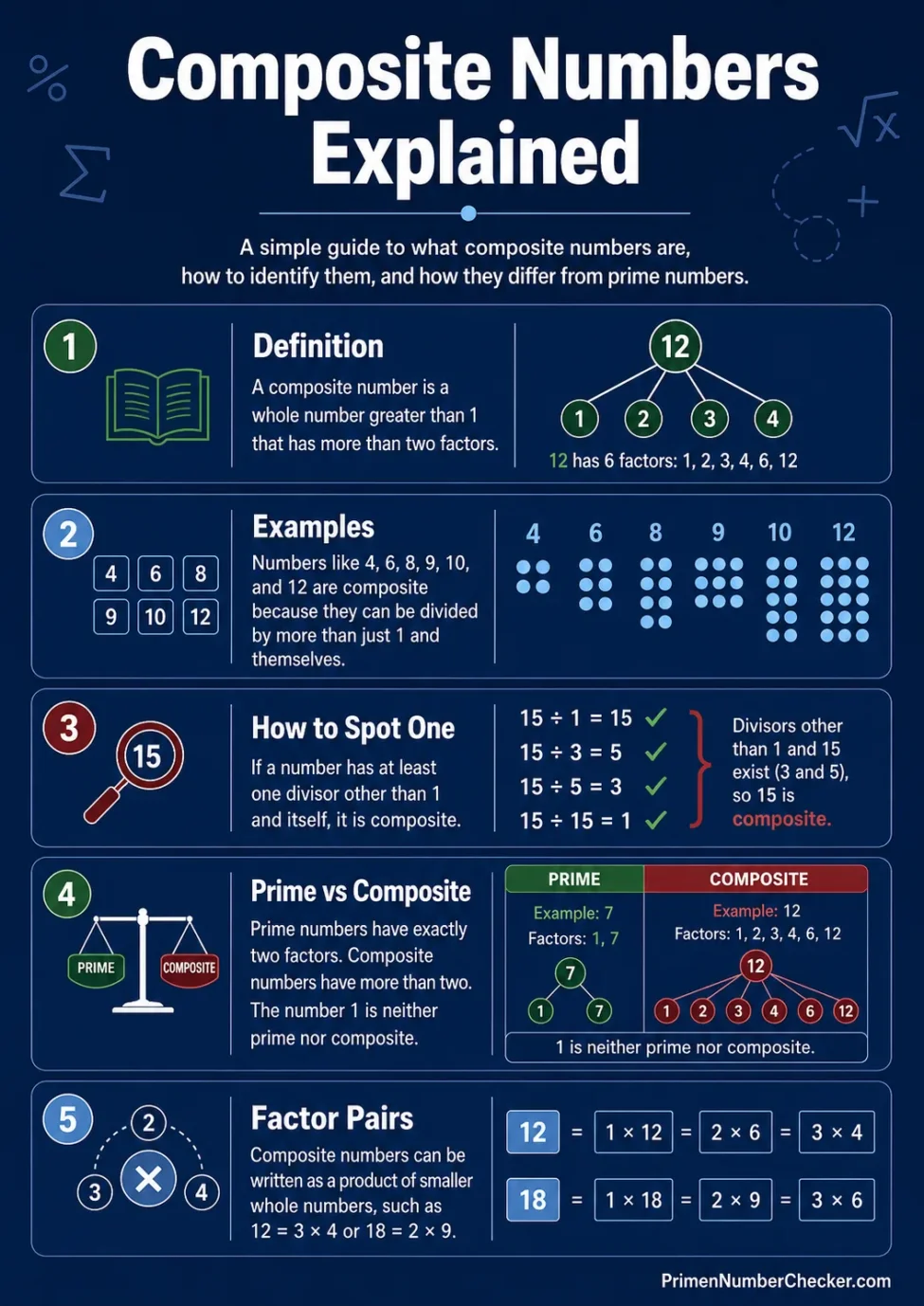
A composite number is a positive whole number greater than 1 that has more than two positive divisors. In simpler words, a composite number can be divided evenly by 1, by itself, and by at least one other number.
What Is a Composite Number?
A composite number is a whole number that can be made by multiplying two smaller positive whole numbers greater than 1. For example, 12 is composite because it can be written as 3 × 4 or 2 × 6.
The idea is closely tied to divisibility. If a number has a divisor other than 1 and itself, it is composite. This is why 4 is the smallest composite number. It has three positive divisors: 1, 2, and 4.
Composite numbers sit beside prime numbers in basic number theory. A prime number has exactly two positive divisors. A composite number has more than two. The number 1 is different: it is neither prime nor composite.
Composite Number Definition
In standard mathematics, a composite number is defined as:
A positive integer n is composite if n > 1 and there are positive integers a and b, both greater than 1, such that n = a × b.
This definition tells us two important things. First, composite numbers are only discussed among positive whole numbers in the usual school and number theory setting. Second, a composite number must be factorable into smaller whole numbers.
Examples of Composite Numbers
Some early composite numbers are:
4, 6, 8, 9, 10, 12, 14, 15, 16, 18, 20, 21, 22, 24, 25
Each of these numbers has at least one divisor between 1 and itself. For instance, 15 is composite because it is divisible by 3 and 5. The number 25 is composite because it equals 5 × 5.
| Number Type | Divisor Pattern | Examples |
|---|---|---|
| Prime number | Exactly two positive divisors | 2, 3, 5, 7, 11 |
| Composite number | More than two positive divisors | 4, 6, 8, 9, 10 |
| Neither | Does not fit the prime or composite rule | 1 |
Why Composite Numbers Are Not Prime
A prime number cannot be split into smaller whole-number factors other than 1 and itself. A composite number can. That is the main difference.
Take 13. Its only positive divisors are 1 and 13, so 13 is prime. Now take 14. Its positive divisors are 1, 2, 7, and 14, so 14 is composite.
This matters because composite numbers are built from smaller factors. Prime numbers act as the indivisible pieces of multiplication, while composite numbers show how those pieces combine.
How to Know If a Number Is Composite
A number is composite if you can find a divisor other than 1 and the number itself. For small numbers, this is often easy. For larger numbers, it helps to test divisibility in a more focused way.
1. Check if the Number Is Greater Than 1
Only positive whole numbers greater than 1 can be prime or composite. The number 1 is not composite because it has only one positive divisor.
2. Look for a Factor Other Than 1 and Itself
If a number divides evenly by another whole number, it may be composite. For example, 27 is divisible by 3, so 27 is composite.
3. You Only Need to Test Up to the Square Root
You do not need to test every possible divisor. If a number has a factor larger than its square root, it must also have a matching factor smaller than its square root.
For example, to test 49, you only need to check divisors up to 7 because √49 = 7. Since 49 is divisible by 7, it is composite.
If you want to test a number quickly, use the Prime Number Checker. It helps confirm whether a number is prime or composite and supports the same divisor logic explained here.
Common Patterns in Composite Numbers
Composite numbers are not random. Many of them follow easy patterns that help you recognize them faster.
Every Even Number Greater Than 2 Is Composite
The number 2 is prime because its only positive divisors are 1 and 2. But every even number greater than 2 is divisible by 2, which means it has at least three positive divisors.
Examples include 4, 6, 8, 10, 12, 14, 16, and so on.
Squares of Numbers Greater Than 1 Are Composite
A square such as 9, 16, or 25 is composite because it can be written as a number multiplied by itself.
For example, 25 = 5 × 5. Even though 25 has a repeated factor, it still has more than two positive divisors: 1, 5, and 25.
Products of Two Numbers Greater Than 1 Are Composite
If a number is made by multiplying two whole numbers greater than 1, it is composite. For example, 21 is composite because 21 = 3 × 7.
Why 1 Is Not a Composite Number
The number 1 often causes confusion. It is not prime, but it is not composite either.
A composite number must have more than two positive divisors. The number 1 has only one positive divisor: itself. So it does not meet the composite number rule.
This separation keeps prime factorization clean. If 1 were treated as prime or composite, the same number could have endless factor forms such as 6 = 1 × 2 × 3 or 6 = 1 × 1 × 2 × 3. Mathematics avoids that by keeping 1 outside both groups.
Composite Numbers and Prime Factorization
Every composite number can be broken into prime factors. This is one of the most useful ideas connected to composite numbers.
For example:
36 = 2 × 2 × 3 × 3
This shows that 36 is composite, but it also reveals its inner structure. The number is not just “not prime.” It is a product of primes.
Prime factorization is used in divisibility, greatest common factor, least common multiple, fractions, modular arithmetic, and many higher-level number topics. Composite numbers are the place where those ideas become visible.
Is 0 a Composite Number?
No. In the standard definition used for prime and composite numbers, 0 is not composite. Composite numbers must be positive integers greater than 1.
Zero behaves differently from ordinary positive whole numbers. Many nonzero integers divide 0 evenly, so it does not fit the same divisor pattern used for prime and composite classification.
Are Negative Numbers Composite?
In standard school mathematics and elementary number theory, negative numbers are not usually called prime or composite. The classification is normally limited to positive integers greater than 1.
So -6 may have factor pairs, but it is not normally listed as a composite number in basic prime number study.
Composite Numbers in Modern Math Use
Composite numbers appear anywhere factor structure matters. They show up in arithmetic, algebra, divisibility tests, fraction simplification, and computational number checking.
In computer-based prime testing, the question is not only “Is this number prime?” A good test also helps explain why a number fails the prime test. If a divisor is found, the number is composite.
This is why composite numbers are not just the opposite of primes. They are a way to understand how multiplication builds larger numbers from smaller parts.
Composite Number FAQ
What is the simplest definition of a composite number?
A composite number is a positive whole number greater than 1 that has more than two positive divisors.
What is the smallest composite number?
The smallest composite number is 4. Its positive divisors are 1, 2, and 4.
Is 2 a composite number?
No. The number 2 is prime because it has exactly two positive divisors: 1 and 2.
Is every odd number composite?
No. Some odd numbers are prime, such as 3, 5, 7, 11, and 13. Odd numbers such as 9, 15, 21, and 25 are composite.
Is every even number composite?
Every even number greater than 2 is composite. The number 2 is the only even prime number.
How do you prove that a number is composite?
You prove that a number is composite by finding a divisor other than 1 and the number itself. For example, 91 is composite because it is divisible by 7 and 13.
Can a composite number have only one prime factor?
It can have one repeated prime factor. For example, 49 is composite because 49 = 7 × 7. The prime factor is repeated.
Final Note on Composite Numbers
A composite number is not simply a number that is “not prime.” It has its own clear rule: it must be a positive whole number greater than 1 with more than two positive divisors.
Once you understand that rule, composite numbers become easier to recognize. They are the numbers that can be split into smaller whole-number factors, and that makes them central to factorization, divisibility, and prime number study.