
The prime numbers between 100 and 200 are 101, 103, 107, 109, 113, 127, 131, 137, 139, 149, 151, 157, 163, 167, 173, 179, 181, 191, 193, 197, and 199.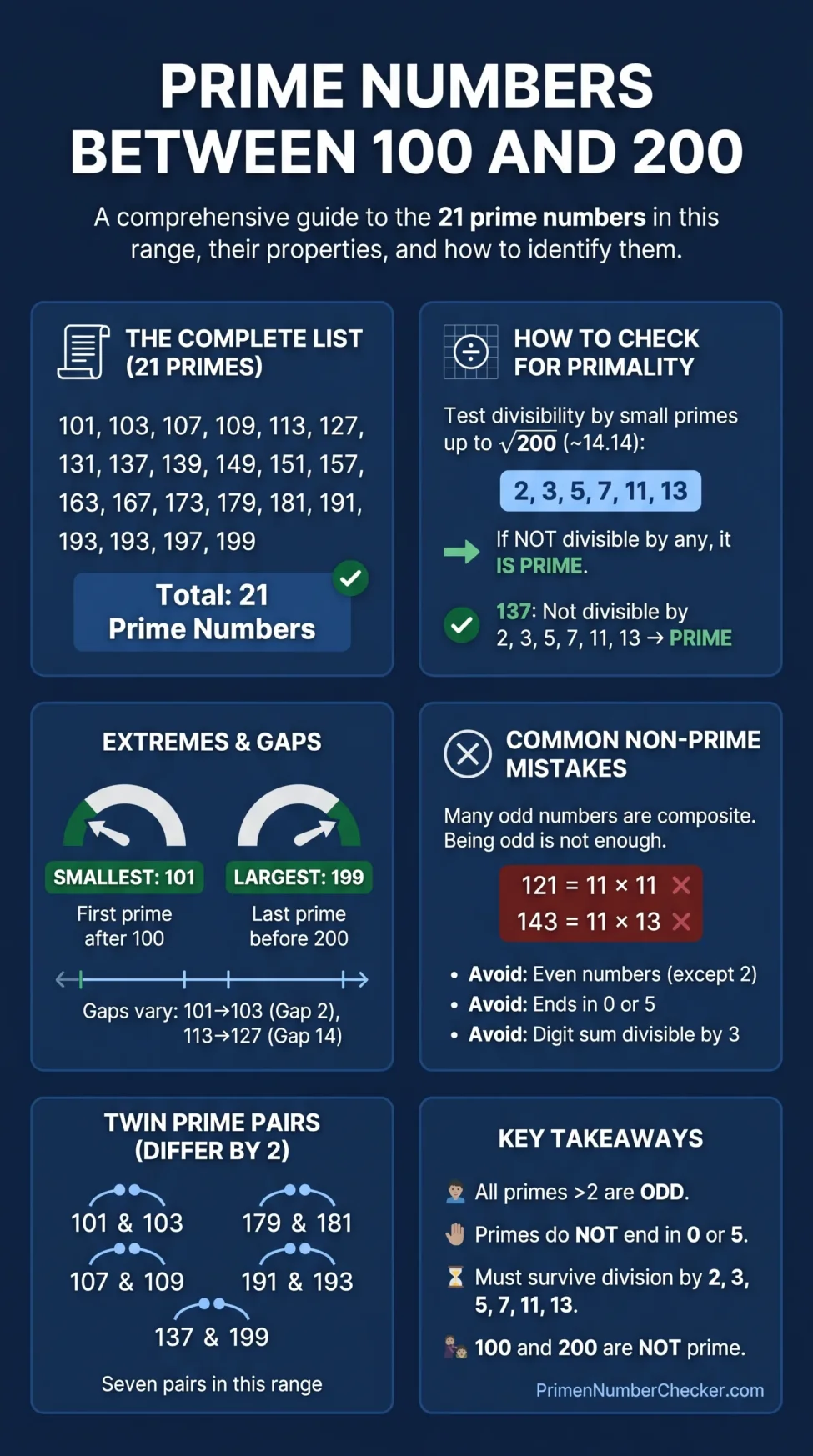
There are 21 prime numbers in this range. Each one is greater than 1 and has exactly two positive divisors: 1 and itself.
If you want to test any number from this range directly, you can use the Prime Number Checker to confirm whether it is prime and see the result faster.
Complete List of Prime Numbers from 100 to 200
| Range | Prime Numbers | Count |
|---|---|---|
| 100–109 | 101, 103, 107, 109 | 4 |
| 110–119 | 113 | 1 |
| 120–129 | 127 | 1 |
| 130–139 | 131, 137, 139 | 3 |
| 140–149 | 149 | 1 |
| 150–159 | 151, 157 | 2 |
| 160–169 | 163, 167 | 2 |
| 170–179 | 173, 179 | 2 |
| 180–189 | 181 | 1 |
| 190–199 | 191, 193, 197, 199 | 4 |
Why These Numbers Are Prime
A number is prime when it cannot be divided evenly by any whole number other than 1 and itself. For numbers between 100 and 200, this test is smaller than it may seem.
To check whether a number below 200 is prime, you only need to test divisibility by prime numbers up to its square root. Since the square root of 200 is a little over 14, the only prime divisors that matter are:
- 2
- 3
- 5
- 7
- 11
- 13
If a number between 100 and 200 is not divisible by any of these, it is prime. This is why 101 is prime: it is not even, its digits do not add to a multiple of 3, it does not end in 0 or 5, and division by 7, 11, and 13 does not produce a whole number.
Why Many Numbers Between 100 and 200 Are Not Prime
Most numbers in this range are composite. A composite number has more than two positive divisors. For example, 121 is not prime because it equals 11 × 11.
Several numbers are removed quickly by simple rules:
- Even numbers are divisible by 2, so 102, 104, 106, and similar numbers are not prime.
- Numbers ending in 0 or 5 are divisible by 5, so 105, 125, 145, and 195 are not prime.
- Numbers whose digit sum is divisible by 3 are divisible by 3. For example, 123 is not prime because 1 + 2 + 3 = 6.
After these easy filters, only a smaller set of candidates remains. That is where divisibility by 7, 11, and 13 becomes useful.
Prime Numbers Between 100 and 200 by Pattern
They Are All Odd
Every prime number greater than 2 is odd. Since this range starts at 100, none of the even numbers can be prime. This cuts the list in half before deeper testing begins.
They Do Not End in 0 or 5
A number ending in 0 or 5 is divisible by 5. That removes numbers such as 105, 115, 135, 155, 175, and 195. The prime numbers in this range end only in 1, 3, 7, or 9.
They Survive Small Prime Division
The real test is not whether a number “looks prime.” A number must survive division by smaller prime numbers. For this range, that means checking against 2, 3, 5, 7, 11, and 13.
Examples: How to Check a Number in This Range
Is 137 Prime?
Yes. 137 is prime. It is not divisible by 2, 3, 5, 7, 11, or 13. Since there is no smaller prime divisor up to its square root, it has no factor pair other than 1 × 137.
Is 143 Prime?
No. 143 is not prime. It equals 11 × 13. This is a useful example because 143 is odd and does not end in 5, but it still fails the prime test.
Is 199 Prime?
Yes. 199 is prime. It is not divisible by any prime number up to 13. That makes 199 the largest prime number below 200.
How Many Prime Numbers Are Between 100 and 200?
There are 21 prime numbers between 100 and 200.
This includes numbers greater than 100 and less than 200. If someone says “from 100 to 200,” the result is the same here because neither 100 nor 200 is prime.
Smallest and Largest Prime in This Range
The smallest prime number greater than 100 is 101.
The largest prime number less than 200 is 199.
Both are useful boundary examples. 101 starts the prime list after 100, while 199 is the last prime before the next hundred.
Prime Gaps Between 100 and 200
A prime gap is the distance between one prime number and the next. In this range, the gap is sometimes small and sometimes wider.
For example:
- 101 and 103 have a gap of 2.
- 113 and 127 have a gap of 14.
- 181 and 191 have a gap of 10.
These gaps show why prime numbers do not appear in a simple repeating pattern. There are rules for removing composite numbers, but there is no basic shortcut that lists every prime by position without testing.
Twin Primes Between 100 and 200
Twin primes are prime numbers that differ by 2. Between 100 and 200, the twin prime pairs are:
- 101 and 103
- 107 and 109
- 137 and 139
- 149 and 151
- 179 and 181
- 191 and 193
- 197 and 199
This range has several twin prime pairs, which makes it useful for learning how close prime numbers can appear even after 100.
Why This Range Is Useful for Learning Prime Numbers
The numbers between 100 and 200 are large enough to require real checking, but still small enough to understand by hand. That makes this range a good practice zone for learning prime testing, factor pairs, divisibility rules, and composite numbers.
It also shows an important point: being odd is not enough. Numbers like 117, 121, 143, 169, and 187 are all odd, but none of them are prime.
A cleaner way to think about this range is simple: first remove the obvious composites, then test the remaining candidates with smaller prime divisors.
FAQ
What are all the prime numbers between 100 and 200?
The prime numbers between 100 and 200 are 101, 103, 107, 109, 113, 127, 131, 137, 139, 149, 151, 157, 163, 167, 173, 179, 181, 191, 193, 197, and 199.
How many prime numbers are there between 100 and 200?
There are 21 prime numbers between 100 and 200.
What is the smallest prime number after 100?
The smallest prime number after 100 is 101.
What is the largest prime number below 200?
The largest prime number below 200 is 199.
Are 100 and 200 prime numbers?
No. 100 and 200 are not prime because both are even and have more than two positive divisors.
Why is 121 not in the prime list?
121 is not prime because it equals 11 × 11. It has divisors other than 1 and itself.