
Prime number tool
To test a number outside the 1 to 50 range, use the Prime Number Checker. It determines whether a selected integer is prime or composite.
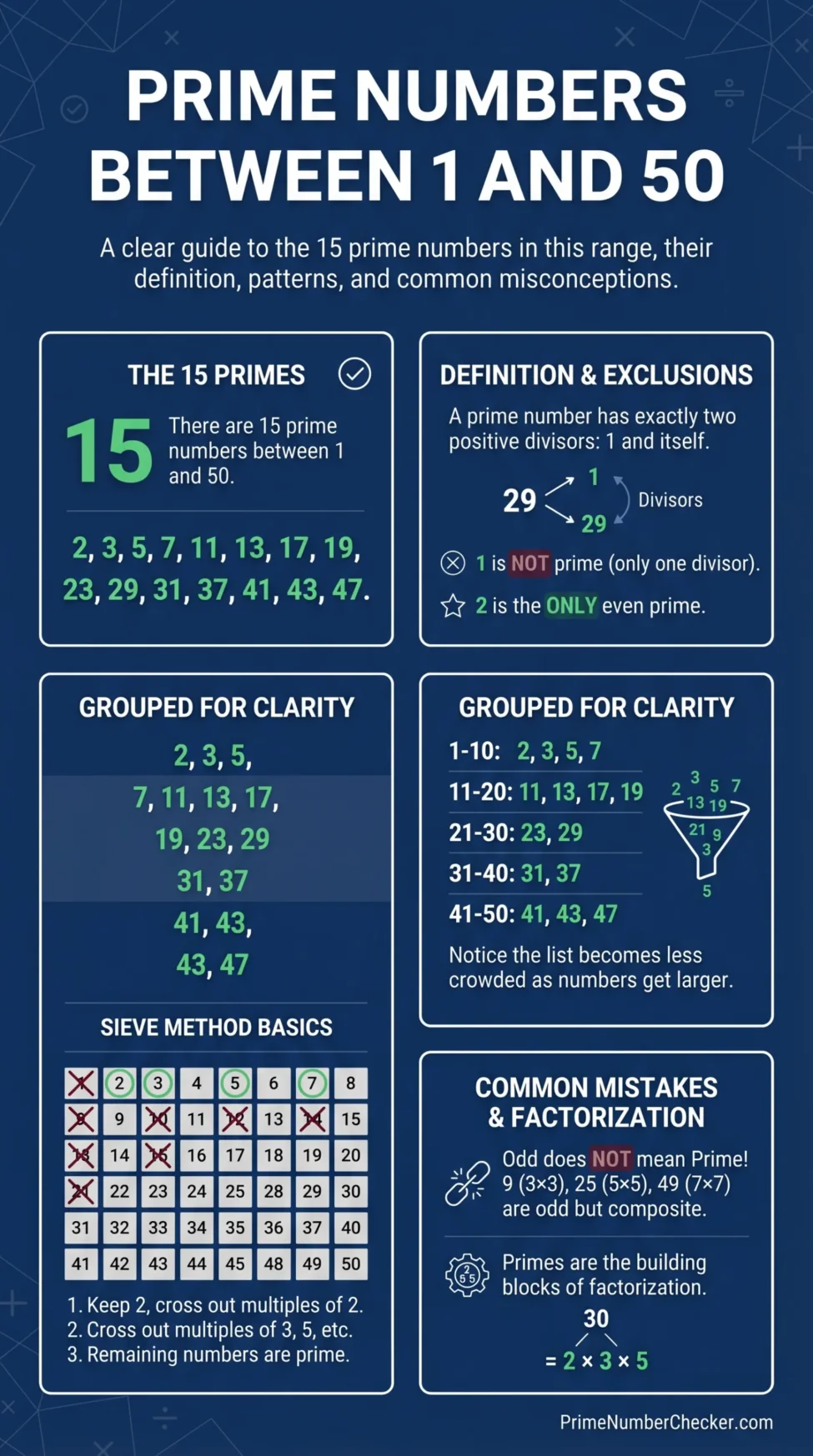
There are 15 prime numbers between 1 and 50. In the inclusive range from 1 to 50, the primes are 2, 3, 5, 7, 11, 13, 17, 19, 23, 29, 31, 37, 41, 43, and 47.
Each number on the list has exactly two positive divisors: 1 and itself. Numbers such as 9, 21, 25, 35, and 49 are excluded because they have additional divisors, while 1 is excluded because it has only one positive divisor.
| Count | 15 |
|---|---|
| First prime in the range | 2 |
| Last prime in the range | 47 |
| Only even prime | 2 |
| Numbers excluded at the ends | 1 is not prime, and 50 is composite |
Why these numbers are prime
A prime number has exactly two positive divisors: 1 and itself. An integer greater than 1 with additional positive divisors is composite.
2 is prime because its only positive divisors are 1 and 2. 3 has only 1 and 3. 5 has only 1 and 5. The same definition applies to every other prime in the range.
1 is not a prime number because it has only one positive divisor: 1. It is neither prime nor composite.
50 is not a prime number because it has several positive divisors, including 1, 2, 5, 10, 25, and 50. It is therefore composite.
Examples from the range
29 is prime. Its square root is slightly above 5, so the relevant prime divisors to test are 2, 3, and 5. None divides 29 evenly.
35 is composite because 35 = 5 × 7. It therefore has positive divisors other than 1 and 35.
49 is composite because 49 = 7 × 7. This also shows why an odd number is not automatically prime.
Prime numbers grouped by tens
- 1 to 10: 2, 3, 5, 7
- 11 to 20: 11, 13, 17, 19
- 21 to 30: 23, 29
- 31 to 40: 31, 37
- 41 to 50: 41, 43, 47
The number of primes is not the same in every ten-number block. There are four primes from 1 to 10, four from 11 to 20, two from 21 to 30, two from 31 to 40, and three from 41 to 50.
Prime numbers continue beyond 50 without ending. Their spacing varies because consecutive primes do not occur at a fixed interval.
How to identify the primes from 1 to 50
The primes in this range can be found by eliminating numbers divisible by smaller primes.
- Keep 2, because it is prime.
- Remove every other even number because it is divisible by 2.
- Keep 3 and remove larger multiples of 3, such as 6, 9, 12, 15, and 21.
- Keep 5 and remove larger multiples of 5, such as 10, 15, 20, 25, and 35.
- Keep 7 and remove its composite multiples in the range, such as 14, 21, 28, 35, 42, and 49.
This elimination method follows the idea used by the Sieve of Eratosthenes. Multiples of known primes are removed, leaving the prime numbers.
Why only small divisors are needed
If an integer is composite, it has a factor less than or equal to its square root. If both factors were greater than the square root, their product would be greater than the original number.
Since √50 is a little more than 7, checking divisibility by the primes 2, 3, 5, and 7 is enough to classify every integer from 2 through 50 as prime or composite.
For example, 49 is caught by the divisor 7. The number 47 is not divisible by 2, 3, 5, or 7, and because √47 is below 7, no further divisor test is needed.
Properties visible in the 1 to 50 range
The number 2 is the only even prime
2 is the only even prime number. Every even integer greater than 2 is divisible by 2 and therefore has more than two positive divisors.
Not every odd number is prime
The odd composite numbers from 1 to 50 include 9, 15, 21, 25, 27, 33, 35, 39, 45, and 49. Each has at least one divisor other than 1 and itself.
Examples include 9 = 3 × 3, 21 = 3 × 7, 25 = 5 × 5, 33 = 3 × 11, and 49 = 7 × 7.
Composite numbers have prime factorizations
Every composite integer greater than 1 can be written as a product of prime numbers. Examples from this range include:
- 18 = 2 × 3 × 3
- 30 = 2 × 3 × 5
- 42 = 2 × 3 × 7
- 45 = 3 × 3 × 5
- 50 = 2 × 5 × 5
This property connects prime numbers with factorization, greatest common divisors, least common multiples, and divisibility.
Prime and non-prime numbers from 1 to 50
- Prime numbers: 2, 3, 5, 7, 11, 13, 17, 19, 23, 29, 31, 37, 41, 43, 47
- Composite numbers: 4, 6, 8, 9, 10, 12, 14, 15, 16, 18, 20, 21, 22, 24, 25, 26, 27, 28, 30, 32, 33, 34, 35, 36, 38, 39, 40, 42, 44, 45, 46, 48, 49, 50
- Neither prime nor composite: 1
The distinction for 1 follows directly from the divisor definition. It has one positive divisor, while primes have exactly two and composite numbers have more than two.
Prime gaps between 1 and 50
A prime gap is the difference between two consecutive prime numbers. The gaps in this range are not constant.
| Consecutive primes | Gap |
|---|---|
| 2 and 3 | 1 |
| 3 and 5 | 2 |
| 7 and 11 | 4 |
| 23 and 29 | 6 |
| 31 and 37 | 6 |
| 43 and 47 | 4 |
The gaps show that primes are not evenly spaced. Some consecutive primes differ by 2, while other neighboring primes in this range are separated by 4 or 6.
Twin primes between 1 and 50
Twin primes are pairs of primes that differ by 2. Several such pairs occur below 50:
- 3 and 5
- 5 and 7
- 11 and 13
- 17 and 19
- 29 and 31
- 41 and 43
Both numbers in each pair must be prime. A difference of 2 alone does not make a pair twin primes if either number is composite.
Prime numbers from 1 to 50 in factorization
The 15 primes in this range also appear as factors of composite integers. For example, 2 divides every even number, 3 divides 6, 9, 12, 15, and many other composites, while 5 divides numbers ending in 0 or 5.
Larger primes below 50 can also appear as factors when the other factor keeps the product within the range. For example, 11 divides 22, 33, and 44, while 13 divides 26 and 39.
Primes greater than 25 have no multiple other than themselves within the 1 to 50 interval. This is why numbers such as 29, 31, 37, 41, 43, and 47 remain after smaller-prime multiples have been removed.
Checking numbers beyond 50
The same divisibility definition applies to integers larger than 50. For a manual trial-division test, possible prime divisors only need to be checked through the square root of the number.
For example, checking 97 requires testing 2, 3, 5, and 7 because √97 is less than 10. None divides 97 evenly, so 97 is prime.
The Prime Number Checker can perform the primality test for a selected integer.