Skip to content

First 100 Prime Numbers

    .prime-article{font-family:Arial,Helvetica,sans-serif;line-height:1.7;color:#1F2937;max-width:900px}
    .prime-article h2,.prime-article h3,.prime-article h4{color:#1F2937;margin:28px 0 12px}
    .prime-article p{margin:0 0 16px}
    .prime-article .intro-box,.prime-article .tool-box,.prime-article .note-box,.prime-article .pattern-box{border:1px solid #e5e7eb;border-radius:12px;padding:18px 20px;margin:18px 0;background:#f9fafb}
    .prime-article .tool-box{background:#eef5ff;border-color:#cfe0ff}
    .prime-article .note-box{background:#f5fbf7;border-color:#cfe9d6}
    .prime-article .pattern-box{background:#fff8f8;border-color:#edd4d4}
    .prime-article .prime-list{columns:4;column-gap:28px;margin:18px 0 22px;padding-left:22px}
    .prime-article .prime-list li{margin:0 0 8px;break-inside:avoid}
    .prime-article .prime-info{width:100%;border-collapse:collapse;margin:18px 0 24px}
    .prime-article .prime-info caption{caption-side:top;text-align:left;font-weight:700;margin-bottom:10px;color:#1F2937}
    .prime-article .prime-info th,.prime-article .prime-info td{border:1px solid #d1d5db;padding:10px 12px;text-align:left;vertical-align:top}
    .prime-article .prime-info th{background:#f3f4f6}
    .prime-article details{border:1px solid #e5e7eb;border-radius:10px;padding:14px 16px;margin:10px 0;background:#fff}
    .prime-article summary{cursor:pointer;font-weight:700}
    .prime-article .small{font-size:0.95em}
    @media (max-width: 782px){
    .prime-article .prime-list{columns:2}
    }

    The first 100 prime numbers start at 2 and end at 541. That single fact clears up a common point of confusion: the first 100 primes are not the same thing as the prime numbers from 1 to 100. There are only 25 prime numbers up to 100, but the first 100 primes continue far beyond 100.
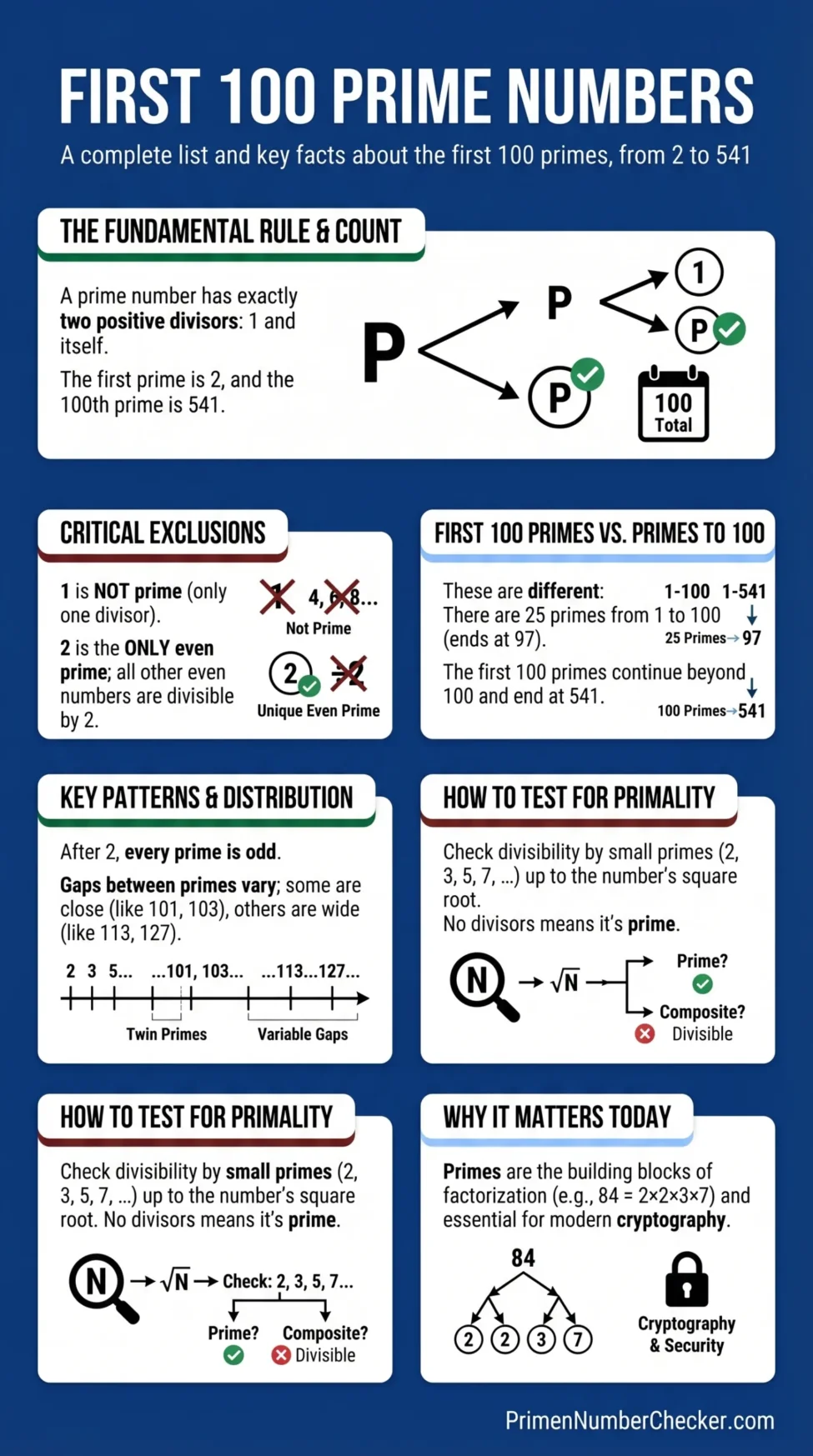
    Prime numbers matter because each prime has exactly two positive divisors: 1 and itself. That simple rule shapes factorization, divisibility, and many familiar number patterns.

    Want to test a larger number? The list below is useful for learning, checking factors, and spotting patterns. For any number outside this list, use the Prime Number Checker to verify whether it is prime or composite.

    First 100 prime numbers

    Here is the full list in order from smallest to largest:

    1. 2
    2. 3
    3. 5
    4. 7
    5. 11
    6. 13
    7. 17
    8. 19
    9. 23
    10. 29
    11. 31
    12. 37
    13. 41
    14. 43
    15. 47
    16. 53
    17. 59
    18. 61
    19. 67
    20. 71
    21. 73
    22. 79
    23. 83
    24. 89
    25. 97
    26. 101
    27. 103
    28. 107
    29. 109
    30. 113
    31. 127
    32. 131
    33. 137
    34. 139
    35. 149
    36. 151
    37. 157
    38. 163
    39. 167
    40. 173
    41. 179
    42. 181
    43. 191
    44. 193
    45. 197
    46. 199
    47. 211
    48. 223
    49. 227
    50. 229
    51. 233
    52. 239
    53. 241
    54. 251
    55. 257
    56. 263
    57. 269
    58. 271
    59. 277
    60. 281
    61. 283
    62. 293
    63. 307
    64. 311
    65. 313
    66. 317
    67. 331
    68. 337
    69. 347
    70. 349
    71. 353
    72. 359
    73. 367
    74. 373
    75. 379
    76. 383
    77. 389
    78. 397
    79. 401
    80. 409
    81. 419
    82. 421
    83. 431
    84. 433
    85. 439
    86. 443
    87. 449
    88. 457
    89. 461
    90. 463
    91. 467
    92. 479
    93. 487
    94. 491
    95. 499
    96. 503
    97. 509
    98. 521
    99. 523
    100. 541
    Fast facts about the first 100 prime numbers
    FactValueWhy it matters
    1st prime22 is the only even prime, because every other even number is divisible by 2.
    25th prime97This shows that there are 25 primes from 1 to 100.
    50th prime229The list moves past 200 well before the halfway point.
    75th prime379Prime gaps grow, but they do not grow in a smooth pattern.
    100th prime541This is the endpoint of the first 100-prime list.

    Why these numbers are prime

    A prime number has exactly two positive divisors: 1 and the number itself. That is why 2, 3, 5, and 7 are prime, while 4, 6, 8, and 9 are not.

    Take 29. It is prime because no whole number other than 1 and 29 divides it evenly. Take 21. It is not prime because 21 = 3 × 7. Once a number has more than two positive divisors, it becomes composite.

    One detail matters a lot: 1 is not a prime number. It has only one positive divisor, not two. That rule keeps prime factorization clean and unique, which is one reason mathematics treats 1 separately from both primes and composite numbers.

    Why 2 is special

    2 is the only even prime number. Every even number greater than 2 can be divided by 2, so it has at least three positive divisors: 1, 2, and itself. That breaks the prime rule right away.

    As a result, every prime after 2 is odd. This is one of the first useful patterns people notice when they start studying prime numbers.

    Why the first 100 primes end at 541

    This question comes up often because many people expect the first 100 prime numbers to stay close to 100. They do not. Prime numbers become less frequent as numbers get larger, so it takes more space on the number line to collect the next prime.

    That is why the 100th prime is 541. The list does not stop at 100, or 200, or even 500. It stops at the point where the count of primes reaches 100.

    First 100 primes vs. primes up to 100

    These are two different ideas.

    • Prime numbers up to 100 means every prime from 2 through 97. There are 25 of them.
    • First 100 prime numbers means the first 100 entries in the prime sequence, and that list ends at 541.

    This distinction helps people avoid one of the most common errors in prime number searches.

    Patterns inside the first 100 primes

    The list may look random at first, but it has real structure. Primes are irregular, yet not chaotic. Once you know what to watch, the sequence becomes easier to read.

    Pattern 1: After 2, every prime is odd.

    Pattern 2: Many primes greater than 3 fall into the form 6k ± 1. That does not mean every number of that form is prime, but every prime above 3 must fit one of those two shapes.

    Pattern 3: The gaps between primes change. Sometimes primes sit close together, like 101 and 103. Sometimes the gap is wider, like 113 and 127.

    The idea behind the sieve

    A classic way to explain lists like this is the Sieve of Eratosthenes. It works by removing multiples of 2, then multiples of 3, then multiples of 5, and so on. The numbers left behind are prime.

    This matters because it shows why prime lists are found by filtering, not by guesswork. It also helps explain why prime-checking tools can test a number much faster than scanning every smaller integer one by one.

    How this list connects to factorization and divisibility

    Prime numbers are the basic pieces of factorization. Every whole number greater than 1 can be written as a product of primes in one unique way, apart from order. That is why lists of primes are useful far beyond memorization.

    If a number is not prime, it can be broken into smaller prime parts. For example, 84 can be written as 2 × 2 × 3 × 7. Those smaller prime pieces explain the full number.

    That is also why a prime list pairs so naturally with a checker tool. The list helps with small-number intuition, while a checker helps when the number is too large to inspect mentally.

    Small examples that make the logic clear

    • 37 is prime because it has no positive divisors other than 1 and 37.
    • 39 is composite because 39 = 3 × 13.
    • 49 is composite because 49 = 7 × 7.
    • 53 is prime because no smaller prime divides it evenly.

    Where the first 100 primes still matter today

    For students, this list supports divisibility, factor trees, and number sense. For teachers and parents, it gives a clean reference set. For puzzle lovers, it shows how order and surprise can sit side by side inside arithmetic.

    Modern computing also uses prime numbers in areas such as cryptography and algorithm design. The first 100 primes are far too small for real security, but they teach the same divisibility logic used by larger prime tests.

    The list is short enough to scan, but long enough to reveal real behavior. That is why the first 100 primes work so well for both learning and checking.

    Historical note

    Prime numbers have been studied for more than two thousand years. Euclid showed that there is no largest prime number, which means the sequence never ends. Eratosthenes later gave mathematics a clear sieve method for finding them.

    That history still matters today. Modern methods are faster, but the basic questions stay the same: which numbers are prime, why are they prime, and how are primes spread across the number line?

    FAQ

    What are the first 100 prime numbers?

    The first 100 prime numbers begin with 2, 3, 5, 7, 11 and end with 541. They are the first 100 positive integers greater than 1 that have exactly two positive divisors.

    Is 1 a prime number?

    No. 1 is not prime because it has only one positive divisor. A prime number must have exactly two positive divisors.

    What is the 100th prime number?

    The 100th prime number is 541.

    How many prime numbers are there from 1 to 100?

    There are 25 prime numbers from 1 to 100. The largest one in that range is 97.

    Why is 2 the only even prime?

    Any even number greater than 2 is divisible by 2, so it cannot have exactly two positive divisors. That leaves 2 as the only even prime.

    {
    “@context”: “https://schema.org”,
    “@type”: “FAQPage”,
    “mainEntity”: [
    {
    “@type”: “Question”,
    “name”: “What are the first 100 prime numbers?”,
    “acceptedAnswer”: {
    “@type”: “Answer”,
    “text”: “The first 100 prime numbers begin with 2, 3, 5, 7, 11 and end with 541. They are the first 100 positive integers greater than 1 that have exactly two positive divisors.”
    }
    },
    {
    “@type”: “Question”,
    “name”: “Is 1 a prime number?”,
    “acceptedAnswer”: {
    “@type”: “Answer”,
    “text”: “No. 1 is not prime because it has only one positive divisor. A prime number must have exactly two positive divisors.”
    }
    },
    {
    “@type”: “Question”,
    “name”: “What is the 100th prime number?”,
    “acceptedAnswer”: {
    “@type”: “Answer”,
    “text”: “The 100th prime number is 541.”
    }
    },
    {
    “@type”: “Question”,
    “name”: “How many prime numbers are there from 1 to 100?”,
    “acceptedAnswer”: {
    “@type”: “Answer”,
    “text”: “There are 25 prime numbers from 1 to 100. The largest one in that range is 97.”
    }
    },
    {
    “@type”: “Question”,
    “name”: “Why is 2 the only even prime?”,
    “acceptedAnswer”: {
    “@type”: “Answer”,
    “text”: “Any even number greater than 2 is divisible by 2, so it cannot have exactly two positive divisors. That leaves 2 as the only even prime.”
    }
    }
    ]
    }