
Odd Prime Numbers List
Odd prime numbers are prime numbers that are not divisible by 2. In plain terms, every odd prime has exactly two positive divisors: 1 and itself.
The smallest odd prime number is 3. After that come 5, 7, 11, 13, 17, 19, and so on. The only prime number that is not odd is 2, because 2 is the only even prime.
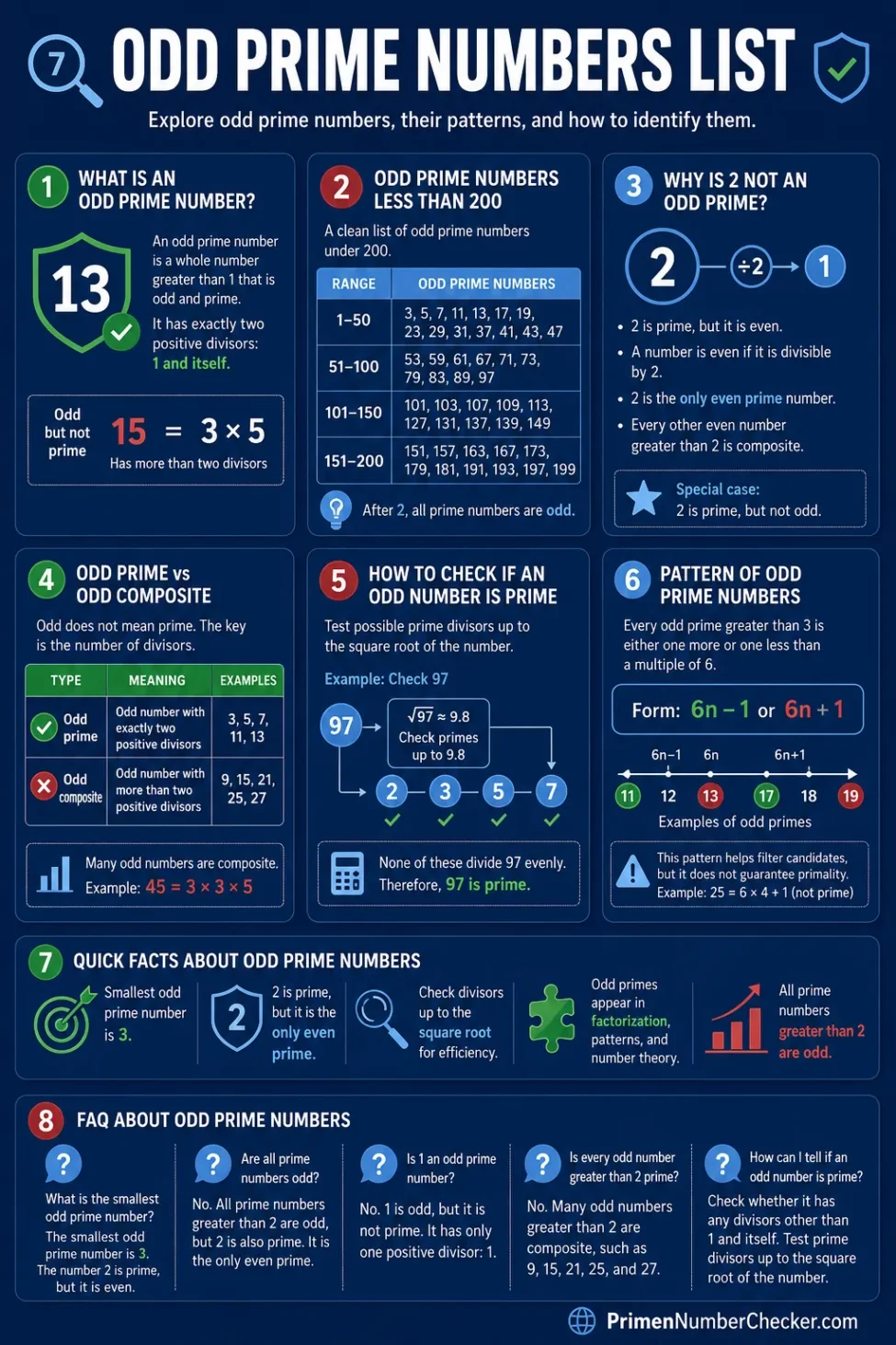
What Is an Odd Prime Number?
An odd prime number is a whole number greater than 1 that is both odd and prime. That means it cannot be divided evenly by 2, and it has no positive divisors other than 1 and itself.
For example, 13 is an odd prime. It is odd, and its only positive divisors are 1 and 13. By contrast, 15 is odd but not prime, because 15 can be divided by 3 and 5.
List of Odd Prime Numbers
Here is a clean list of odd prime numbers under 200. This range is useful because it shows the pattern clearly without turning the page into a long raw number dump.
| Range | Odd Prime Numbers |
|---|---|
| 1–50 | 3, 5, 7, 11, 13, 17, 19, 23, 29, 31, 37, 41, 43, 47 |
| 51–100 | 53, 59, 61, 67, 71, 73, 79, 83, 89, 97 |
| 101–150 | 101, 103, 107, 109, 113, 127, 131, 137, 139, 149 |
| 151–200 | 151, 157, 163, 167, 173, 179, 181, 191, 193, 197, 199 |
Why Is 2 Not an Odd Prime?
2 is prime, but it is not odd. A number is even when it is divisible by 2. Since 2 divided by 2 equals 1, it is even.
This makes 2 a special case. It is the only even prime number. Every other even number greater than 2 is divisible by 2 and by itself, so it has more than two divisors. That means it cannot be prime.
Why Are All Odd Primes Greater Than 2?
Every prime number must be greater than 1 and have exactly two positive divisors. Since every even number greater than 2 can be divided evenly by 2, none of those even numbers can be prime.
So once 2 is removed, all remaining prime numbers must be odd. This is why prime number lists often start with 2 and then continue with only odd numbers.
Simple Rule
If a number is prime and greater than 2, it must be odd. But being odd alone is not enough. 9, 15, 21, 25, and 27 are odd, but they are not prime.
Odd Prime Numbers vs Odd Composite Numbers
This is where many learners get mixed up. Odd does not mean prime. An odd number only tells us the number is not divisible by 2. It does not tell us whether the number has other divisors.
For example, 45 is odd but composite. It can be divided by 3, 5, 9, and 15. So 45 has more than two positive divisors.
| Type | Meaning | Examples |
|---|---|---|
| Odd prime | Odd number with exactly two positive divisors | 3, 5, 7, 11, 13 |
| Odd composite | Odd number with more than two positive divisors | 9, 15, 21, 25, 27 |
How to Check Whether an Odd Number Is Prime
To test an odd number for primality, you do not need to divide it by every smaller number. A more efficient method is to test possible divisors up to the square root of the number.
For example, to check 97, you only need to test prime divisors up to 9.8. That means checking 2, 3, 5, and 7. Since none of them divide 97 evenly, 97 is prime.
If you want to check a number quickly, use the Prime Number Checker. It is useful after learning the rule because it helps confirm whether a number is truly prime, not just odd.
Examples of Odd Prime Checks
Is 29 an odd prime?
Yes. 29 is odd, and it is not divisible by 2, 3, or 5. Its only positive divisors are 1 and 29, so 29 is an odd prime number.
Is 51 an odd prime?
No. 51 is odd, but it is not prime. It can be divided by 3 because 5 + 1 = 6, and 6 is divisible by 3. So 51 = 3 × 17.
Is 101 an odd prime?
Yes. 101 is odd, and it has no positive divisors other than 1 and 101. Since no prime divisor up to its square root divides it evenly, 101 is prime.
Odd Prime Numbers in Mathematics
Odd primes appear in many parts of number theory. They help explain divisibility, factorization, prime gaps, modular arithmetic, twin primes, and prime patterns.
They also matter because every whole number greater than 1 can be broken into prime factors. For example, 45 is not prime, but it factors into 3 × 3 × 5. All of those prime factors are odd primes.
Pattern Worth Knowing
Every odd prime greater than 3 is either one more or one less than a multiple of 6. In other words, it has the form 6n − 1 or 6n + 1.
This pattern helps filter possible primes, but it does not prove that every number in those forms is prime. For example, 25 is 6 × 4 + 1, but 25 is not prime.
Common Mistakes About Odd Prime Numbers
Odd primes are simple once the definition is clear, but a few mistakes appear often:
- Thinking every odd number is prime. Many odd numbers are composite, such as 9, 15, 21, and 33.
- Forgetting that 2 is prime. 2 is not an odd prime, but it is still a prime number.
- Checking only divisibility by 2. An odd number can still be divisible by 3, 5, 7, 11, or another prime.
- Confusing prime numbers with prime factors. A composite number can contain odd prime factors without being prime itself.
FAQ About Odd Prime Numbers
What is the smallest odd prime number?
The smallest odd prime number is 3. The number 2 is prime, but it is even, so it is not an odd prime.
Are all prime numbers odd?
No. All prime numbers greater than 2 are odd, but 2 is also prime. It is the only even prime number.
Is 1 an odd prime number?
No. 1 is odd, but it is not prime. A prime number must have exactly two positive divisors. The number 1 has only one positive divisor: itself.
Is every odd number greater than 2 prime?
No. Many odd numbers greater than 2 are composite. For example, 9, 15, 21, 25, and 27 are odd, but they are not prime.
How can I tell if an odd number is prime?
Check whether it has any divisors other than 1 and itself. A practical method is to test prime divisors up to the square root of the number.
Final Note on Odd Prime Numbers
An odd prime number is not just any odd number. It must be odd and have exactly two positive divisors. This makes numbers like 3, 5, 7, 11, 13, 17, and 19 part of the odd prime list, while numbers like 9, 15, and 21 stay outside it.
The main rule is simple: every prime number greater than 2 is odd, but not every odd number is prime.