Prime Numbers Chart
A prime numbers chart is a clean list of numbers that have exactly two positive divisors:
1 and the number itself. The first prime numbers are
2, 3, 5, 7, 11, 13, 17, 19, 23, and 29.The chart is useful because it lets you spot prime numbers quickly, compare number ranges, and learn the pattern behind primes without testing every number one by one. Still, a chart has a limit. For larger numbers, it is better to test the number directly with a prime-checking method.
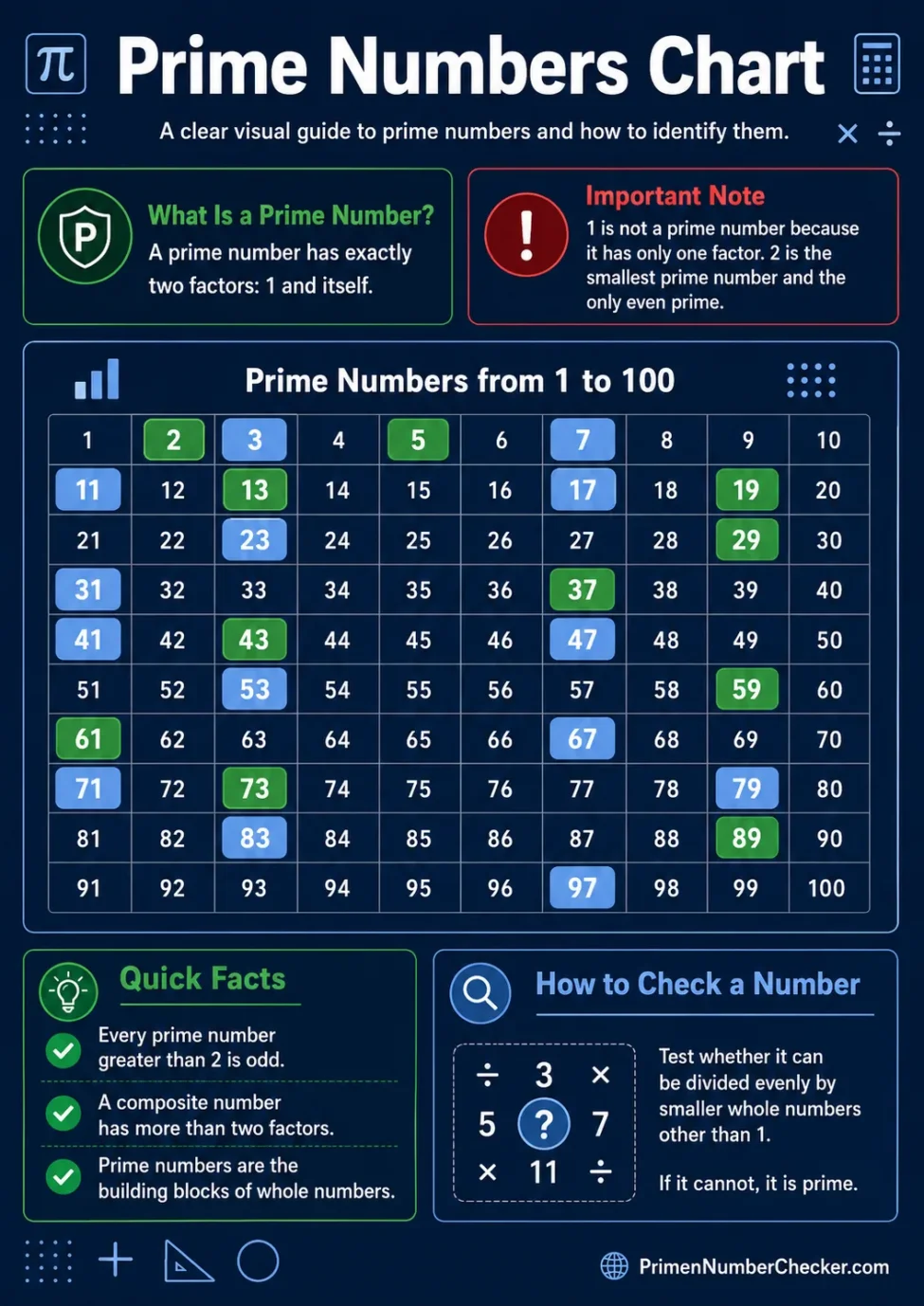
Prime Numbers from 1 to 100
Here are all prime numbers between
1 and 100. Notice two important details:
2 is prime, and
1 is not prime.
Prime numbers chart from 1 to 100| 2 | 3 | 5 | 7 | 11 |
| 13 | 17 | 19 | 23 | 29 |
| 31 | 37 | 41 | 43 | 47 |
| 53 | 59 | 61 | 67 | 71 |
| 73 | 79 | 83 | 89 | 97 |
Quick answer: There are 25 prime numbers from 1 to 100. They begin at 2 and end at 97.
First 100 Prime Numbers
The
first 100 prime numbers are often used in math practice, divisibility lessons, factorization work, coding exercises, and number theory examples. This chart gives a wider view than the 1 to 100 chart because it lists the first 100 primes, ending at
541.
First 100 prime numbers| 2 | 3 | 5 | 7 | 11 | 13 | 17 | 19 | 23 | 29 |
| 31 | 37 | 41 | 43 | 47 | 53 | 59 | 61 | 67 | 71 |
| 73 | 79 | 83 | 89 | 97 | 101 | 103 | 107 | 109 | 113 |
| 127 | 131 | 137 | 139 | 149 | 151 | 157 | 163 | 167 | 173 |
| 179 | 181 | 191 | 193 | 197 | 199 | 211 | 223 | 227 | 229 |
| 233 | 239 | 241 | 251 | 257 | 263 | 269 | 271 | 277 | 281 |
| 283 | 293 | 307 | 311 | 313 | 317 | 331 | 337 | 347 | 349 |
| 353 | 359 | 367 | 373 | 379 | 383 | 389 | 397 | 401 | 409 |
| 419 | 421 | 431 | 433 | 439 | 443 | 449 | 457 | 461 | 463 |
| 467 | 479 | 487 | 491 | 499 | 503 | 509 | 521 | 523 | 541 |
What Makes a Number Prime?
A prime number is a whole number greater than 1 that can be divided evenly only by
1 and itself. That means a prime number has exactly two positive divisors.For example,
13 is prime because its only positive divisors are 1 and 13. But
15 is not prime because it can be divided by 1, 3, 5, and 15.
Prime and composite number comparison| Number | Divisors | Result | Reason |
|---|
| 7 | 1, 7 | Prime | It has exactly two positive divisors. |
|---|
| 12 | 1, 2, 3, 4, 6, 12 | Composite | It has more than two positive divisors. |
|---|
| 1 | 1 | Neither | It has only one positive divisor. |
|---|
| 2 | 1, 2 | Prime | It is the only even prime number. |
|---|
Why 1 Is Not in the Prime Numbers Chart
Many learners expect 1 to be prime because it feels simple. But
1 is not a prime number. A prime number must have exactly two positive divisors. The number 1 has only one positive divisor: itself.This rule also keeps factorization clean. Every whole number greater than 1 can be written as a product of prime numbers in one clear way, apart from order. For example,
30 = 2 × 3 × 5. If 1 were prime, the same number could be written as 1 × 2 × 3 × 5, or 1 × 1 × 2 × 3 × 5, and so on. That would make prime factorization messy.
Simple rule: 1 is neither prime nor composite. Prime numbers start at 2.
Why 2 Is the Only Even Prime Number
The number
2 is prime because it has exactly two divisors: 1 and 2. It is also the only even prime number.Every other even number is divisible by 2. For example, 4, 6, 8, 10, 12, and 14 all have 2 as a divisor. Since they have more divisors than just 1 and themselves, they are composite.That is why, after 2, every prime number in the chart is
odd. But be careful:
not every odd number is prime. The number 9 is odd, but it is not prime because 9 = 3 × 3.
How to Read a Prime Numbers Chart
A prime numbers chart is more than a memory list. It helps you see how primes behave across number ranges.
- Start with 2. It is the first prime number and the only even prime.
- Skip 1. It is not prime because it has only one divisor.
- Watch for divisibility. Numbers ending in 0, 2, 4, 5, 6, or 8 are usually easy to reject, except 2 and 5.
- Check smaller prime divisors. A composite number must have a factor pair.
- Use the square root shortcut. To test a number, you only need to check prime divisors up to its square root.
The Square Root Shortcut
The square root shortcut explains why prime checking does not require testing every smaller number. If a number has a factor larger than its square root, the matching factor must be smaller than the square root.For example, to test
97, the square root is a little less than 10. You only need to check prime divisors up to 9:
2, 3, 5, and 7. Since none of them divide 97 evenly, 97 is prime.This is the same basic idea behind many prime-checking tools. A chart helps you recognize common primes. A checker helps when the number is larger, less familiar, or easy to misread.
Prime Numbers by Range
Prime numbers do not appear in a perfectly even rhythm. They become less frequent as numbers get larger, but they never stop. This table shows how many primes appear in common ranges.
Prime number counts in common ranges| Range | Number of Primes | Smallest Prime in Range | Largest Prime in Range |
|---|
| 1 to 10 | 4 | 2 | 7 |
|---|
| 1 to 100 | 25 | 2 | 97 |
|---|
| 1 to 1,000 | 168 | 2 | 997 |
|---|
| 1 to 10,000 | 1,229 | 2 | 9,973 |
|---|
Common Patterns in Prime Number Charts
Prime numbers have patterns, but they do not follow a simple repeating cycle. That is one reason they are so important in number theory.
Most primes end in 1, 3, 7, or 9
After 5, any prime number must end in
1, 3, 7, or 9. A number ending in 0, 2, 4, 6, or 8 is even, so it is divisible by 2. A number ending in 5 is divisible by 5.This rule helps you reject many composite numbers fast. But it does not prove primality. For example,
49 ends in 9, but it is not prime because 49 = 7 × 7.
Prime gaps vary
The gap between two nearby prime numbers is called a
prime gap. Sometimes the gap is small, as in 11 and 13. Sometimes it is larger, as in 89 and 97.These gaps make prime charts interesting. They show that prime numbers are not evenly spaced, even though they follow strict divisibility rules.
Twin primes appear in pairs
Twin primes are prime numbers that differ by 2. Examples include
3 and 5,
11 and 13,
17 and 19, and
29 and 31.Twin primes are easy to spot in a chart because they sit close together with one even number between them.
How Prime Charts Help with Factorization
Prime numbers are used to break composite numbers into smaller parts. This is called
prime factorization.For example:
- 18 = 2 × 3 × 3
- 45 = 3 × 3 × 5
- 84 = 2 × 2 × 3 × 7
- 100 = 2 × 2 × 5 × 5
A prime chart helps because you can check possible prime divisors in order: 2, 3, 5, 7, 11, and so on. This makes factorization easier and reduces guesswork.
Prime Numbers in Modern Use
Prime numbers are not only classroom topics. They also appear in computing, encryption, random number work, hashing, and algorithm design.In cryptography, large prime numbers help protect digital communication. In programming, prime numbers appear in hashing methods, test cases, and mathematical algorithms. In education, prime charts help students understand divisibility, factors, multiples, and composite numbers.The same idea connects all these uses: prime numbers are numbers that cannot be broken into smaller whole-number factors except 1 and themselves.
When a Chart Is Enough and When It Is Not
A chart is best when the number is small or when you want to study common primes. It is not ideal when the number is large, has many digits, or falls outside the range shown.
When to use a prime chart or a prime checker| Need | Best Option | Why |
|---|
| Learning primes from 1 to 100 | Prime chart | It gives a clean visual list. |
|---|
| Checking one larger number | Prime checker | It tests divisibility directly. |
|---|
| Studying factorization | Chart plus practice | It helps you try prime divisors in order. |
|---|
| Avoiding manual mistakes | Prime checker | It is safer for long or unfamiliar numbers. |
|---|
Prime Numbers Chart FAQ
What is a prime numbers chart?
A prime numbers chart is a list or table of prime numbers. It helps you find primes quickly and compare them across number ranges.
What are the prime numbers from 1 to 100?
The prime numbers from 1 to 100 are 2, 3, 5, 7, 11, 13, 17, 19, 23, 29, 31, 37, 41, 43, 47, 53, 59, 61, 67, 71, 73, 79, 83, 89, and 97.
How many prime numbers are there from 1 to 100?
There are 25 prime numbers from 1 to 100.
Is 1 a prime number?
No. The number 1 is not prime because it has only one positive divisor. A prime number must have exactly two positive divisors.
Is 2 a prime number?
Yes. The number 2 is prime because its only positive divisors are 1 and 2. It is also the only even prime number.
What is the 100th prime number?
The 100th prime number is 541.
Are all odd numbers prime?
No. Many odd numbers are composite. For example, 9, 15, 21, 25, and 27 are odd, but they are not prime. 