
There is no largest prime number. That is the direct answer. Prime numbers do not stop, so there can never be a final one. What people often mean instead is the largest known prime: the biggest prime that has been found so far.
Quick answer
Largest prime number: does not exist.
Why: for any prime you name, there is always a larger prime.
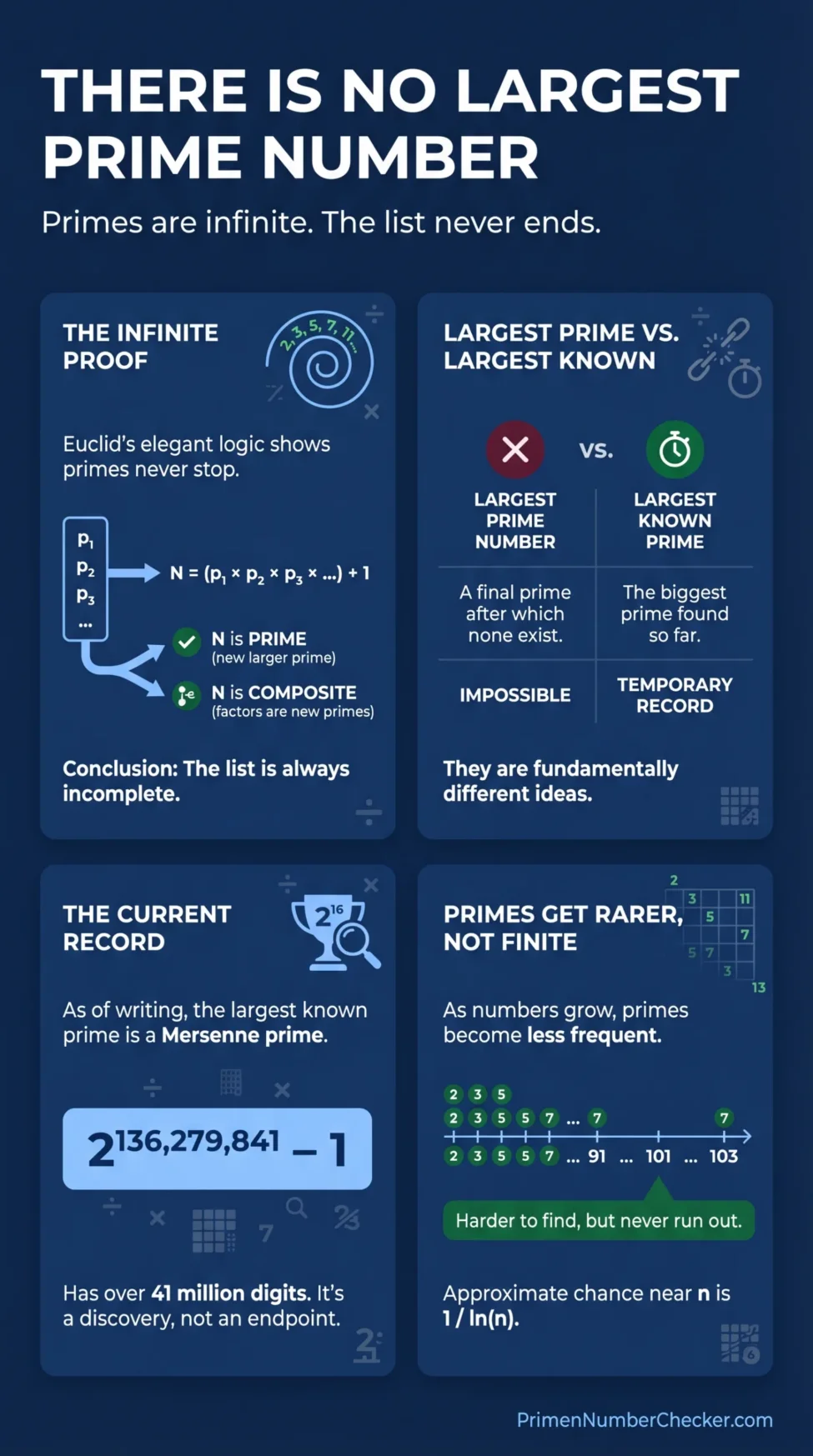
Largest known prime: 2136,279,841 − 1, with 41,024,320 digits as of July 31, 2026.
Why there is no largest prime number
The reason is elegant and old, and it still holds. Suppose you list all prime numbers and claim the list ends with a largest prime. Multiply every prime on that list together, then add 1.
N = p1 × p2 × p3 × … × pn + 1
This new number N leaves a remainder of 1 when divided by any prime from the list. So none of those primes can divide it. That creates only two options:
- N is prime, which means there is a prime larger than the supposed largest prime.
- N is composite, but then its prime factors are not in the original list, so the list was still incomplete.
Either way, the idea of a final prime fails. Prime numbers are infinite.
Small but important detail: this argument does not say that the number you build is always prime. It says the original list cannot contain every prime. That is enough to prove there is no largest prime number.
Largest prime number vs largest known prime
| Term | Meaning | Status |
|---|---|---|
| Largest prime number | A final prime after which no other prime exists | Impossible |
| Largest known prime | The biggest prime found so far | Temporary record |
| Next larger prime | A prime greater than any prime already named | Always exists |
This distinction matters. Many pages blur these two ideas and leave readers with a half-answer. The math question and the record question are different.
What is the largest known prime?
As of July 31, 2026, the largest known prime is the Mersenne prime:
2136,279,841 − 1
It has exactly 41,024,320 decimal digits and is the 52nd known Mersenne prime. Luke Durant confirmed the number as prime on October 12, 2024. The official GIMPS announcement followed on October 21, 2024 after independent verification on different hardware and with different programs.
The number is more than 16 million digits larger than the previous record, 282,589,933 − 1, which has 24,862,048 digits. According to the current GIMPS record list, no larger verified prime had been announced by July 31, 2026.
It remains a record-holder, not a final prime. Another larger prime may be found later, but even if no new record appeared for years, the logic would stay the same: there still would not be a largest prime number.
Why record primes are often Mersenne primes
Mersenne primes have the form 2p − 1. They matter because numbers of this shape can be tested with methods that are faster than general-purpose prime tests. That is why many record primes come from this family.
Still, the form alone is not enough. Even if p is prime, 2p − 1 does not have to be prime. For example:
211 − 1 = 2047 = 23 × 89
So the search is narrow, but not automatic.
The search that produced the current record used thousands of cloud-based server GPUs spread across 24 data center regions in 17 countries. An NVIDIA A100 GPU in Dublin first reported that the number was probably prime on October 11, 2024. An NVIDIA H100 GPU in San Antonio confirmed its primality with a Lucas–Lehmer test the following day.
Why primes feel rarer as numbers get larger
As numbers grow, primes appear less often. That makes them feel like they might run out. They do not. They just become thinner on the number line.
The broad pattern is described by the prime number theorem. It says that near a large number n, the chance of hitting a prime is roughly 1 / ln(n). In plain language, large primes are harder to bump into, but there is no last one.
A common mistake: “primes get rarer” does not mean “primes eventually stop.” Those are two very different claims.
Why mathematicians still search for very large primes
Once you know there is no largest prime, a natural question follows: why keep looking for bigger ones?
- To test algorithms. Very large primes push primality testing methods to their limits.
- To test hardware and distributed systems. Record searches often involve large networks of computers.
- To study number patterns. Record primes reveal how special prime families behave.
- To connect theory and computation. Prime research sits between pure math and machine-based verification.
There is also a practical angle. Large primes matter in cryptography, but the primes used in real systems are not chosen just because they break size records. Record primes are about discovery. Cryptographic primes are about suitability, randomness, and protocol design.
Related ideas that help this topic make sense
Every whole number breaks into primes
Every integer greater than 1 can be written as a product of prime numbers. That is why primes matter so much. They are the irreducible factors behind composite numbers.
Prime gaps can be large
Sometimes many composite numbers appear in a row. These stretches are called prime gaps. They may get long, but they never prove the end of primes.
Mersenne primes link to perfect numbers
Mersenne primes are tied to even perfect numbers. If 2p − 1 is prime, then 2p−1(2p − 1) is a perfect number. That link is one reason Mersenne primes show up so often in prime number discussions.
Where the Prime Number Checker fits
This page answers a theory question. It explains why the prime list has no endpoint. But many visitors have a more practical question: is a specific number prime?
That is where the Prime Number Checker fits naturally. It helps test individual numbers, while this article explains the bigger idea behind the prime sequence itself.
So the two pages serve different needs:
- This page: explains why no largest prime exists and identifies the current record.
- The checker: tests whether one chosen number is prime or composite.
Common misunderstandings
“The largest known prime is the largest prime”
No. It is only the biggest one found and verified so far.
“A very large odd number is probably prime”
Not necessarily. Every prime greater than 2 is odd, but most odd numbers are still composite.
“If Euclid’s construction makes a new number, that new number is always prime”
No. The point is not that the new number must be prime. The point is that it cannot be fully explained by the old list of primes.
“Maybe primes stop after a huge gap”
No. Gaps can grow, but the set of primes still goes on forever.
FAQ
Is there a largest prime number?
No. There is no largest prime number because the set of prime numbers is infinite.
What is the largest known prime number?
As of July 31, 2026, the largest known prime is 2136,279,841 − 1. It has 41,024,320 decimal digits and is the 52nd known Mersenne prime.
Who found the largest known prime?
Luke Durant confirmed 2136,279,841 − 1 as prime on October 12, 2024. GIMPS officially announced the discovery on October 21, 2024 after independent verification.
How much larger is the current record prime?
It has more than 16 million additional digits compared with the previous record prime, 282,589,933 − 1.
Why are many record primes Mersenne primes?
They have a special form, 2p − 1, which allows more efficient testing than many general large numbers.
Do prime numbers get rarer?
Yes. They become less frequent as numbers grow, but they never stop appearing.
Is 2 the largest even prime?
Yes. It is the only even prime number, so it is also the largest even prime.