
Prime Numbers Matter Because They Shape How Whole Numbers Work
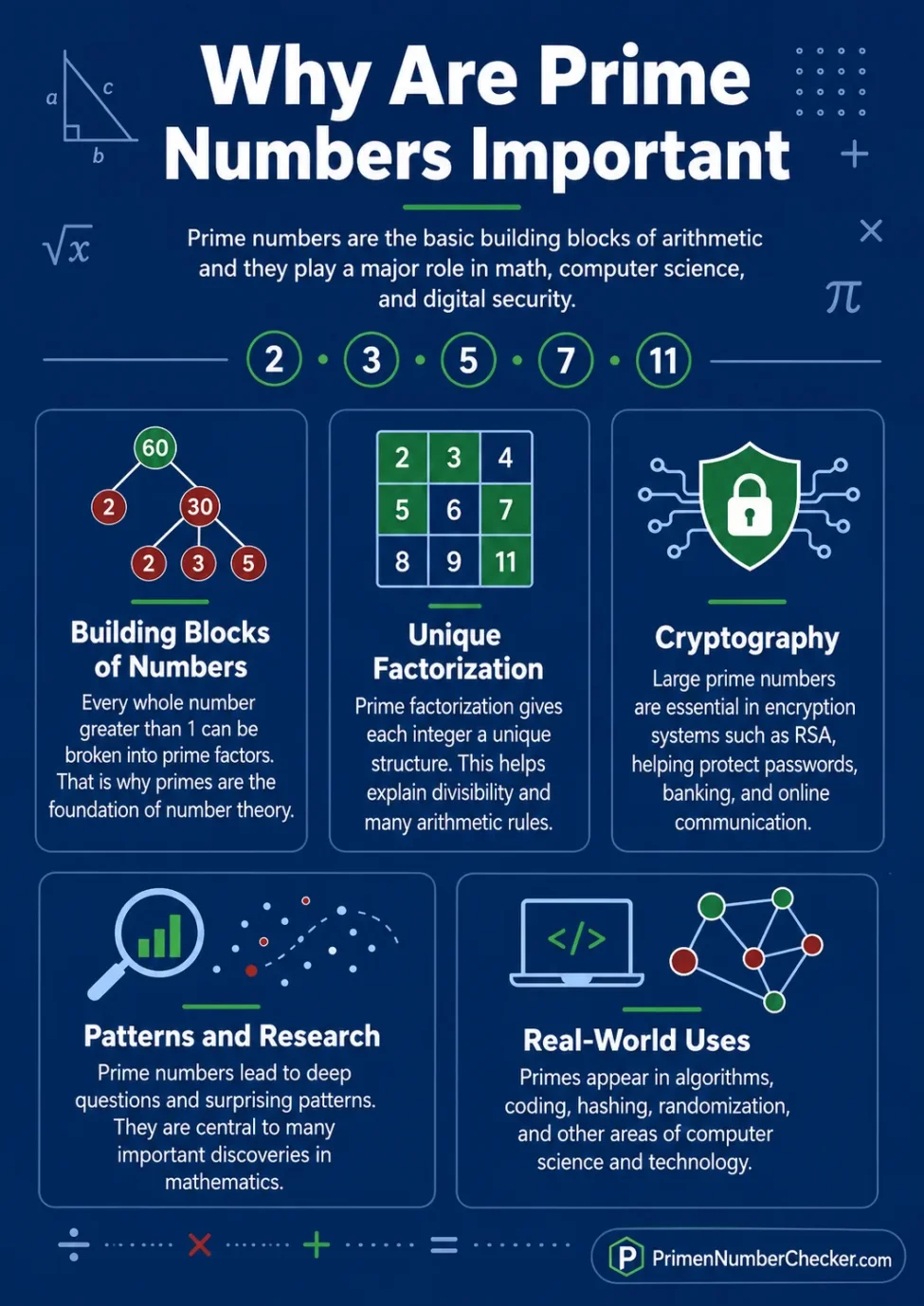
Prime numbers are important because they are the simplest indivisible numbers greater than 1. Every whole number greater than 1 is either prime or can be broken into a product of primes.
That single idea connects primes to factorization, divisibility, encryption, algorithms, number theory, and mathematical proof. A prime number may look small and plain, but it controls how larger numbers are built, tested, protected, and studied.
For example, 12 is not random in its structure. It breaks into 2 × 2 × 3. The primes 2 and 3 explain its divisibility. The same idea works for much larger numbers, even when finding the prime parts becomes very hard.
What Is a Prime Number?
A prime number is a whole number greater than 1 that has exactly two positive divisors: 1 and itself.
So 7 is prime because only 1 and 7 divide it evenly. But 9 is not prime because 1, 3, and 9 divide it evenly.
Small but important detail
1 is not prime. A prime number must have exactly two positive divisors. The number 1 has only one positive divisor: itself. Keeping 1 out of the prime list also keeps prime factorization clean and unique.
The first few prime numbers are:
2, 3, 5, 7, 11, 13, 17, 19, 23, 29
The number 2 is the only even prime. Every other even number is divisible by 2, so it cannot be prime.
The Main Reason Prime Numbers Are Important
The main reason primes matter is the unique factorization of whole numbers. Every integer greater than 1 can be written as a product of prime numbers in only one way, apart from the order of the factors.
For example:
84 = 2 × 2 × 3 × 7
You can rearrange those primes, but you cannot replace them with a different set of prime factors. That makes primes the basic units of multiplication for whole numbers.
Why that matters
Without prime numbers, divisibility would be much harder to organize. Primes give each number a hidden structure. Once that structure is known, many questions become easier:
- Which numbers divide this number evenly?
- Do two numbers share a common factor?
- What is the greatest common divisor?
- What is the least common multiple?
- Can this number be simplified in a fraction?
This is why prime numbers appear so early in math education, but they do not stay basic. The same idea grows into deeper topics such as modular arithmetic, cryptography, and computational number theory.
Prime Numbers Explain Divisibility
Divisibility is one of the cleanest places to see why primes are useful. A composite number can be divided by smaller whole numbers because it is made from prime factors.
Take 60:
60 = 2 × 2 × 3 × 5
This tells us that 60 is divisible by 2, 3, 4, 5, 6, 10, 12, 15, 20, and 30. Those divisors come from different combinations of its prime factors.
A prime number does not work that way. 13 has no smaller whole-number parts except 1. That is why it acts like a stopping point in factorization.
Prime vs. composite in one sentence
A prime number cannot be split into smaller whole-number factors. A composite number can.
Prime Numbers Make Factorization Possible
Factorization means breaking a number into smaller parts that multiply back to the original number. Prime factorization goes one step further: it breaks the number down until all parts are prime.
For example:
210 = 2 × 3 × 5 × 7
This prime factorization tells a lot about 210. It is even, divisible by 3, divisible by 5, divisible by 7, and made from four different prime factors.
When students learn prime factorization, they are not only learning a school method. They are learning how whole numbers store information.
Why prime factorization feels simple for small numbers but hard for large ones
Small numbers are easy to factor because trial division works quickly. You can test small primes such as 2, 3, 5, 7, and 11.
Large numbers are different. A number with hundreds of digits may be very hard to factor, even though checking a proposed factor is easy. This gap between easy to verify and hard to discover is one reason primes appear in digital security.
Prime Numbers Protect Digital Information
Prime numbers are used in several areas of computer security, especially in systems based on large-number arithmetic. The best-known example is RSA encryption, which uses multiplication of large primes as part of its design.
The basic idea is simple to state:
- Multiplying two large prime numbers is fast for a computer.
- Factoring the product back into those two primes can be extremely hard when the primes are large enough.
This does not mean every modern security system depends only on primes. Some systems use elliptic curves, finite fields, or newer methods. Still, prime numbers remain central to many parts of cryptography, especially where modular arithmetic and finite fields are involved.
A simple example
Suppose two small primes are multiplied:
17 × 23 = 391
For a small number like 391, factoring is easy. But when the primes have hundreds or thousands of bits, the same type of problem becomes far harder. That difficulty can be used to help protect information.
Prime Numbers Help Computers Test and Organize Data
Prime numbers also appear in algorithms. An algorithm is a step-by-step method used by a computer or by a person to solve a problem.
Primes are useful in areas such as:
- Primality testing, where a number is checked to see if it is prime.
- Hashing, where numbers help spread data across storage positions.
- Randomized algorithms, where modular arithmetic can help control patterns.
- Error detection and coding theory, where number structures help protect data from mistakes.
Not every algorithm uses primes. But primes often appear when a system needs clean divisibility behavior, wide spacing, or arithmetic with fewer unwanted patterns.
Tool connection
When a number is small, divisibility rules may be enough. When a number is larger, a direct test is faster and safer. To check a specific value, use the Prime Number Checker and then compare the result with the reasoning explained here.
Prime Numbers Reveal Patterns and Limits in Mathematics
Prime numbers do not appear in a simple repeating pattern. Yet they are not chaotic either. They become less frequent as numbers grow, but they keep appearing forever.
This makes primes one of the most studied topics in mathematics. They are easy to define, but many questions about them are very hard.
There are infinitely many primes
Euclid gave a famous proof that there is no largest prime. The idea is elegant: assume there are only finitely many primes, multiply them together, and add 1. The new number cannot be divided evenly by any prime on the assumed list. That means either the new number is prime or it has a prime factor not on the list.
So the list was not complete. There must be infinitely many primes.
Prime gaps and distribution
A prime gap is the distance between two neighboring primes. For example, the gap between 11 and 13 is 2. The gap between 23 and 29 is 6.
Prime gaps show that primes are not evenly spaced. Some primes sit close together, while others are separated by longer stretches of composite numbers. This mix of order and surprise is one reason primes remain active in mathematical research.
Prime Numbers Support Modular Arithmetic
Modular arithmetic studies remainders. It is the math behind clock-style counting. For example, on a 12-hour clock, 14 behaves like 2 because 14 leaves a remainder of 2 when divided by 12.
Prime numbers make modular arithmetic cleaner in many cases. When the modulus is prime, nonzero numbers behave especially well under multiplication. This creates useful systems called finite fields.
Finite fields appear in:
- cryptography,
- error-correcting codes,
- computer algebra,
- digital communication,
- some forms of data verification.
This is one of the reasons primes are not only a topic in school math. They help shape the arithmetic used inside real digital systems.
Prime Numbers Build Better Number Sense
Prime numbers also matter because they train mathematical thinking. They force a reader to ask better questions:
- What does it mean for a number to be divisible?
- How can a number be tested efficiently?
- Why is 2 prime but every larger even number composite?
- Why is 1 excluded?
- How can a number have many divisors while another nearby number has almost none?
These questions help students move beyond memorizing rules. They start to see numbers as structured objects, not just symbols on a page.
Common Areas Where Prime Numbers Matter
| Area | Why Primes Matter | Simple Example |
|---|---|---|
| Number theory | Primes define the structure of whole numbers. | 45 = 3 × 3 × 5 |
| Fractions | Prime factors help simplify ratios. | 18/24 simplifies using shared factors. |
| Cryptography | Large primes help create hard factorization problems. | RSA uses products of large primes. |
| Algorithms | Primality tests and modular methods use prime properties. | Testing whether 997 is prime. |
| Education | Primes improve understanding of divisibility and factors. | Knowing why 21 is composite. |
Why Prime Numbers Still Matter Today
Prime numbers remain important because they connect simple arithmetic with advanced mathematics and computing. A child can understand that 5 is prime, yet large primes can still support difficult problems used in security and research.
This range is rare. Prime numbers are simple to define, hard to predict, and useful across many levels of math.
They help explain why numbers divide the way they do. They help computers test large values. They support parts of modern cryptography. They create questions that mathematicians still study.
That is why prime numbers are not just a list to memorize. They are one of the main ways mathematics understands the structure of whole numbers.
Frequently Asked Questions
Why are prime numbers important in simple terms?
Prime numbers are important because they are the simplest whole numbers greater than 1 that cannot be split into smaller whole-number factors. They help explain how all larger whole numbers are built through multiplication.
Why are prime numbers used in cryptography?
Prime numbers are used in some cryptographic systems because multiplying large primes can be fast, while factoring the result back into the original primes can be very hard. This difficulty helps protect information in certain security methods.
Are prime numbers only useful in advanced math?
No. Prime numbers are useful in basic arithmetic too. They help with divisibility, factors, fractions, greatest common divisors, and least common multiples. Advanced uses grow from these same ideas.
Why is 2 the only even prime number?
2 is prime because it has exactly two positive divisors: 1 and 2. Every even number greater than 2 is divisible by 2, so it has more than two divisors and is composite.
Why is 1 not a prime number?
1 is not prime because a prime number must have exactly two positive divisors. The number 1 has only one positive divisor. Excluding 1 also keeps prime factorization unique.