
Prime Numbers Have a Long Mathematical Story
Prime numbers are whole numbers greater than 1 that can be divided evenly only by 1 and by themselves. The idea sounds simple, but the history behind it is one of the longest threads in mathematics.
Prime numbers appear in early Greek mathematics, medieval arithmetic, modern number theory, computer science, and digital security. Their story is not just about old discoveries. It is about one question that never went away:
how are prime numbers arranged inside the counting numbers?
Why Prime Numbers Became Important
Early mathematicians studied numbers by asking how they could be divided. Some numbers split into smaller whole-number parts. For example, 12 can be written as 2 × 6, 3 × 4, or 2 × 2 × 3. But 7 cannot be split this way.
That difference made primes special. A prime number is not just a number that “cannot be divided.” More exactly, it has exactly two positive divisors. This is why 2, 3, 5, 7, 11, and 13 are prime, while 1 is not.
The deeper reason is that every whole number greater than 1 can be broken down into primes in one fixed way, apart from the order of the factors. This idea is now called unique prime factorization. It explains why prime numbers sit near the base of arithmetic.
Prime Numbers in Ancient Greek Mathematics
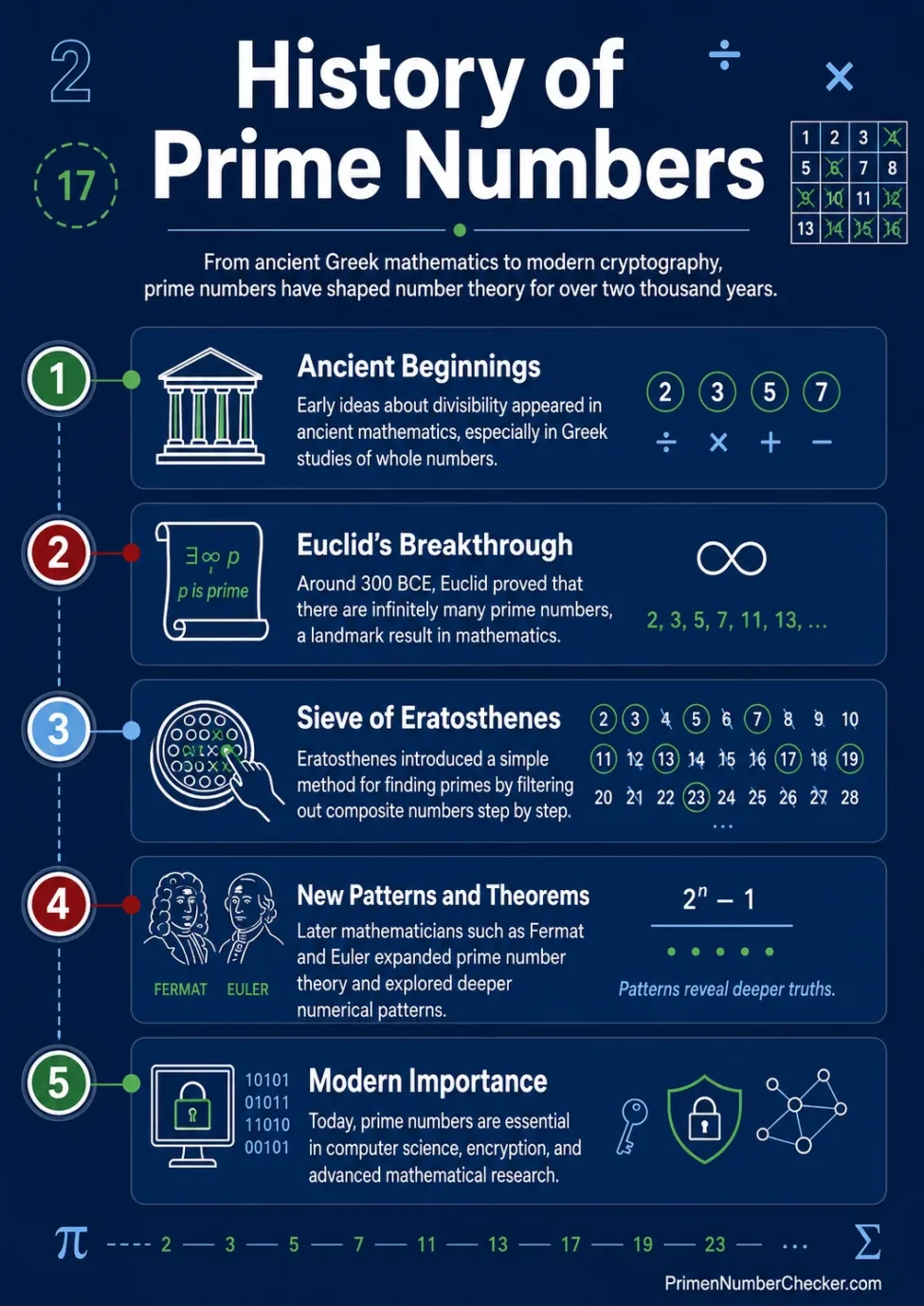
The first clear written treatment of prime numbers comes from Greek mathematics, especially through Euclid. His work Elements, written around 300 BCE, organized many number ideas into logical proofs.
Euclid did more than list primes. He proved that there are infinitely many prime numbers. His argument is still taught because it is short, sharp, and powerful.
Euclid’s Idea in Plain English
Suppose you already have a finite list of primes. Multiply them together, then add 1. The new number leaves a remainder of 1 when divided by every prime on the list. So either the new number is prime, or it has a prime factor not on the list.
That means no finite list can contain all primes.
This proof changed the way mathematicians thought about numbers. It showed that prime numbers are not a small pattern that eventually stops. They continue forever.
The Sieve of Eratosthenes
Another famous early method is the Sieve of Eratosthenes. Eratosthenes was a Greek scholar from the third century BCE. His method gives a clean way to find primes by removing composite numbers from a list.
Start with whole numbers from 2 upward. Keep 2, then cross out multiples of 2. Keep the next number not crossed out, which is 3, then cross out multiples of 3. Continue this process. The numbers left are prime.
The sieve is old, but the logic still feels modern. It does not test each number in isolation. It uses the structure of divisibility to remove many non-primes at once.
For a quick check while studying examples, you can test any value with the Prime Number Checker. It helps connect the historical idea of divisibility with a direct answer for a specific number.
A Short Timeline of Prime Number History
Prime numbers did not develop as one single discovery. Different periods added new questions, better methods, and sharper language.
| Period | Main Development | Why It Matters |
|---|---|---|
| Ancient Greece | Euclid proves there are infinitely many primes | Shows primes never run out |
| 3rd century BCE | Sieve of Eratosthenes | Gives a practical way to list primes |
| 17th century | Fermat studies special prime forms | Links primes with deeper patterns |
| 18th century | Euler expands prime theory | Connects primes with infinite series |
| 19th century | Gauss studies prime distribution | Leads toward the Prime Number Theorem |
| 20th century | Computers find larger primes | Changes how prime searches are done |
| Digital age | Primes support public-key cryptography | Connects prime theory with online security |
Fermat, Mersenne, and Special Prime Forms
As mathematics developed, scholars began asking whether certain formulas could produce primes. Two names often appear in this part of the story: Fermat and Mersenne.
Fermat Primes
A Fermat number has the form 22n + 1. Fermat believed numbers of this form might always be prime, but later work showed that this is not true. This was an important lesson: a formula may produce some primes without producing only primes.
Mersenne Primes
A Mersenne prime has the form 2p − 1, where p itself is prime. These primes became especially famous because many of the largest known primes have this form.
Special prime forms matter because they reduce the search area. Instead of testing random numbers, mathematicians can test numbers with a known structure. This is one reason prime searches became closely tied to computing.
Euler and the Link Between Primes and Infinite Patterns
Leonhard Euler brought prime numbers into a wider mathematical setting. He showed that primes are connected with infinite series, especially through what is now called the Euler product.
The idea can be stated simply: information about all whole numbers can be connected to information about primes. That link gave mathematicians a new way to study how primes behave.
Euler’s work helped move prime numbers from arithmetic into what we now call number theory. The subject became less about listing primes and more about proving how primes behave across the number line.
Gauss and the Distribution of Prime Numbers
By the 19th century, mathematicians wanted to know how often primes appear. Small primes are easy to spot, but the gaps between primes grow as numbers get larger.
Carl Friedrich Gauss studied tables of primes and noticed that the number of primes below a large number x seemed close to a pattern involving logarithms. This led toward the Prime Number Theorem, which describes the average density of primes.
Important Point
Prime numbers do not appear in a simple repeating cycle. Yet they are not completely chaotic either. Their average behavior can be measured, even when each single prime remains hard to predict.
This balance is one reason primes remain interesting. They are strict enough to study, but irregular enough to keep producing hard questions.
Prime Numbers in Modern Mathematics
Prime numbers now sit inside many areas of mathematics. They appear in algebra, modular arithmetic, analytic number theory, and computational math.
One famous open problem is the Riemann Hypothesis, which is linked to how primes are distributed. Another is the Twin Prime Conjecture, which asks whether there are infinitely many prime pairs that differ by 2, such as 11 and 13 or 17 and 19.
These problems show that prime numbers are not “finished” mathematics. Even after thousands of years, simple questions about primes can remain unsolved.
Prime Numbers and Computers
Computers changed the scale of prime number research. Before computers, prime tables were built by hand or with mechanical help. Today, algorithms can test very large numbers and search for primes with millions of digits.
Modern primality testing does not rely only on trial division. It can use faster methods that decide whether very large numbers are prime. This matters because numbers used in research and security are often far too large for basic checking by hand.
Still, the basic definition remains the same. A number is prime if it has exactly two positive divisors. The method gets faster, but the idea stays clean.
Why Prime Numbers Matter in Digital Security
Prime numbers also became important outside pure mathematics. In public-key cryptography, large primes help create systems where information can be shared securely without both sides starting with the same private secret.
The practical value comes from the difference between two tasks. Multiplying large primes is easy for a computer. Reversing the process by factoring the product can be much harder when the numbers are large enough and chosen well.
This does not mean every prime is useful for security. Cryptographic systems need carefully generated primes, safe parameters, and correct implementation. But the mathematical reason traces back to the same old idea: prime factorization.
What the History Teaches About Primes
The history of prime numbers teaches three clear lessons.
- Prime numbers are simple to define, but their behavior is hard to fully describe.
- Old methods still matter, especially Euclid’s proof and the Sieve of Eratosthenes.
- Modern uses grew from old questions, including factorization, divisibility, and prime distribution.
This is why prime numbers are still studied by students, teachers, researchers, and programmers. They connect basic arithmetic with some of the hardest questions in mathematics.
Common Misunderstandings About Prime Number History
Prime numbers were not invented
Prime numbers were discovered as properties of whole numbers. Humans created the language and proofs around them, but the divisibility pattern itself comes from arithmetic.
The number 1 used to be treated differently
In older writing, 1 was sometimes handled in ways that do not match the modern definition. Today, 1 is not prime because primes must have exactly two positive divisors. The number 1 has only one.
Prime numbers are not random in the usual sense
Prime numbers can look irregular, especially as they get larger. But they follow strict rules. A number either has the right divisor structure or it does not.
FAQ About the History of Prime Numbers
Who first studied prime numbers?
Prime numbers were studied in ancient Greek mathematics. Euclid gave the first famous proof that there are infinitely many prime numbers.
What is the oldest famous method for finding prime numbers?
The Sieve of Eratosthenes is one of the oldest known methods for listing prime numbers. It works by crossing out multiples and leaving primes behind.
Why is Euclid important in prime number history?
Euclid proved that there are infinitely many prime numbers. His proof is still one of the clearest examples of mathematical reasoning.
Why did prime numbers become useful in computers?
Computers made it possible to test and search much larger numbers. Prime numbers also became useful in digital security because large prime factorization can be hard to reverse.
Are all questions about prime numbers solved?
No. Problems such as the Twin Prime Conjecture and the Riemann Hypothesis show that prime numbers still raise hard questions.
Final Note on Prime Number History
Prime numbers began as a question about divisibility. Over time, they became central to proofs, patterns, algorithms, and secure communication. Their history is not a closed chapter. It is still growing.
The same idea behind Euclid’s proof and Eratosthenes’ sieve remains useful today: to understand a number, first understand how it divides.