
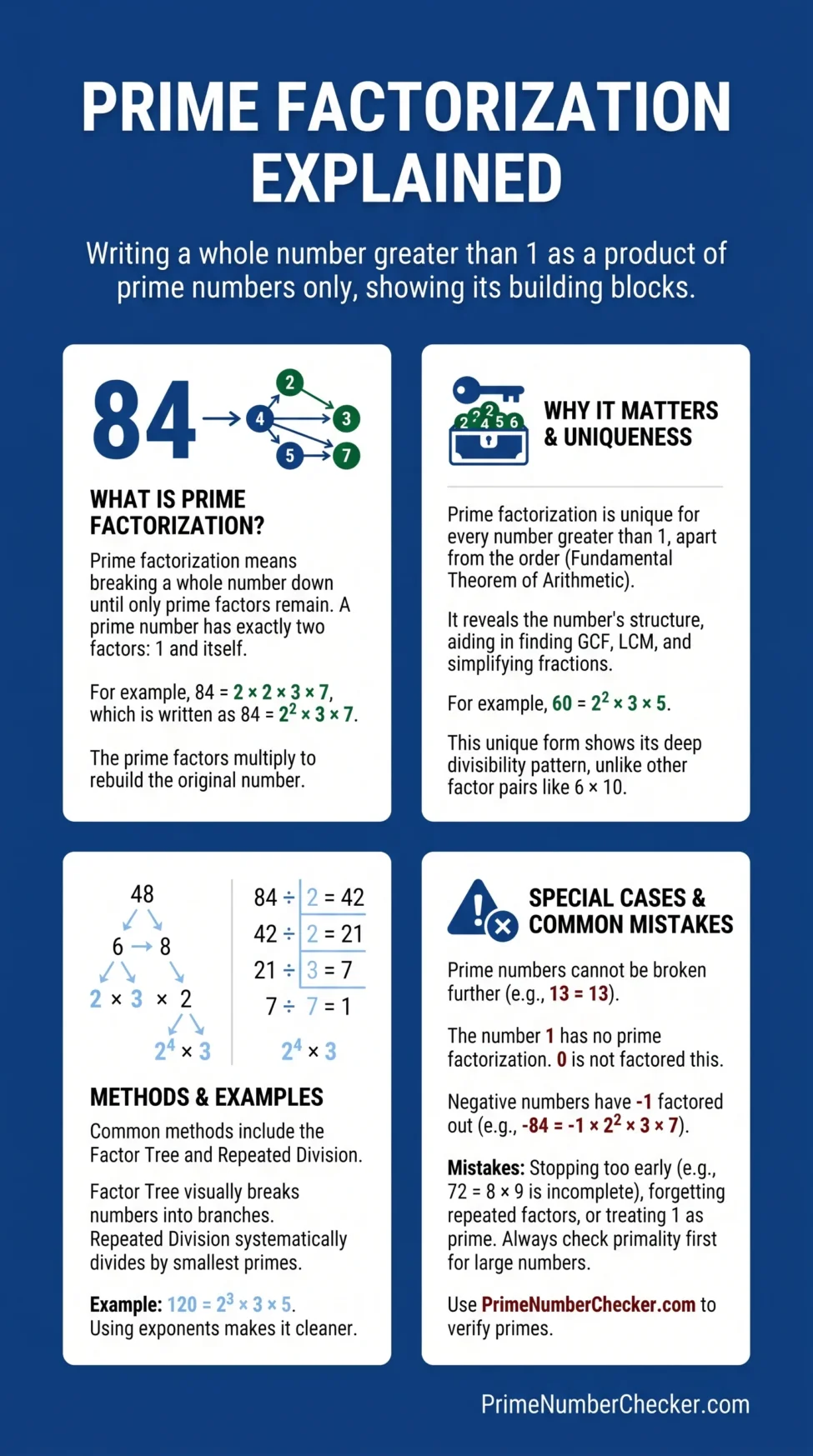
For example, the prime factorization of 84 is:
84 = 2 × 2 × 3 × 7
This is often written with exponents as:
84 = 22 × 3 × 7
The short idea is simple: prime factorization shows the prime numbers that multiply together to rebuild the original number.
Why Prime Factorization Matters
Prime factorization is useful because prime numbers are the smallest meaningful pieces of multiplication. A composite number may have many factors, but its prime factorization reveals the exact prime structure underneath it.
Take 60. It can be written as 6 × 10, 3 × 20, 4 × 15, or 2 × 30. Those are all valid factor pairs, but they are not the deepest form. When every composite part is broken down, the result is:
60 = 22 × 3 × 5
That final form tells you more than a random factor pair. It shows the number’s divisibility pattern, repeated prime factors, and relationship to other numbers.
This is why prime factorization connects naturally to greatest common factor, least common multiple, fractions, divisibility rules, square roots, and many number theory ideas.
The Mathematical Definition
For any whole number greater than 1, its prime factorization is a product of prime numbers that equals the original number.
If a number is already prime, its prime factorization is just the number itself. For example:
13 = 13
If a number is composite, it can be split into smaller factors until only primes remain. For example:
72 = 2 × 2 × 2 × 3 × 3 = 23 × 32
The order of the prime factors does not change the meaning. 2 × 2 × 3 × 7 and 7 × 3 × 2 × 2 both describe the same factorization of 84. Standard form usually lists primes from smallest to largest.
Prime Factorization Is Unique
One of the most important facts in elementary number theory is that every whole number greater than 1 has one unique prime factorization, apart from the order of the factors.
This idea is known as the Fundamental Theorem of Arithmetic. It means a number cannot have two truly different prime factorizations.
For example:
90 = 2 × 3 × 3 × 5 = 2 × 32 × 5
You may reach that result through different paths. You might start with 9 × 10, or 2 × 45, or 3 × 30. The route can change. The final prime factors cannot.
That is the reason prime factorization is so reliable. It gives a stable identity for a number’s multiplicative structure.
Prime Factors vs Regular Factors
A factor is any whole number that divides another number without a remainder. A prime factor is a factor that is also prime.
For the number 36, the positive factors are:
1, 2, 3, 4, 6, 9, 12, 18, 36
But the prime factors are only:
2 and 3
The full prime factorization is:
36 = 22 × 32
This difference matters. Listing all factors tells you every divisor. Prime factorization tells you the prime ingredients that create the number.
How Prime Factorization Works
Prime factorization works by repeatedly splitting a composite number into smaller factors. Whenever a prime number appears, it stays. Whenever a composite number appears, it can still be broken down.
Example: Prime Factorization of 120
Start with a simple factor pair:
120 = 12 × 10
Now break both composite factors:
12 = 2 × 2 × 3
10 = 2 × 5
Put the prime factors together:
120 = 2 × 2 × 2 × 3 × 5
Write repeated factors with exponents:
120 = 23 × 3 × 5
The exponent on 2 means that 2 appears three times as a prime factor.
Two Common Ways to Find Prime Factorization
Factor Tree Method
A factor tree starts with the original number and splits it into branches. Each branch continues until every end point is prime.
For 48, one path is:
48 = 6 × 8
6 = 2 × 3
8 = 2 × 2 × 2
So:
48 = 24 × 3
The factor tree method is useful because it makes the breakdown visual. It also shows why different starting factor pairs still lead to the same prime result.
Repeated Division Method
The repeated division method divides the number by prime numbers, usually starting with the smallest prime: 2, then 3, then 5, then 7, and so on.
For 84:
84 ÷ 2 = 42
42 ÷ 2 = 21
21 ÷ 3 = 7
7 ÷ 7 = 1
The divisors used were 2, 2, 3, and 7.
84 = 22 × 3 × 7
This method is clean for larger numbers because it keeps the process organized.
Prime Factorization Examples
| Number | Prime Factorization | What It Shows |
|---|---|---|
| 18 | 2 × 32 | One factor of 2 and two factors of 3 |
| 24 | 23 × 3 | Mostly built from powers of 2 |
| 45 | 32 × 5 | Divisible by 3, 5, 9, and 15 |
| 100 | 22 × 52 | A square number with paired prime factors |
| 210 | 2 × 3 × 5 × 7 | A product of the first four prime numbers |
Special Cases
Prime Numbers
If the number is prime, it cannot be broken into smaller prime factors. Its prime factorization is itself.
29 = 29
This does not mean 29 has no factors. It has two positive factors: 1 and 29. But only 29 is a prime factor.
The Number 1
The number 1 has no prime factorization. It is not prime and not composite. It has only one positive factor: itself.
This detail prevents confusion. If 1 were treated as prime, prime factorization would no longer be unique, because extra 1s could be inserted forever.
Zero
0 does not have a prime factorization. It is divisible by many whole numbers, but it cannot be written as a finite product of primes in the same way positive integers greater than 1 can.
Negative Numbers
A negative integer can be handled by factoring out -1 first. For example:
-84 = -1 × 22 × 3 × 7
The prime factorization part still describes the positive size of the number, while -1 carries the sign.
Why Exponents Make Prime Factorization Cleaner
Repeated prime factors can make a factorization look long. Exponents shorten the form while keeping the exact meaning.
For example:
144 = 2 × 2 × 2 × 2 × 3 × 3
With exponents:
144 = 24 × 32
This tells you that 144 contains four copies of 2 and two copies of 3. It also explains why 144 is a square number: every prime exponent is even.
That pattern matters in many topics. A number is a perfect square when all prime exponents are even. A number is a perfect cube when all prime exponents are multiples of 3.
How Prime Factorization Connects to Other Math Topics
Greatest Common Factor
Prime factorization makes the greatest common factor easier to see. Compare 36 and 60:
36 = 22 × 32
60 = 22 × 3 × 5
The shared prime factors are 22 and 3.
So the greatest common factor is:
22 × 3 = 12
Least Common Multiple
For the least common multiple, prime factorization shows which prime powers are needed to cover both numbers.
Using 36 and 60 again:
36 = 22 × 32
60 = 22 × 3 × 5
The LCM needs 22, 32, and 5.
LCM = 22 × 32 × 5 = 180
Fractions
Prime factorization also helps explain why fractions reduce. For example:
84 / 120
84 = 22 × 3 × 7
120 = 23 × 3 × 5
The shared part is 22 × 3 = 12. Dividing top and bottom by 12 gives:
84 / 120 = 7 / 10
Prime Factorization and Prime Checking
Prime factorization depends on knowing which numbers are prime. When a number is small, divisibility rules are often enough. For larger numbers, checking primality first can make the factorization process easier.
If you need to test whether a number is prime before breaking down a related composite number, use the Prime Number Checker. It helps separate prime numbers from composite numbers before you study their factors.
This matters because a prime number stops the factorization process. A composite number keeps splitting.
Prime Factorization in Modern Use
Prime factorization is not only a school topic. It appears in computer science, digital security, coding theory, and algorithm design.
Large-number factorization is especially important in public-key cryptography. Some encryption systems rely on the fact that multiplying large primes is easy for computers, while factoring the resulting large composite number can be very hard when the primes are chosen correctly.
In everyday math, prime factorization is more direct. It helps with simplifying fractions, finding common denominators, checking divisibility, working with radicals, and understanding how numbers are built.
The same idea scales from simple arithmetic to advanced number theory: primes control multiplication.
Common Mistakes
Stopping Too Early
A factorization is not prime factorization if composite numbers remain.
72 = 8 × 9 is a factorization, but not a prime factorization.
The prime factorization is:
72 = 23 × 32
Forgetting Repeated Factors
If a prime divides the number more than once, every copy must be counted.
For example, 40 is not just 2 × 5. The full prime factorization is:
40 = 23 × 5
Treating 1 as Prime
The number 1 is not prime. It should not appear as a prime factor. Prime factorization uses primes only, and primes must have exactly two positive factors.
Mixing Up Factors and Prime Factors
All prime factors are factors, but not all factors are prime factors. For example, 12 is a factor of 36, but it is not a prime factor because 12 is composite.
A Clean Way to Think About Prime Factorization
Prime factorization answers one main question:
Which prime numbers multiply together to create this number?
That question is more useful than it first appears. It turns a number from a single value into a visible structure. You can see repeated primes, shared factors, square patterns, cube patterns, and divisibility clues.
For a small number, the result may be obvious. For a larger number, the structure may be hidden. Prime factorization reveals it.
FAQ About Prime Factorization
What is prime factorization?
Prime factorization is writing a whole number greater than 1 as a product of prime numbers. For example, 84 = 22 × 3 × 7.
What is the prime factorization of a prime number?
The prime factorization of a prime number is the number itself. For example, 17 = 17 because 17 cannot be broken into smaller prime factors.
Does 1 have a prime factorization?
No. The number 1 does not have a prime factorization because it is not prime and not composite.
Why is prime factorization unique?
Every whole number greater than 1 has only one prime factorization apart from the order of the factors. This is the Fundamental Theorem of Arithmetic.
What is the difference between factors and prime factors?
Factors are all whole numbers that divide a number evenly. Prime factors are the factors that are prime numbers.
Why do we use exponents in prime factorization?
Exponents show repeated prime factors in a shorter form. For example, 2 × 2 × 2 × 3 can be written as 23 × 3.