
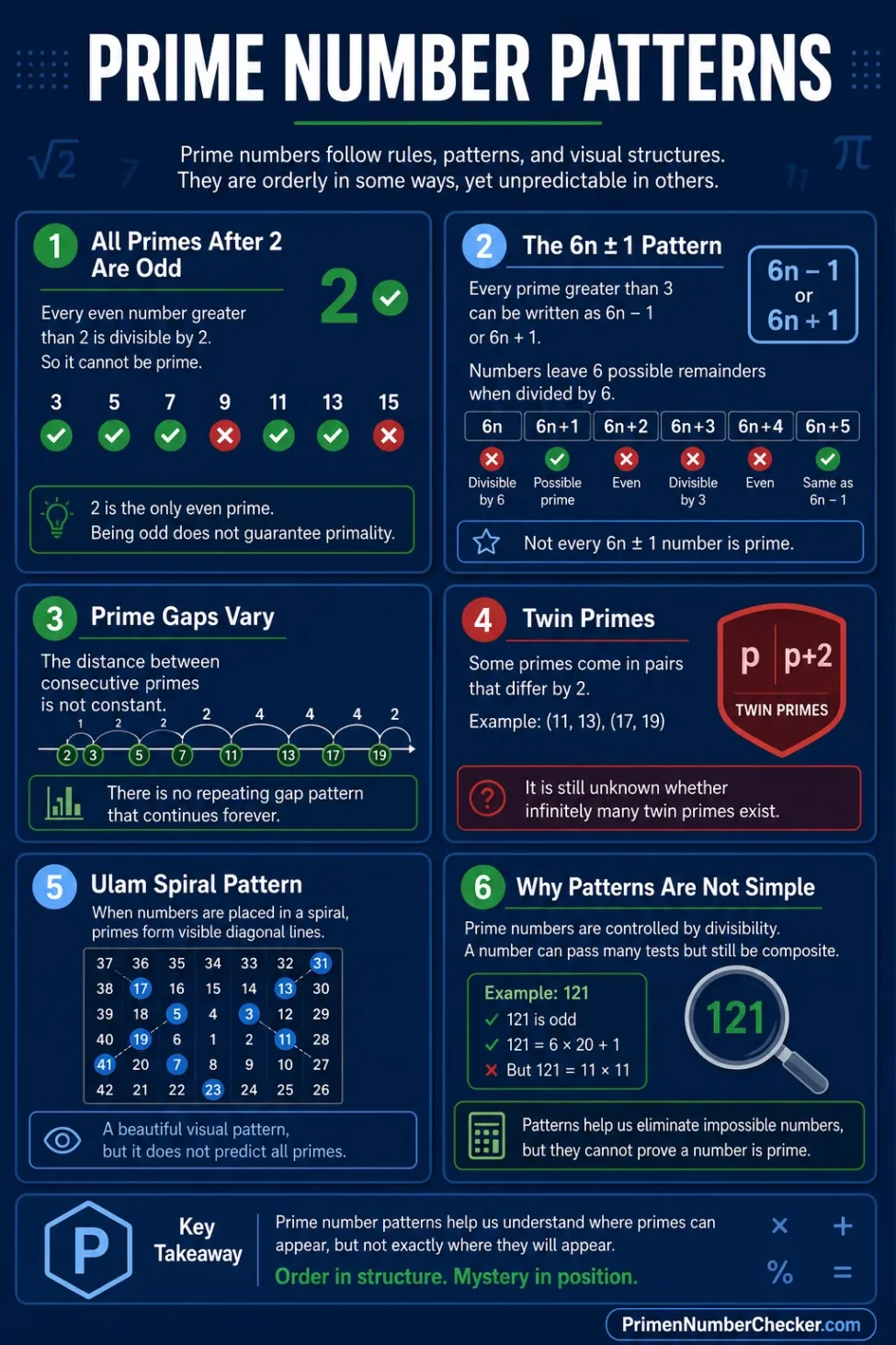
Prime number patterns are the repeated structures, restrictions, and visual behaviors that appear in the list of prime numbers. The most important fact is simple: prime numbers do have patterns, but they do not follow one easy repeating formula. After 2, every prime is odd. After 3, every prime is either one less or one more than a multiple of 6. Yet these patterns only show where primes can appear, not where they must appear.
This is why prime numbers feel both orderly and unpredictable. They obey strict divisibility rules, but their exact positions still resist a simple shortcut. That tension is what makes prime patterns one of the most studied topics in number theory.
What Is a Prime Number Pattern?
A prime number pattern is any repeated relationship that helps describe how prime numbers appear among whole numbers. Some patterns come from divisibility rules. Some come from modular arithmetic. Others appear visually when primes are arranged in grids or spirals.
A prime number is a whole number greater than 1 with exactly two positive divisors: 1 and itself. So 2, 3, 5, 7, 11, and 13 are prime. Numbers such as 4, 6, 8, 9, 10, and 12 are not prime because they can be divided evenly by other numbers.
The pattern question starts here: if primes are defined by what does not divide them, can their locations still form visible order? The answer is yes, but only in limited ways.
The First Pattern: All Primes After 2 Are Odd
The simplest prime pattern is also the easiest to prove. Every prime number greater than 2 is odd.
Any even number greater than 2 is divisible by 2. That means it has at least three positive divisors: 1, 2, and itself. So it cannot be prime.
This gives the first clean filter:
- 2 is the only even prime.
- Every prime after 2 must be odd.
- Being odd does not guarantee primality.
For example, 9, 15, 21, 25, and 27 are odd, but none of them are prime. This shows an important idea about prime patterns: a pattern can remove impossible numbers without proving the remaining numbers are prime.
The 6n ± 1 Pattern
One of the most useful prime number patterns is the 6n ± 1 pattern. Every prime number greater than 3 can be written in one of these two forms:
- 6n − 1
- 6n + 1
Here, n is a positive whole number. This pattern exists because every whole number can be placed into one of six remainder classes when divided by 6:
6n, 6n + 1, 6n + 2, 6n + 3, 6n + 4, 6n + 5
Now remove the forms that cannot produce primes greater than 3:
- 6n is divisible by 6.
- 6n + 2 is even.
- 6n + 3 is divisible by 3.
- 6n + 4 is even.
That leaves 6n + 1 and 6n + 5. Since 6n + 5 is the same as 6(n + 1) − 1, it is commonly written as 6n − 1.
Examples:
- 5 = 6 × 1 − 1
- 7 = 6 × 1 + 1
- 11 = 6 × 2 − 1
- 13 = 6 × 2 + 1
- 17 = 6 × 3 − 1
- 19 = 6 × 3 + 1
But there is a limit. Not every number of the form 6n ± 1 is prime. For example, 25 = 6 × 4 + 1, but 25 is composite. Also, 35 = 6 × 6 − 1, but 35 = 5 × 7.
Common Prime Number Patterns
Prime patterns are best understood as filters, structures, and tendencies. Some are exact. Some only describe where primes often appear. The table below separates the useful patterns from their limits.
| Pattern | What It Means | Important Limit |
|---|---|---|
| All primes after 2 are odd | Even numbers greater than 2 cannot be prime | Many odd numbers are composite |
| All primes after 3 are 6n ± 1 | Primes avoid multiples of 2 and 3 | Not every 6n ± 1 number is prime |
| Prime gaps vary | The distance between primes changes | No fixed gap pattern continues forever |
| Twin primes | Some prime pairs differ by 2 | It is still unknown whether infinitely many exist |
| Ulam spiral diagonals | Primes form visible lines in a number spiral | The visual pattern does not predict all primes |
Why Prime Patterns Are Not Simple
Prime numbers are controlled by divisibility. A number is prime only if no smaller integer greater than 1 divides it evenly. That creates many restrictions at once.
For example, a number might pass the odd-number test. It might also pass the 6n ± 1 test. But it can still fail because it is divisible by 5, 7, 11, 13, or another smaller prime.
Take 121:
- 121 is odd.
- 121 = 6 × 20 + 1.
- But 121 = 11 × 11.
So 121 fits a common prime pattern but is not prime. This is the main reason prime numbers cannot be found by one small rule. A pattern can narrow the search, but primality still depends on divisibility.
Prime Gaps: The Spaces Between Primes
A prime gap is the difference between two consecutive prime numbers. For example:
- 3 and 5 have a gap of 2.
- 7 and 11 have a gap of 4.
- 23 and 29 have a gap of 6.
- 89 and 97 have a gap of 8.
Prime gaps reveal another pattern: small gaps appear often near the beginning, while larger gaps become possible as numbers grow. This happens because more divisibility barriers appear as numbers get larger.
Still, gaps do not grow smoothly. Sometimes primes appear close together. Sometimes there is a long run of composite numbers. That uneven rhythm is part of what makes prime numbers hard to predict exactly.
Twin Primes
Twin primes are prime pairs with a gap of 2. Examples include:
- 3 and 5
- 5 and 7
- 11 and 13
- 17 and 19
- 29 and 31
Twin primes are one of the most famous prime patterns. The open question is whether there are infinitely many twin prime pairs. Many mathematicians believe there are, but a full proof remains out of reach.
Prime Numbers and Modular Patterns
Many prime patterns become clearer through modular arithmetic. This means looking at remainders after division.
For example, when a number is divided by 10, its last digit gives a simple remainder pattern. Any prime greater than 5 must end in one of these digits:
1, 3, 7, or 9
Why? A number ending in 0, 2, 4, 6, or 8 is even. A number ending in 5 is divisible by 5. So primes greater than 5 can only end in 1, 3, 7, or 9.
Again, this is a filter, not a guarantee. For example:
- 31 is prime.
- 39 ends in 9 but is divisible by 3.
- 49 ends in 9 but equals 7 × 7.
- 91 ends in 1 but equals 7 × 13.
This is a useful way to think about prime patterns: they identify possible prime locations by removing obvious composites.
The Sieve Pattern Behind Prime Numbers
The classic way to see prime structure is the Sieve of Eratosthenes. It works by listing whole numbers and crossing out multiples of each prime.
First, remove multiples of 2. Then remove multiples of 3. Then remove multiples of 5, 7, 11, and so on. What remains are prime numbers.
This creates a layered pattern:
- Multiples of 2 remove every second number.
- Multiples of 3 remove every third number.
- Multiples of 5 remove every fifth number.
- Each new prime removes another repeating set of composites.
The result is not random. It is structured by repeated divisibility cycles. But because many cycles overlap, the final list of primes looks irregular.
This explains why prime numbers can be both patterned and hard to predict. The order is real, but it is produced by many overlapping rules at once.
Visual Prime Patterns
Prime patterns are not only numerical. They can also appear visually when numbers are arranged in certain shapes.
The Ulam Spiral
The Ulam spiral places whole numbers in a square spiral and marks the primes. When this is done, many primes appear along diagonal lines.
This does not mean primes follow a simple diagonal rule. Instead, it shows that certain quadratic expressions produce primes more often than others for a while. The pattern is striking because it reveals hidden structure in the prime sequence.
Prime Number Grids
If numbers are arranged in columns, prime patterns often appear as vertical or diagonal bands. These bands usually come from modular rules. For example, a 6-column grid makes the 6n ± 1 pattern easy to see because primes greater than 3 appear only in two columns.
Visual patterns help learners see why primes are not scattered without order. They also show why a visual clue alone cannot prove primality.
Do Prime Numbers Become Less Common?
Yes. Prime numbers become less dense as numbers get larger. In simple terms, primes thin out.
Among small numbers, primes appear often. As numbers grow, each number has more possible smaller divisors that could make it composite. So the chance that a large number is prime gradually decreases.
The Prime Number Theorem describes this behavior. It says that around a large number n, the chance of a number being prime is roughly related to 1 / log(n). This does not tell us exactly which numbers are prime, but it gives a strong estimate of how many primes appear up to a given size.
This is one of the deeper facts about prime patterns: exact prime locations are hard, but the overall density is predictable.
Can a Formula Generate All Prime Numbers?
No simple formula is known that generates exactly all prime numbers and only prime numbers in a useful ordered way.
Some formulas produce many primes for a limited range. For example, certain quadratic expressions can generate long runs of prime values. But eventually they produce composite numbers too.
This matters because many people look for a clean prime formula after noticing patterns such as 6n ± 1. The problem is that candidate patterns are not the same as prime-generating formulas.
A good pattern may say, “A prime could be here.” It does not always say, “A prime is here.”
How Prime Patterns Help With Primality Testing
Prime patterns help reduce wasted work when testing numbers. For example, there is no need to test whether a large even number is prime unless the number is 2. There is also no need to treat a number ending in 5 as prime unless the number is exactly 5.
For an exact answer, the number still needs a proper primality check. A reliable test checks whether the number has a divisor other than 1 and itself. For practical use, you can enter a number into the Prime Number Checker to confirm whether it is prime and connect the result back to the patterns explained here.
This creates a useful learning loop: the pattern gives context, and the check gives certainty.
Examples of Prime Patterns in Action
Consider the number 97.
- It is odd.
- It ends in 7, which is possible for primes greater than 5.
- It fits the 6n + 1 pattern because 97 = 6 × 16 + 1.
- It has no divisor among the primes up to its square root.
So 97 is prime.
Now consider 143.
- It is odd.
- It ends in 3, which is possible for primes greater than 5.
- It fits the 6n − 1 pattern because 143 = 6 × 24 − 1.
- But 143 = 11 × 13.
So 143 is not prime.
These two examples show the real value of prime number patterns. They help you reason faster, but they do not replace proof.
Why Prime Patterns Matter
Prime patterns matter because prime numbers sit at the center of many areas of mathematics. They help explain factorization, divisibility, number structure, modular arithmetic, and mathematical proof.
They also matter in modern computing. Many cryptographic systems use large prime numbers because multiplying primes is easy, while reversing the process through factorization can be very hard for large values.
Prime patterns do not make primes easy. They make them understandable. That is the useful distinction.
Common Misunderstandings About Prime Number Patterns
“All odd numbers are prime”
This is false. Odd numbers are only possible prime candidates. Many odd numbers are composite, including 9, 15, 21, 25, 27, and 33.
“Every 6n ± 1 number is prime”
This is also false. The 6n ± 1 pattern only says that primes greater than 3 must appear in those forms. It does not say every number in those forms is prime.
“Prime numbers are random”
Prime numbers are not random in the ordinary sense. They follow exact divisibility rules. But their exact sequence is irregular enough that no simple repeating pattern predicts every prime.
“Large primes are impossible to test”
Large primes can be tested, but the method matters. Small numbers can be checked by trial division. Very large numbers need faster algorithms designed for primality testing.
FAQ About Prime Number Patterns
Do prime numbers have a pattern?
Yes. Prime numbers have many patterns, such as being odd after 2 and fitting the 6n ± 1 form after 3. But there is no simple repeating pattern that gives every prime number exactly.
What is the 6n ± 1 prime pattern?
The 6n ± 1 pattern says every prime number greater than 3 can be written as one less or one more than a multiple of 6. This happens because all other remainder classes are divisible by 2 or 3.
Are all numbers in the 6n ± 1 pattern prime?
No. Numbers such as 25, 35, 49, and 121 fit the 6n ± 1 form but are composite. The pattern gives possible prime candidates, not guaranteed primes.
Why do prime gaps get larger?
Prime gaps can get larger because longer stretches of composite numbers become possible as numbers grow. However, gaps do not increase in a smooth line. Small gaps can still appear among large primes.
Can prime number patterns predict the next prime?
Prime patterns can narrow the search, but they do not reliably predict the next prime by themselves. To know the next prime with certainty, each candidate must be tested for divisibility or checked with a valid primality test.
Final Note on Prime Patterns
Prime number patterns show that primes are neither simple nor chaotic. They follow strict rules, avoid many predictable positions, and form visible structures in tables, spirals, gaps, and modular systems.
The main lesson is this: patterns explain where primes are allowed to appear, while primality tests confirm whether a number is actually prime. Understanding both gives a clearer view of how prime numbers work.