A number is prime when it is a whole number greater than 1 and has exactly two positive factors: 1 and itself. That is the full rule. No hidden condition. No decimal case. No shortcut based only on whether the number looks odd or large.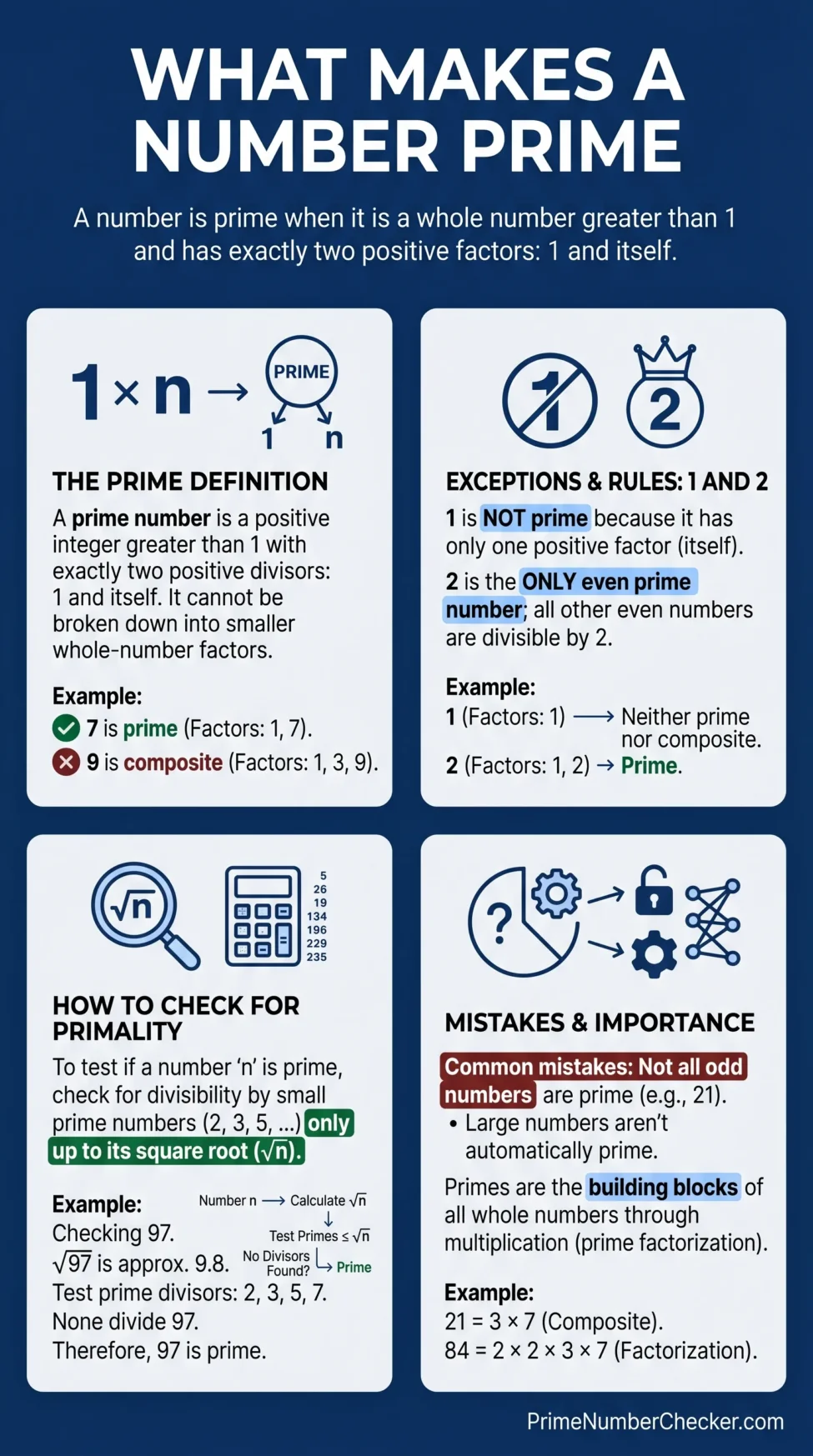 For example, 7 is prime because its only positive factors are 1 and 7. But 9 is not prime because it can be divided by 1, 3, and 9. The extra factor, 3, changes the number from prime to composite.If you want to test a specific value while reading, you can use the prime number checker and then compare the result with the rule explained below.
The Mathematical Definition of a Prime Number
In simple terms, a prime number is a positive integer greater than 1 with exactly two positive divisors.That definition includes three parts:- The number must be a whole number.
- The number must be greater than 1.
- The number must have only two positive factors: 1 and itself.
This is why 2, 3, 5, 7, 11, and 13 are prime numbers. Each one passes the same test. They do not have any positive divisor hiding between 1 and the number itself.Prime numbers are not defined by size. They are defined by factor structure. A small number can be composite, and a large number can be prime.Why Having Exactly Two Factors Matters
The word prime is about division. A prime number cannot be broken into smaller whole-number factors, except by using 1 and the number itself.Take 13. You can write it as:13 = 1 × 13There is no way to write 13 as a product of two smaller positive whole numbers greater than 1. That makes 13 prime.Now compare it with 15:15 = 3 × 5Because 15 can be made from 3 and 5, it is composite. It has more than two positive factors: 1, 3, 5, and 15.This difference is small, but it matters. Prime numbers are the numbers that cannot be factored into smaller positive integers other than 1 and themselves.Prime, Composite, and Neither
Most confusion comes from numbers near the start of the number line. The rule is clean once you separate prime, composite, and neither.How common number types fit the prime number rule| Number | Status | Reason |
|---|
| 1 | Neither prime nor composite | It has only one positive factor. |
| 2 | Prime | Its only positive factors are 1 and 2. |
| 4 | Composite | It has 1, 2, and 4 as factors. |
| 9 | Composite | It is divisible by 3. |
| 17 | Prime | It has no positive divisor except 1 and 17. |
Why 1 Is Not Prime
1 is not prime because it does not have exactly two positive factors. It has only one: itself.This may feel like a small exception, but it keeps factorization clean. Every whole number greater than 1 can be written as a product of primes in one basic way, apart from the order of the factors. If 1 were treated as prime, that idea would become messy because you could keep adding extra 1s forever.For example:12 = 2 × 2 × 3If 1 were prime, you could also write:12 = 1 × 2 × 2 × 3Or:12 = 1 × 1 × 1 × 2 × 2 × 3That would damage the clean structure of prime factorization. So 1 is kept outside both groups: it is neither prime nor composite.Why 2 Is the Only Even Prime Number
2 is prime because its only positive factors are 1 and 2. It is also the only even prime number.Every other even number is divisible by 2. That means every even number greater than 2 has at least three positive factors: 1, 2, and itself. So it cannot be prime.Examples:- 6 is not prime because 6 = 2 × 3.
- 10 is not prime because 10 = 2 × 5.
- 28 is not prime because 28 = 2 × 14.
This gives a fast first check: if a number is even and greater than 2, it is composite.How to Tell If a Number Is Prime
To know whether a number is prime, you test whether it has a divisor other than 1 and itself. For small numbers, this is easy by mental math. For larger numbers, you need a cleaner method.Start With Small Divisors
First check simple divisibility:- Is the number even?
- Does it end in 5 or 0?
- Is the sum of its digits divisible by 3?
These checks quickly remove many composite numbers. For example, 57 is not prime because 5 + 7 = 12, and 12 is divisible by 3. So 57 is divisible by 3.Only Test Up to the Square Root
You do not need to test every smaller number. To test whether n is prime, it is enough to check possible divisors up to √n.Here is why: if a number has a factor larger than its square root, the matching factor must be smaller than its square root. So if no divisor appears up to √n, no larger divisor can appear later.Example: to test 97, note that √97 is a little less than 10. You only need to test prime divisors up to 10: 2, 3, 5, and 7. Since none of them divides 97, the number is prime.Test Prime Divisors, Not Every Number
Once you understand the pattern, testing becomes cleaner. You do not need to test 4, 6, 8, or 9 if you already tested 2 and 3. Composite divisors are built from smaller prime divisors.For a number like 131, √131 is between 11 and 12. You only need to test 2, 3, 5, 7, and 11. Since none divides 131 evenly, 131 is prime.Common Mistakes About Prime Numbers
“Odd” Does Not Mean Prime
All prime numbers greater than 2 are odd, but not every odd number is prime. This is a common mistake.21 is odd, but it is not prime because 21 = 3 × 7. 25 is odd, but it is not prime because 25 = 5 × 5.Large Numbers Are Not Automatically Prime
A number can look hard to divide and still be composite. For example, 221 may look prime at first, but it is not. It equals 13 × 17.This is why checking a large number by sight is risky. A factor may not be obvious.Negative Numbers Are Not Prime in the Usual Definition
In standard school and number theory use, prime numbers are positive integers greater than 1. So -5 is not treated as prime in this setting, even though it relates to 5 through multiplication by -1.Zero Is Not Prime
0 is not prime. It is divisible by many positive integers and does not fit the “exactly two positive factors” rule.Why Prime Numbers Matter
Prime numbers matter because they explain how whole numbers break apart under multiplication. Every composite number greater than 1 can be factored into primes.For example:84 = 2 × 2 × 3 × 7This prime factorization shows the hidden structure of 84. It tells you which prime numbers combine to create it.Prime numbers also appear in many areas of mathematics and computing. They are used in divisibility, greatest common factors, least common multiples, modular arithmetic, random-looking patterns, and public-key cryptography. The basic definition is simple, but the behavior of primes becomes deep very quickly.That contrast is part of what makes prime numbers special: the rule is short, yet the pattern is not easy to predict.A Short Historical Note
Prime numbers have been studied for more than two thousand years. Euclid showed that there are infinitely many primes. His idea is still admired because it uses plain logic rather than heavy notation.The rough idea is this: if you think you have listed all primes, multiply them together and add 1. The new number will not be divisible by any prime in your list. That means either the new number is prime, or it has a prime factor missing from the list.So the primes never run out. There is always another one somewhere further along the number line.Examples of Prime and Composite Numbers
Seeing several examples side by side helps the rule feel less abstract.Prime and composite examples with short explanations| Number | Prime? | Explanation |
|---|
| 11 | Yes | Only divisible by 1 and 11. |
| 18 | No | Divisible by 2, 3, 6, and 9. |
| 29 | Yes | No divisor other than 1 and 29. |
| 49 | No | 49 = 7 × 7. |
| 101 | Yes | Not divisible by 2, 3, 5, or 7. |
The Clean Test for Primality
A number is prime if it survives every valid divisor test up to its square root. That is the practical form of the definition.For a number n greater than 1:- If n = 2, it is prime.
- If n is even and greater than 2, it is composite.
- If no prime number up to √n divides it evenly, it is prime.
This is the reason a prime checker can give a fast answer. It does not need to divide by every number below n. It only needs to test enough possible divisors to prove whether another factor exists.Prime means “no extra whole-number factor.” Once you understand that, the rule becomes much easier to use.FAQ About What Makes a Number Prime
What makes a number prime?
A number is prime when it is a whole number greater than 1 and has exactly two positive factors: 1 and itself.
Why is 1 not a prime number?
1 is not prime because it has only one positive factor. A prime number must have exactly two positive factors.
Is 2 a prime number?
Yes. 2 is prime because its only positive factors are 1 and 2. It is also the only even prime number.
Can an odd number be composite?
Yes. Odd numbers such as 9, 15, 21, and 25 are composite because they have factors other than 1 and themselves.
How do you check if a number is prime?
Check whether it has any divisor other than 1 and itself. For a cleaner test, check prime divisors only up to the square root of the number.