
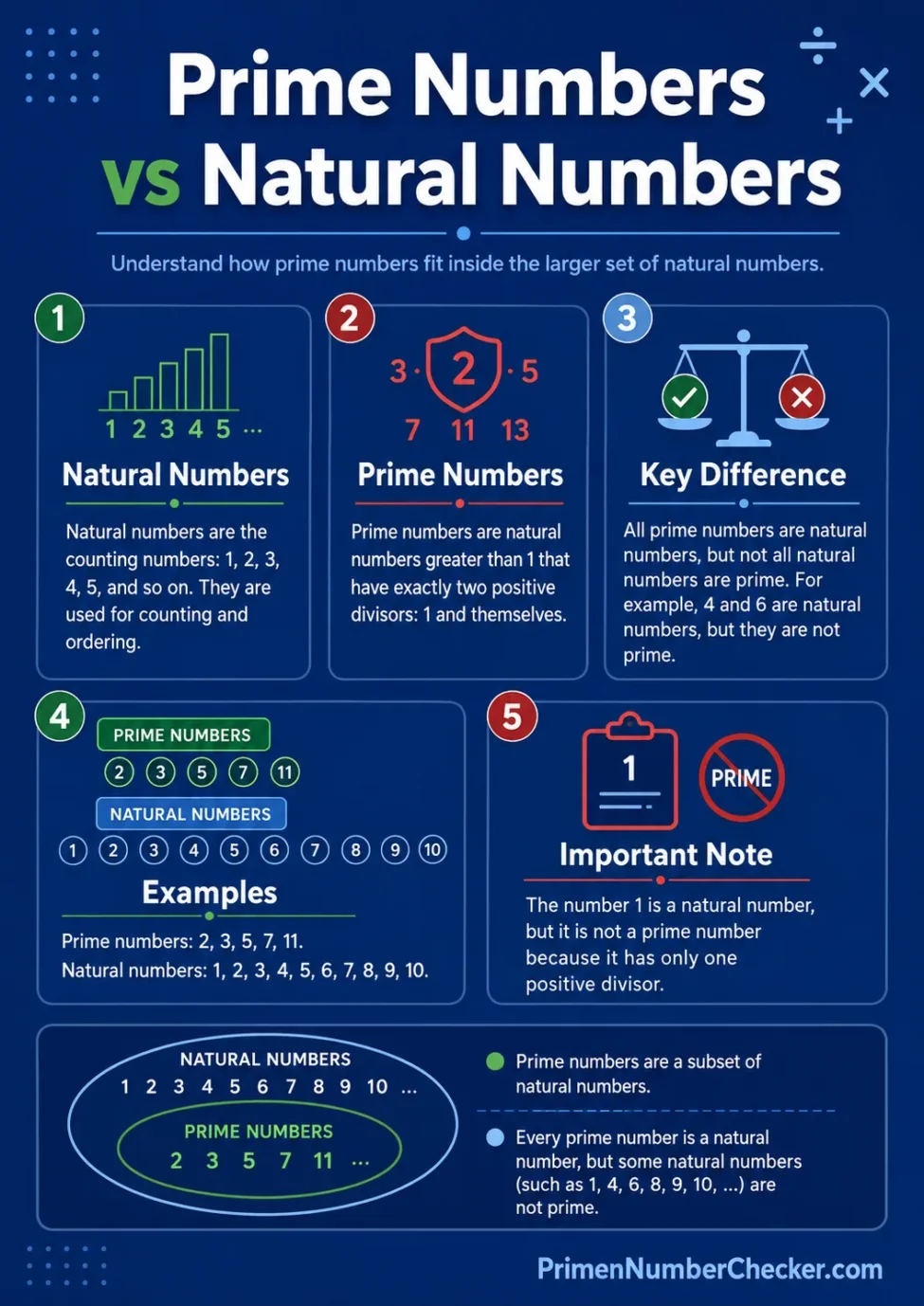
Natural numbers are the counting numbers, while prime numbers are a special group inside the natural numbers. In simple terms, every prime number is a natural number, but not every natural number is prime.
The difference is not only about naming. Natural numbers describe quantity and order. Prime numbers describe a stricter idea: a number that can be divided evenly only in a very limited way.
| Concept | Basic meaning | Examples |
|---|---|---|
| Natural numbers | Numbers used for counting | 1, 2, 3, 4, 5, 6, … |
| Prime numbers | Natural numbers greater than 1 with exactly two positive divisors | 2, 3, 5, 7, 11, 13, … |
What Are Natural Numbers?
Natural numbers are the numbers we use when we count objects. If you count apples, pages, steps, or students, you normally use natural numbers: 1, 2, 3, 4, 5, and so on.
In many school settings, the natural numbers start at 1. In some areas of mathematics and computer science, 0 is also included. Because of this, you may see two common versions:
- Positive natural numbers: 1, 2, 3, 4, 5, …
- Whole-number style natural numbers: 0, 1, 2, 3, 4, 5, …
For prime numbers, this difference does not cause a problem. 0 and 1 are not prime numbers, so primes always begin later in the natural number list.
What Are Prime Numbers?
A prime number is a natural number greater than 1 that has exactly two positive divisors: 1 and itself.
For example, 7 is prime because the only positive numbers that divide 7 evenly are 1 and 7. But 8 is not prime because it can be divided evenly by 1, 2, 4, and 8.
This gives prime numbers a special role. They are not just counting numbers. They are numbers with a strict divisor pattern.
The first prime numbers
The first few prime numbers are:
2, 3, 5, 7, 11, 13, 17, 19, 23, 29
Notice that 2 is the only even prime number. Every even number greater than 2 can be divided by 2, so it has more than two positive divisors.
The Main Difference
The main difference is this: natural numbers form a broad counting set, while prime numbers form a filtered subset of that set.
Natural numbers answer the question, “How many?” Prime numbers answer a more specific question: “Does this counting number have exactly two positive divisors?”
| Number | Natural number? | Prime number? | Why? |
|---|---|---|---|
| 0 | Sometimes included | No | Prime numbers must be greater than 1 |
| 1 | Yes | No | It has only one positive divisor |
| 2 | Yes | Yes | Its only positive divisors are 1 and 2 |
| 4 | Yes | No | It has divisors 1, 2, and 4 |
| 11 | Yes | Yes | Its only positive divisors are 1 and 11 |
Why Every Prime Number Is Natural
A prime number must first be a number that can be counted. That places it inside the natural numbers. But it must also pass an extra test: it must be greater than 1 and have exactly two positive divisors.
So the relationship looks like this:
Natural numbers contain prime numbers, composite numbers, and special cases such as 1.
Prime numbers are not a separate number system. They are a more selective part of the natural numbers.
Why Not Every Natural Number Is Prime
Many natural numbers have more than two positive divisors. These are called composite numbers.
For example:
- 6 is natural, but not prime. It has divisors 1, 2, 3, and 6.
- 9 is natural, but not prime. It has divisors 1, 3, and 9.
- 12 is natural, but not prime. It has divisors 1, 2, 3, 4, 6, and 12.
These examples show the real divide. Natural numbers are about membership in a counting sequence. Prime numbers are about divisor structure.
The Role of 1
The number 1 is often the point where users get confused. It is a natural number, but it is not a prime number.
The reason is simple: a prime number must have exactly two positive divisors. The number 1 has only one positive divisor, which is 1 itself.
This rule also keeps prime factorization clean. If 1 were treated as prime, factorizations could be written in endless ways, such as 6 = 2 × 3, 6 = 1 × 2 × 3, or 6 = 1 × 1 × 2 × 3. Excluding 1 keeps the structure clear.
Prime Numbers, Composite Numbers, and Natural Numbers
Once natural numbers are greater than 1, they fall into two main groups: prime numbers and composite numbers.
- Prime numbers have exactly two positive divisors.
- Composite numbers have more than two positive divisors.
This is why 2 is prime, 4 is composite, and 1 is neither prime nor composite.
| Group | Divisor rule | Examples |
|---|---|---|
| Neither prime nor composite | Does not fit either rule | 1 |
| Prime numbers | Exactly two positive divisors | 2, 3, 5, 7 |
| Composite numbers | More than two positive divisors | 4, 6, 8, 9 |
How to Tell If a Natural Number Is Prime
To decide whether a natural number is prime, check whether it has any divisor other than 1 and itself. A practical method is to test divisibility only up to the square root of the number.
For example, to test 31, you do not need to divide it by every smaller number. Since the square root of 31 is a little more than 5, you only need to check possible prime divisors up to 5: 2, 3, and 5. None divide 31 evenly, so 31 is prime.
This is the idea behind many prime checking tools. You can test any number directly with the Prime Number Checker and then use the result to understand whether that natural number is prime, composite, or outside the prime range.
Why This Difference Matters
The difference between prime numbers and natural numbers matters because they do different jobs in mathematics.
Natural numbers give us the basic language of counting. Prime numbers help explain how numbers are built through multiplication. Every integer greater than 1 can be broken into prime factors in one exact way, apart from the order of the factors.
For example:
- 12 breaks into 2 × 2 × 3
- 18 breaks into 2 × 3 × 3
- 45 breaks into 3 × 3 × 5
This is why primes appear in number theory, divisibility, fractions, least common multiples, greatest common divisors, and modern cryptography. They reveal the multiplication structure hidden inside natural numbers.
Simple Visual Way to Think About It
Think of natural numbers as the full counting line:
1, 2, 3, 4, 5, 6, 7, 8, 9, 10, 11, 12, …
Prime numbers are selected from that line:
2, 3, 5, 7, 11, 13, 17, 19, …
So a prime number is not “more natural” than another number. It simply has a special divisor pattern.
Common Misunderstandings
“All odd natural numbers are prime”
This is false. Many odd numbers are composite. For example, 9, 15, 21, and 25 are odd, but each has more than two positive divisors.
“All prime numbers are odd”
This is also false. 2 is prime and even. It is the only even prime number.
“1 is prime because it divides itself”
A prime number must have exactly two positive divisors. Since 1 has only one, it is not prime.
“Natural numbers and prime numbers are the same type of list”
They are related, but not the same. Natural numbers are a broad counting set. Prime numbers are a narrower group chosen by a divisor rule.
Prime Numbers vs Natural Numbers in One Sentence
Natural numbers are used for counting, while prime numbers are natural numbers greater than 1 that can be divided evenly only by 1 and themselves.
That one sentence captures the relationship: primes belong to the natural numbers, but they follow a much stricter rule.
FAQ
Are prime numbers natural numbers?
Yes. Every prime number is a natural number because primes are counting numbers greater than 1. However, only some natural numbers are prime.
Are natural numbers prime numbers?
Some natural numbers are prime, but many are not. For example, 2, 3, and 5 are prime, while 1, 4, 6, and 9 are not prime.
Is 1 a prime number or a natural number?
1 is a natural number in the usual counting-number definition, but it is not a prime number. It has only one positive divisor.
Is 0 a natural number?
It depends on the convention being used. Some definitions include 0 as a natural number, while others start natural numbers at 1. In either case, 0 is not prime.
What is the smallest prime number?
The smallest prime number is 2. It is also the only even prime number.
What is the smallest natural number?
In many school definitions, the smallest natural number is 1. In some mathematical settings, 0 is included as the first natural number.
What is the difference between prime and composite numbers?
A prime number has exactly two positive divisors. A composite number has more than two positive divisors. Both are natural numbers greater than 1.