The prime numbers from 1 to 100 are 2, 3, 5, 7, 11, 13, 17, 19, 23, 29, 31, 37, 41, 43, 47, 53, 59, 61, 67, 71, 73, 79, 83, 89, and 97.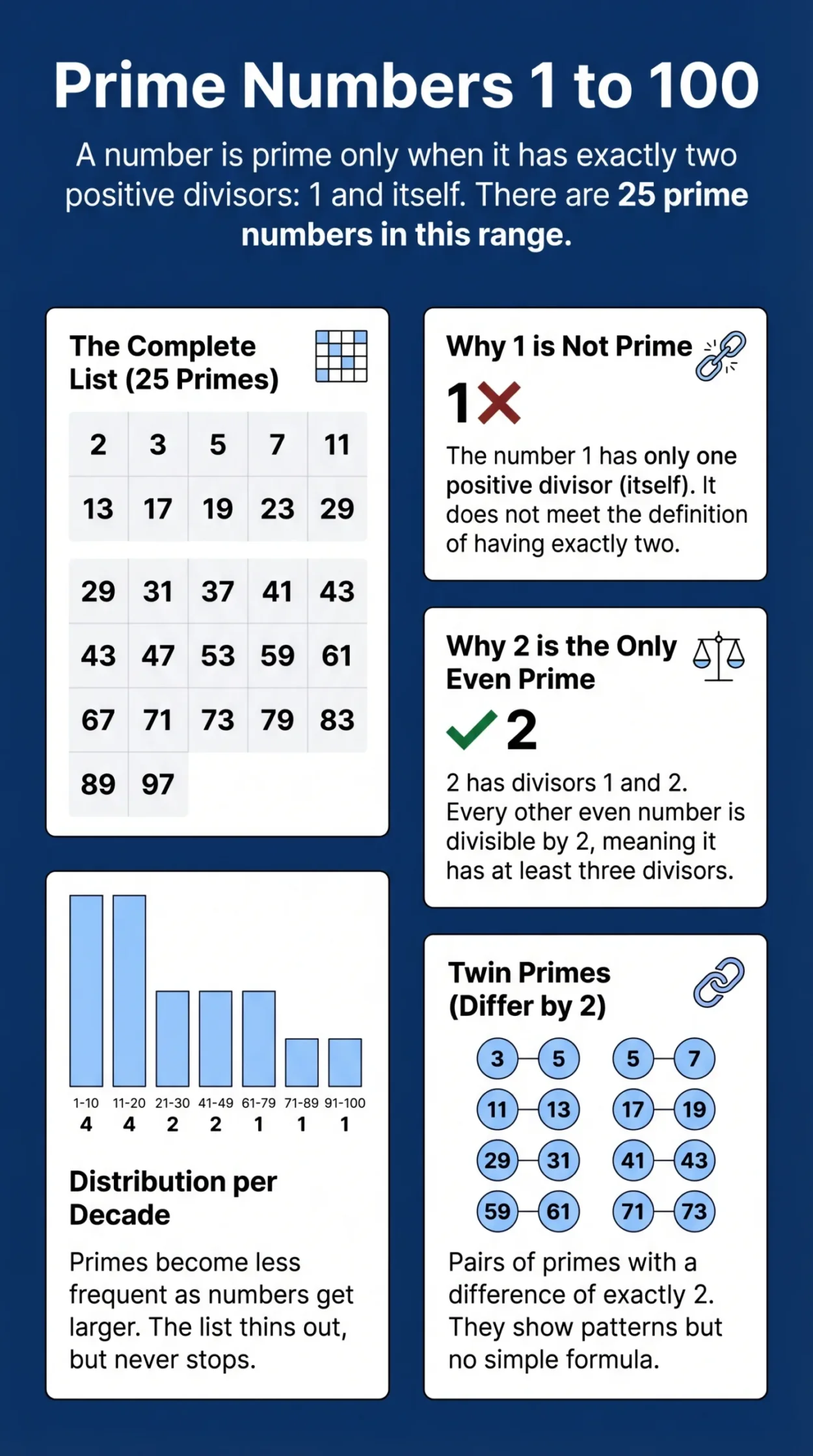
Most pages about this topic stop at the list. That is useful, but it leaves out the reason. A number is prime only when it has exactly two positive divisors: 1 and itself. Nothing more. Nothing less.That simple rule explains the full list from 1 to 100. It also explains why 1 does not belong on the list. The number 1 has only one positive divisor, so it does not meet the definition.There are 25 prime numbers in this range. 1 is not a prime number, and 2 is the only even prime number.
To test any number outside this list, use the Prime Number Checker.What Makes a Number Prime
A prime number cannot be broken into smaller whole-number factors other than 1 and the number itself. For example, 13 is prime because only 1 and 13 divide it exactly. By contrast, 15 is composite because 3 and 5 also divide it.This is the clean split:- Prime numbers have exactly two positive divisors.
- Composite numbers have more than two positive divisors.
- 1 is neither prime nor composite.
Quick example: 7 is prime because its only exact divisors are 1 and 7. 9 is not prime because 3 divides it evenly.
Prime Numbers from 1 to 100 by Range
The full list becomes easier to scan when grouped into smaller intervals. This also shows how primes spread out across the number line. They do not appear at regular steps.| Range | Prime Numbers |
|---|---|
| 1 to 10 | 2, 3, 5, 7 |
| 11 to 20 | 11, 13, 17, 19 |
| 21 to 30 | 23, 29 |
| 31 to 40 | 31, 37 |
| 41 to 50 | 41, 43, 47 |
| 51 to 60 | 53, 59 |
| 61 to 70 | 61, 67 |
| 71 to 80 | 71, 73, 79 |
| 81 to 90 | 83, 89 |
| 91 to 100 | 97 |
Why 1 Is Not Prime
This question comes up often, and for good reason. The number 1 feels special. But in number theory, special does not mean prime.A prime number must have two positive divisors. The number 1 has only one. That is why mathematicians keep it outside the prime list. This is not a small technical detail. It keeps prime factorization clean and consistent.Every whole number greater than 1 can be written as a product of prime numbers in one clear way, apart from order. That rule works neatly only when 1 is excluded from the prime set.Why 2 Is the Only Even Prime
The number 2 is prime because it has exactly two positive divisors: 1 and 2. Every other even number is divisible by 2 and by itself, which means it already has at least three divisors when the number is greater than 2.So after 2, every prime number is odd. Still, not every odd number is prime. Numbers like 9, 15, 21, 25, 27, and 35 are odd, but each has extra factors.
Patterns You Can See in the 1 to 100 List
Even a short list of primes reveals a lot. Prime numbers do not follow a simple repeating pattern, yet they are not random noise either. They have structure, but that structure takes work to see.Primes get less frequent
There are many primes early on, but the gaps slowly widen. Between 1 and 20, primes appear often. Near 100, they are a bit more spread out. The list thins out, but it never fully stops. More than two thousand years ago, Euclid showed that there is no final prime number.Prime gaps change
The distance between one prime and the next is called a prime gap. Sometimes the gap is 2, sometimes 4, sometimes 6, and it keeps shifting.- Between 11 and 13, the gap is 2.
- Between 23 and 29, the gap is 6.
- Between 89 and 97, the gap is 8.
Twin primes under 100
Twin primes are pairs of primes that differ by 2. This list includes several of them: 3 and 5, 5 and 7, 11 and 13, 17 and 19, 29 and 31, 41 and 43, 59 and 61, 71 and 73.These pairs are one reason prime numbers stay interesting even in small ranges. You can spot patterns, but you cannot reduce them to one easy formula.How Numbers Under 100 Are Checked for Primality
For numbers up to 100, the logic is shorter than many people expect. You do not need to test every smaller number. You only need to check divisibility up to the square root of the number.For example, the square root of 97 is a little under 10. That means checking 2, 3, 5, and 7 is enough. Since none of those divides 97, 97 is prime.Why this works: factors come in pairs. If a number has a factor larger than its square root, the matching factor must be smaller than the square root. So one side of the pair always appears early.
This idea matters far beyond the 1 to 100 list. It is one of the basic ideas behind primality testing, factor search, and many prime number tools.Common Mistakes With Prime Numbers 1 to 100
These mistakes appear all the time:
- Treating 1 as prime. It is not.
- Thinking all odd numbers are prime. They are not. Many odd numbers are composite.
- Forgetting hidden factors. For example, 91 may look prime at first, but 91 = 7 × 13.
- Assuming prime numbers follow a fixed step pattern. They do not.