There are 168 prime numbers from 1 to 1000. The list starts with 2, 3, 5, 7 and ends with 991, 997. Just as important, 1 is not a prime number.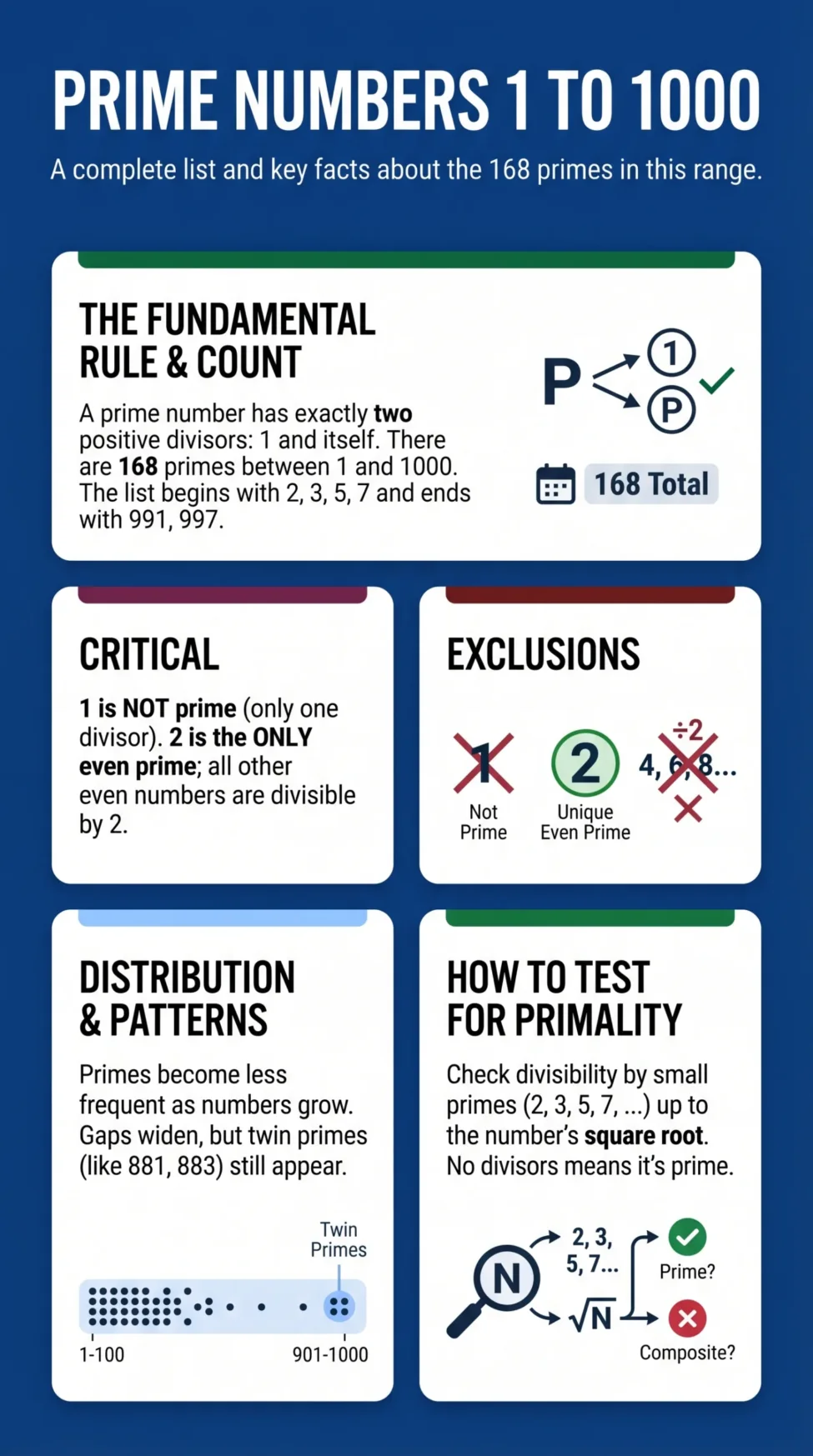 Most people looking for this topic want the full list first. After that, the real value comes from understanding why these numbers are prime, why 1 is excluded, and what patterns appear inside the list. For a quick yes-or-no check on any number outside the range, the Prime Number Checker fits naturally with this page.
Most people looking for this topic want the full list first. After that, the real value comes from understanding why these numbers are prime, why 1 is excluded, and what patterns appear inside the list. For a quick yes-or-no check on any number outside the range, the Prime Number Checker fits naturally with this page.Prime numbers from 1 to 1000
A prime number is a whole number greater than 1 that has exactly two positive divisors: 1 and itself. That simple rule produces the full list below.1 to 100
2, 3, 5, 7, 11, 13, 17, 19, 23, 29, 31, 37, 41, 43, 47, 53, 59, 61, 67, 71, 73, 79, 83, 89, 97101 to 200
101, 103, 107, 109, 113, 127, 131, 137, 139, 149, 151, 157, 163, 167, 173, 179, 181, 191, 193, 197, 199201 to 300
211, 223, 227, 229, 233, 239, 241, 251, 257, 263, 269, 271, 277, 281, 283, 293301 to 400
307, 311, 313, 317, 331, 337, 347, 349, 353, 359, 367, 373, 379, 383, 389, 397401 to 500
401, 409, 419, 421, 431, 433, 439, 443, 449, 457, 461, 463, 467, 479, 487, 491, 499501 to 600
503, 509, 521, 523, 541, 547, 557, 563, 569, 571, 577, 587, 593, 599601 to 700
601, 607, 613, 617, 619, 631, 641, 643, 647, 653, 659, 661, 673, 677, 683, 691701 to 800
701, 709, 719, 727, 733, 739, 743, 751, 757, 761, 769, 773, 787, 797801 to 900
809, 811, 821, 823, 827, 829, 839, 853, 857, 859, 863, 877, 881, 883, 887901 to 1000
907, 911, 919, 929, 937, 941, 947, 953, 967, 971, 977, 983, 991, 997Quick facts: 2 is the smallest prime, 997 is the largest prime below 1000, and the prime-counting value for this range is π(1000) = 168.
Prime count by 100-number range
The list is not evenly spread. As numbers get larger, primes still keep appearing, but they become more spaced out. That is one reason these counts slowly drift downward.| Range | Number of primes |
|---|---|
| 1 to 100 | 25 |
| 101 to 200 | 21 |
| 201 to 300 | 16 |
| 301 to 400 | 16 |
| 401 to 500 | 17 |
| 501 to 600 | 14 |
| 601 to 700 | 16 |
| 701 to 800 | 14 |
| 801 to 900 | 15 |
| 901 to 1000 | 14 |
| Total | 168 |
Why these numbers are prime
The definition is strict
A number is prime only when it has exactly two positive divisors. That means:- 2 is prime because it is divisible only by 1 and 2.
- 13 is prime because it is divisible only by 1 and 13.
- 15 is not prime because it is divisible by 1, 3, 5, and 15.
Why 1 is not a prime number
This is one of the most common points of confusion. The number 1 has only one positive divisor, which is 1 itself. A prime number must have two. So 1 does not belong in the list.That rule keeps the structure of number theory clean. If 1 were prime, prime factorization would stop being unique in the usual sense. For example, 14 could be written as 2 × 7, but also as 1 × 2 × 7, or 1 × 1 × 2 × 7, with no real end. Excluding 1 keeps prime factorization stable and useful.Important: 1 is neither prime nor composite. It sits outside both groups.
Why 2 is the only even prime
Every even number greater than 2 is divisible by 2, so it has at least three positive divisors: 1, 2, and itself. That is enough to make it composite. So 2 is the only even prime.This small fact is useful when scanning a list. Once 2 is handled, every other prime in the range must be odd. That does not mean every odd number is prime. For example, 9, 15, 21, 25, and 27 are all odd, but each has extra divisors.Patterns inside the list
Most primes end in 1, 3, 7, or 9
Any whole number greater than 10 that ends in 0, 2, 4, 5, 6, or 8 cannot be prime. It will be divisible by 2 or 5. That leaves 1, 3, 7, and 9 as the only possible last digits for primes above 10.Still, a last digit alone proves nothing. The number 91 ends in 1, but it is not prime because 91 = 7 × 13. The number 121 ends in 1 too, yet 121 = 11 × 11.Prime numbers thin out as numbers grow
Between 1 and 100 there are 25 primes. Between 901 and 1000 there are 14. The list does not dry up, but the gaps tend to get wider. This is why a short list near 100 feels dense while the same length near 1000 feels more spread out.Twin primes still appear below 1000
Twin primes are pairs of primes that differ by 2, such as 3 and 5, 11 and 13, 17 and 19, and 29 and 31. They keep showing up throughout this range, including later pairs like 809 and 811 and 881 and 883.These pairs help connect a simple list to a wider topic in number theory. A page like this is often the first place where users notice that primes are not random noise. They follow patterns, but not simple ones.Prime gaps change size
The difference between one prime and the next is called a prime gap. Sometimes the next prime comes quickly, as with 101 and 103. Sometimes the gap is much wider, as with 887 and 907.That changing rhythm is part of what makes the list interesting. Prime numbers are not evenly spaced, and that uneven spacing becomes easier to see once the range gets larger.How a list like this is built
The sieve idea
A classic way to generate prime numbers is the Sieve of Eratosthenes. Start with the whole number list, then cross out multiples of 2, 3, 5, 7, and so on. The numbers left behind are prime.That method shows something important: prime numbers are not found by guessing. They appear after composite numbers are removed by divisibility rules.Why checking divisors only up to the square root works
To test whether a number is prime, it is enough to check divisibility up to its square root. That is because any factor larger than the square root would need a partner smaller than the square root.For example, the square root of 997 is a little over 31. So to test whether 997 is prime, it is enough to check prime divisors up to 31: 2, 3, 5, 7, 11, 13, 17, 19, 23, 29, and 31. None divide 997, so 997 is prime.This is exactly where a tool becomes useful. A manual list is great for reference, but a checker is faster when the number is outside the page or when quick verification matters.How this list connects to other prime topics
Prime factorization
Every composite number greater than 1 can be written as a product of primes. For example, 84 = 2 × 2 × 3 × 7. That makes a prime list more than a lookup table. It is also a clean starting point for factor trees, greatest common factor work, and divisibility questions.Composite numbers
If a number in the 1 to 1000 range does not appear in the list and is greater than 1, it is composite. That simple contrast helps students and casual users sort numbers very quickly. It also explains why prime checkers and factor tools belong side by side on the same site.Modern math and computing
Small primes are often used for teaching, pattern spotting, and divisibility work. Much larger primes show up in areas like encryption and modular arithmetic. The range from 1 to 1000 is small enough to explore by hand, but rich enough to show the ideas that continue far beyond it.Common mistakes people make with prime numbers
- Counting 1 as prime. It is not prime.
- Thinking all odd numbers are prime. Numbers like 9, 21, 27, and 91 show why that fails.
- Using the last digit as proof. Ending in 1, 3, 7, or 9 only keeps a number in the running.
- Forgetting that primes must be whole numbers greater than 1. Zero, one, negatives, and decimals do not belong in the prime list.