Short answer: 1 is not a prime number.
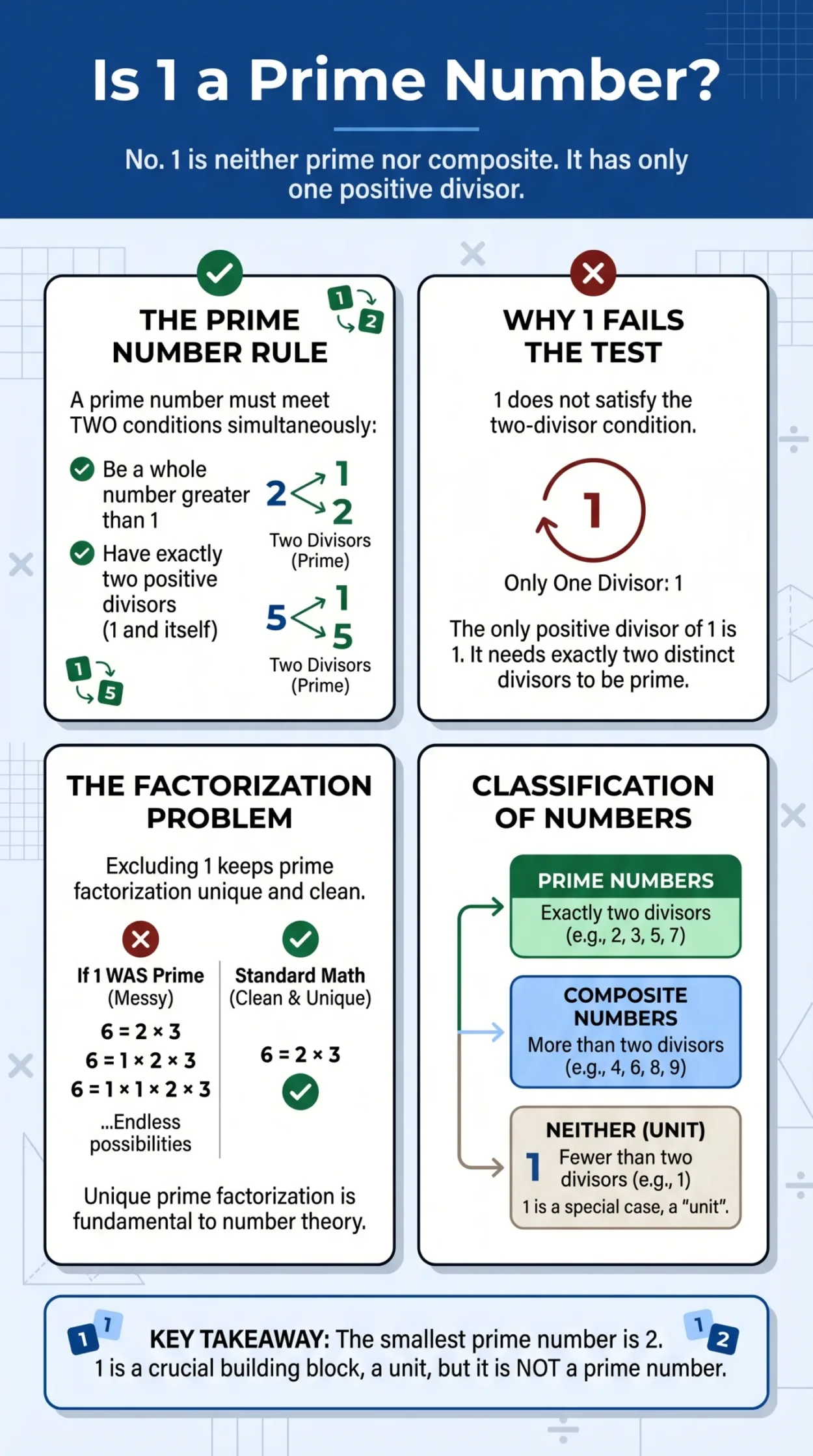
A prime number must have exactly two positive divisors: 1 and itself. The number 1 has only one positive divisor, so it does not meet the definition.
Want to test other numbers the same way? Use the Prime Number Checker to see whether a number is prime and how the result is decided.
Why 1 Is Not Prime
The rule is simple, but the reason matters.A prime number is a whole number greater than 1 that can be divided evenly by only two positive numbers: 1 and the number itself. That definition leaves no room for 1.1 is greater than 0, but it is not greater than 1. Even if you only look at divisors, it still fails. The number 1 can be divided evenly only by 1. That gives it one positive divisor, not two.So the classification is clear: 1 is neither prime nor composite.A quick comparison
| Number | Prime? | Reason |
|---|---|---|
| 0 | No | It is not greater than 1 and has many divisors in a different sense. |
| 1 | No | It has only one positive divisor: 1. |
| 2 | Yes | Its only positive divisors are 1 and 2. |
| 4 | No | It has more than two positive divisors: 1, 2, and 4. |
What Makes a Number Prime
Prime numbers follow a very strict rule. A number must meet both conditions below:- It must be a whole number greater than 1.
- It must have exactly two positive divisors.
Prime, composite, and neither
People often learn prime and composite together, but 1 sits outside both groups.- Prime number: exactly two positive divisors
- Composite number: more than two positive divisors
- Neither: fewer than two positive divisors that fit the prime rule, or numbers that do not belong in the prime/composite split
Why Mathematicians Exclude 1
This is where the topic becomes more interesting.Modern mathematics keeps 1 out of the prime list because it makes number theory clean and stable. Prime numbers are used as the basic pieces of multiplication. Every whole number greater than 1 can be written as a product of primes in one fixed way, aside from the order.For example:- 6 = 2 × 3
- 12 = 2 × 2 × 3
- 30 = 2 × 3 × 5
- 6 = 2 × 3
- 6 = 1 × 2 × 3
- 6 = 1 × 1 × 2 × 3
- 6 = 1 × 1 × 1 × 2 × 3
Small but important point: 1 is a unit, not a prime. In arithmetic, a unit is a number that behaves like a neutral multiplier. Multiplying by 1 does not change the value, so it plays a different role from primes.
Why the two-divisor rule works so well
The definition of prime numbers is not random. It is built to match how multiplication works.A prime should behave like an indivisible whole number in multiplication. Once you treat 1 as its own separate case, the rest of the system becomes easier to classify, easier to teach, and easier to use in proofs.So the definition is not just about memorizing a rule. It protects the logic behind factorization.A Short Historical Note
Older math texts were not always perfectly aligned on this point. In some earlier periods, 1 was treated differently, and the definition of prime numbers was less fixed than it is now.That changed as number theory became more formal. Once mathematicians focused on clean prime factorization, excluding 1 became the standard approach. Today, in school math, university math, and modern references, 1 is not prime.Common Confusion Around the Number 1
“It is only divisible by 1 and itself.”
This sentence sounds convincing, but for 1, those are the same number. Prime numbers need two distinct positive divisors in count: 1 and the number itself. For the number 1, that still gives only one divisor.“If 2 is prime, why not 1?”
Because 2 has exactly two positive divisors: 1 and 2. The number 1 has only one.“Is 1 odd?”
Yes. 1 is an odd number. But odd and prime are not the same thing. Many odd numbers are not prime, such as 9, 15, and 21.“Is 1 a factor?”
Yes. 1 is a factor of every whole number. That fact does not make it prime. It only shows that 1 plays a special role in multiplication.How This Connects to Prime Checking Tools
When someone types 1 into a prime checker, the result should not stop at a plain “no.” A good tool should also explain why the answer is no.That matters because users often test edge cases first:- 0
- 1
- 2
- negative numbers
1 in the Prime Number Ecosystem
Even though 1 is not prime, it still matters. It helps define the boundary of the prime system.Once you know that primes start at 2, several ideas become clearer:- The smallest prime number is 2.
- There is no largest prime number.
- Every prime number other than 2 is odd.
- Prime factorization starts with numbers greater than 1.
Related ideas worth knowing
Once this question makes sense, a few nearby topics become easier too:- Prime factorization: breaking a number into prime parts
- Composite numbers: numbers with more than two divisors
- Divisibility: deciding when one number divides another evenly
- Units in arithmetic: numbers like 1 that behave differently from primes
Quick Answer Block
Is 1 a prime number?
No.
A prime number must be greater than 1 and must have exactly two positive divisors. 1 has only one positive divisor, so it is neither prime nor composite.
FAQ
Is 1 a prime number or a composite number?
It is neither. A prime number has exactly two positive divisors. A composite number has more than two. The number 1 has only one positive divisor.
Why does the definition of prime numbers start above 1?
Because excluding 1 keeps prime factorization clean. It prevents endless versions of the same factorization created by multiplying by 1 again and again.
What is the smallest prime number?
The smallest prime number is 2. It is also the only even prime number.
Can a prime checker return “not prime” for 1?
Yes. That is the correct result. A good checker should also explain that 1 is not composite either. It belongs to its own case.