
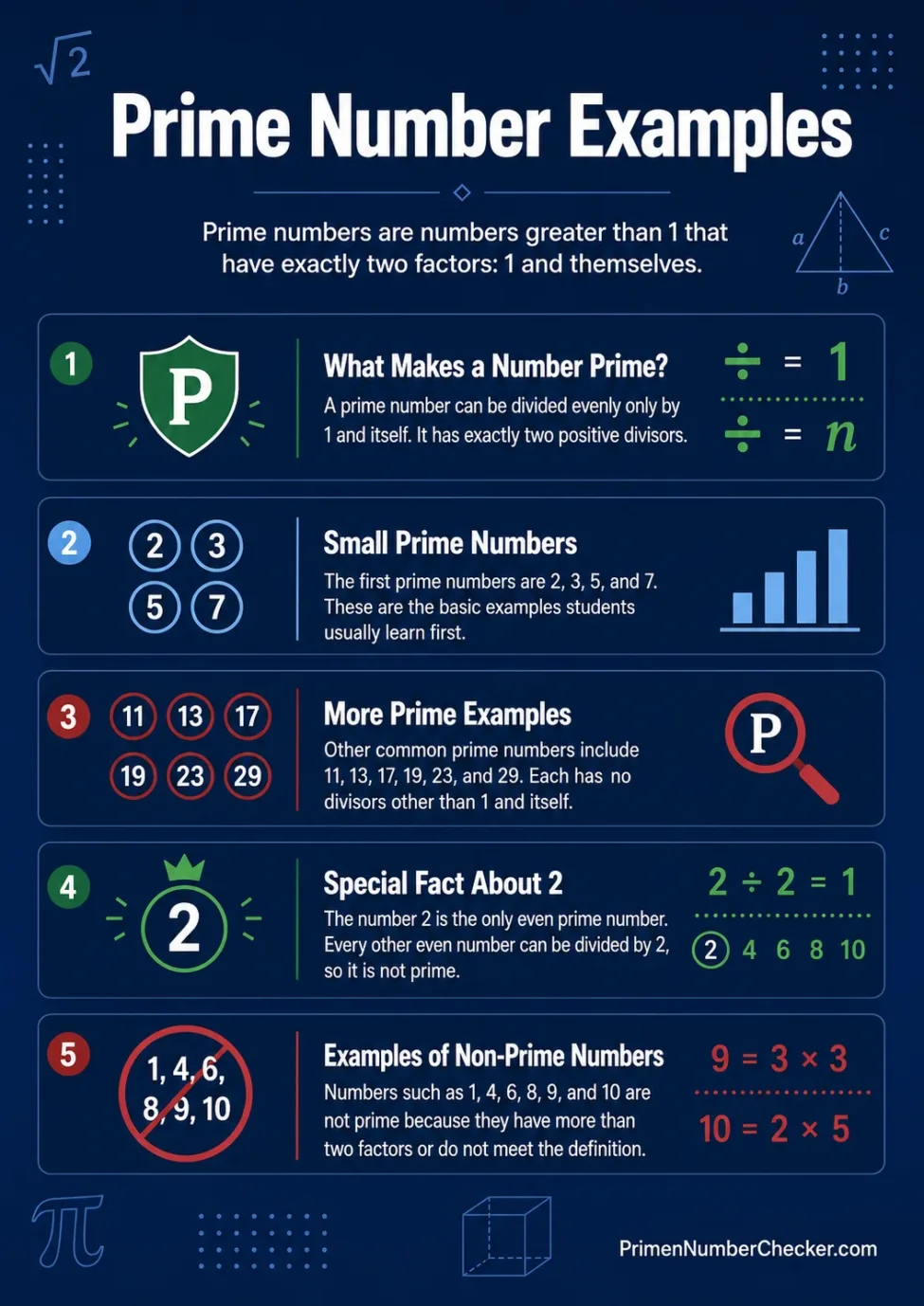
Prime number examples include 2, 3, 5, 7, 11, 13, 17, 19, 23, and 29. A prime number is a whole number greater than 1 that has exactly two positive divisors: 1 and itself.
That definition is simple, but examples make it easier to see what prime numbers really do. A prime is not just a number that “looks indivisible.” It must fail every possible whole-number division except division by 1 and by itself.
Prime Number Examples from Small Numbers
The first prime numbers are the easiest place to start because you can test them by hand. Each number below has only two positive divisors, so each one is prime.
A short list of prime number examples is:
2, 3, 5, 7, 11, 13, 17, 19, 23, 29, 31, 37, 41, 43, 47
These examples also show a useful pattern: after 2, every prime number is odd. That does not mean every odd number is prime. For example, 9, 15, 21, and 25 are odd, but they are not prime.
Why These Numbers Are Prime
A number is prime when it cannot be split into a multiplication of two smaller whole numbers greater than 1. For example, 13 is prime because there is no whole-number pair such as 2 × something, 3 × something, or 4 × something that equals 13.
By contrast, 15 is not prime because 15 = 3 × 5. Once a number has a divisor other than 1 and itself, it becomes a composite number.
Simple rule: a prime number has exactly two positive divisors. A composite number has more than two. The number 1 has only one positive divisor, so it is neither prime nor composite.
Prime Examples and Non-Examples
Seeing prime numbers beside non-prime numbers helps prevent a common mistake: judging by appearance. Some numbers look prime but are not. Others look ordinary but are prime.
| Number | Prime? | Reason |
|---|---|---|
| 2 | Yes | Only divisible by 1 and 2. |
| 9 | No | 9 = 3 × 3, so it has a divisor other than 1 and itself. |
| 17 | Yes | No whole number greater than 1 and less than 17 divides it evenly. |
| 21 | No | 21 = 3 × 7. |
| 29 | Yes | It is not divisible by 2, 3, or 5. |
| 49 | No | 49 = 7 × 7. |
The First 100 Prime Numbers
Here are the first 100 prime numbers. This list is useful for learning patterns, checking factorization, or testing whether a number appears early in the prime sequence.
2, 3, 5, 7, 11, 13, 17, 19, 23, 29, 31, 37, 41, 43, 47, 53, 59, 61, 67, 71, 73, 79, 83, 89, 97, 101, 103, 107, 109, 113, 127, 131, 137, 139, 149, 151, 157, 163, 167, 173, 179, 181, 191, 193, 197, 199, 211, 223, 227, 229, 233, 239, 241, 251, 257, 263, 269, 271, 277, 281, 283, 293, 307, 311, 313, 317, 331, 337, 347, 349, 353, 359, 367, 373, 379, 383, 389, 397, 401, 409, 419, 421, 431, 433, 439, 443, 449, 457, 461, 463, 467, 479, 487, 491, 499, 503, 509, 521, 523, 541
Notice the gaps between primes. Sometimes primes sit close together, such as 11 and 13. Sometimes the gap is larger, such as 89 and 97. Prime numbers do not follow a simple repeating pattern, which is one reason they remain so useful in number theory.
Different Types of Prime Number Examples
Prime numbers can be grouped in different ways. These groups help students and readers move beyond memorizing a list.
Single-Digit Prime Numbers
The single-digit prime numbers are 2, 3, 5, and 7.
There are only four of them. The numbers 0 and 1 are not prime, 4, 6, and 8 are even composite numbers, and 9 equals 3 × 3.
Two-Digit Prime Numbers
Examples of two-digit prime numbers include 11, 13, 17, 19, 23, 29, 31, 37, 41, 43, 47, 53, 59, 61, 67, 71, 73, 79, 83, 89, and 97.
Two-digit primes are useful because they are large enough to show real prime behavior but still small enough to test by hand.
Odd Prime Numbers
Every prime number except 2 is odd. Examples are 3, 5, 7, 11, 13, 17, 19, and 23.
This happens because every even number greater than 2 is divisible by 2. So an even number greater than 2 always has at least three divisors: 1, 2, and itself.
Twin Prime Examples
Twin primes are pairs of prime numbers with a difference of 2. Examples include 3 and 5, 5 and 7, 11 and 13, and 17 and 19.
Twin primes are a natural next step after learning basic prime examples because they show how primes can appear close together.
Prime Square Non-Examples
Numbers such as 4, 9, 25, 49, and 121 are not prime. Each one is the square of a prime number:
- 4 = 2 × 2
- 9 = 3 × 3
- 25 = 5 × 5
- 49 = 7 × 7
- 121 = 11 × 11
This is a helpful warning. A number can be made from a prime and still not be prime itself.
How to Tell If an Example Is Prime
To test a number, divide it by smaller prime numbers. If one divides evenly, the number is not prime. If none of the needed smaller primes divide it evenly, the number is prime.
You do not need to test every smaller number. You only need to test prime divisors up to the square root of the number. For example, to test 97, the square root is a little less than 10. So you only need to check divisibility by 2, 3, 5, and 7.
Example: 97 is not divisible by 2, 3, 5, or 7. Since those are the only prime divisors needed up to its square root, 97 is prime.
For larger numbers, it is faster to use a direct tool. You can test any number on the Prime Number Checker and then compare the result with the examples on this page.
Why 1 Is Not a Prime Number
The number 1 is often the first confusing case. It is not prime because it has only one positive divisor: itself. A prime number must have exactly two positive divisors.
This rule keeps prime factorization clean. For example, 12 = 2 × 2 × 3. If 1 were counted as prime, we could add any number of 1s to the factorization, such as 1 × 2 × 2 × 3 or 1 × 1 × 2 × 2 × 3. That would make prime factorization less clear.
Why 2 Is the Only Even Prime
The number 2 is prime because its only positive divisors are 1 and 2. It is also even because it is divisible by 2.
Every other even number is divisible by 2 and is greater than 2. That means it has at least one extra divisor besides 1 and itself. For example, 10 is not prime because 10 = 2 × 5.
Common mistake: “Prime” does not mean “odd.” Most primes are odd, but not every odd number is prime. The number 27 is odd, yet 27 = 3 × 9.
Prime Numbers in Real Math
Prime numbers matter because they are the basic units of multiplication for whole numbers greater than 1. Every composite number can be written as a product of primes. This idea is called prime factorization.
For example:
- 18 = 2 × 3 × 3
- 30 = 2 × 3 × 5
- 84 = 2 × 2 × 3 × 7
- 100 = 2 × 2 × 5 × 5
This is why prime examples are more than a list to memorize. They help explain divisibility, factors, greatest common divisors, least common multiples, fractions, modular arithmetic, and many ideas used later in algebra and computer science.
Good Prime Number Examples to Remember
If you are learning primes, it helps to remember a few examples from different ranges:
| Range | Prime examples | Why they are useful |
|---|---|---|
| Below 10 | 2, 3, 5, 7 | Best starting examples for the prime definition. |
| 10 to 50 | 11, 13, 17, 19, 23, 29, 31, 37, 41, 43, 47 | Good examples for practicing divisibility tests. |
| 50 to 100 | 53, 59, 61, 67, 71, 73, 79, 83, 89, 97 | Useful for testing square-root based checking. |
| Above 100 | 101, 103, 107, 109, 113, 127, 131 | Good examples for seeing that primes continue beyond small numbers. |
Common Misreads When Learning Prime Examples
“All odd numbers are prime”
This is false. 9, 15, 21, 25, 27, 33, 35, and 39 are all odd, but none of them are prime.
“A number ending in 1, 3, 7, or 9 is always prime”
This is also false. Many primes greater than 5 end in 1, 3, 7, or 9, but many composite numbers do too. For example, 21, 27, 33, 39, 49, and 91 are not prime.
“Large numbers are probably not prime”
Large prime numbers exist. They become less frequent as numbers grow, but they do not stop. Modern prime testing is built around this fact.
FAQ About Prime Number Examples
What are 10 examples of prime numbers?
Ten examples of prime numbers are 2, 3, 5, 7, 11, 13, 17, 19, 23, and 29. Each has exactly two positive divisors: 1 and itself.
What is the smallest prime number?
The smallest prime number is 2. It is also the only even prime number.
Is 1 a prime number?
No. 1 is not prime because it has only one positive divisor. A prime number must have exactly two positive divisors.
Is 9 a prime number?
No. 9 is not prime because it equals 3 × 3. That means it has divisors other than 1 and 9.
Is 2 the only even prime number?
Yes. 2 is the only even prime. Every even number greater than 2 is divisible by 2, so it cannot be prime.
What are examples of prime numbers above 100?
Examples of prime numbers above 100 include 101, 103, 107, 109, 113, 127, 131, 137, and 139.