A prime number is a whole number greater than 1 that has exactly two positive divisors: 1 and itself. That short definition gives the full answer. A number like 2, 3, 5, or 7 is prime because nothing else divides it evenly. A number like 4, 6, 8, or 9 is not prime because at least one extra divisor appears.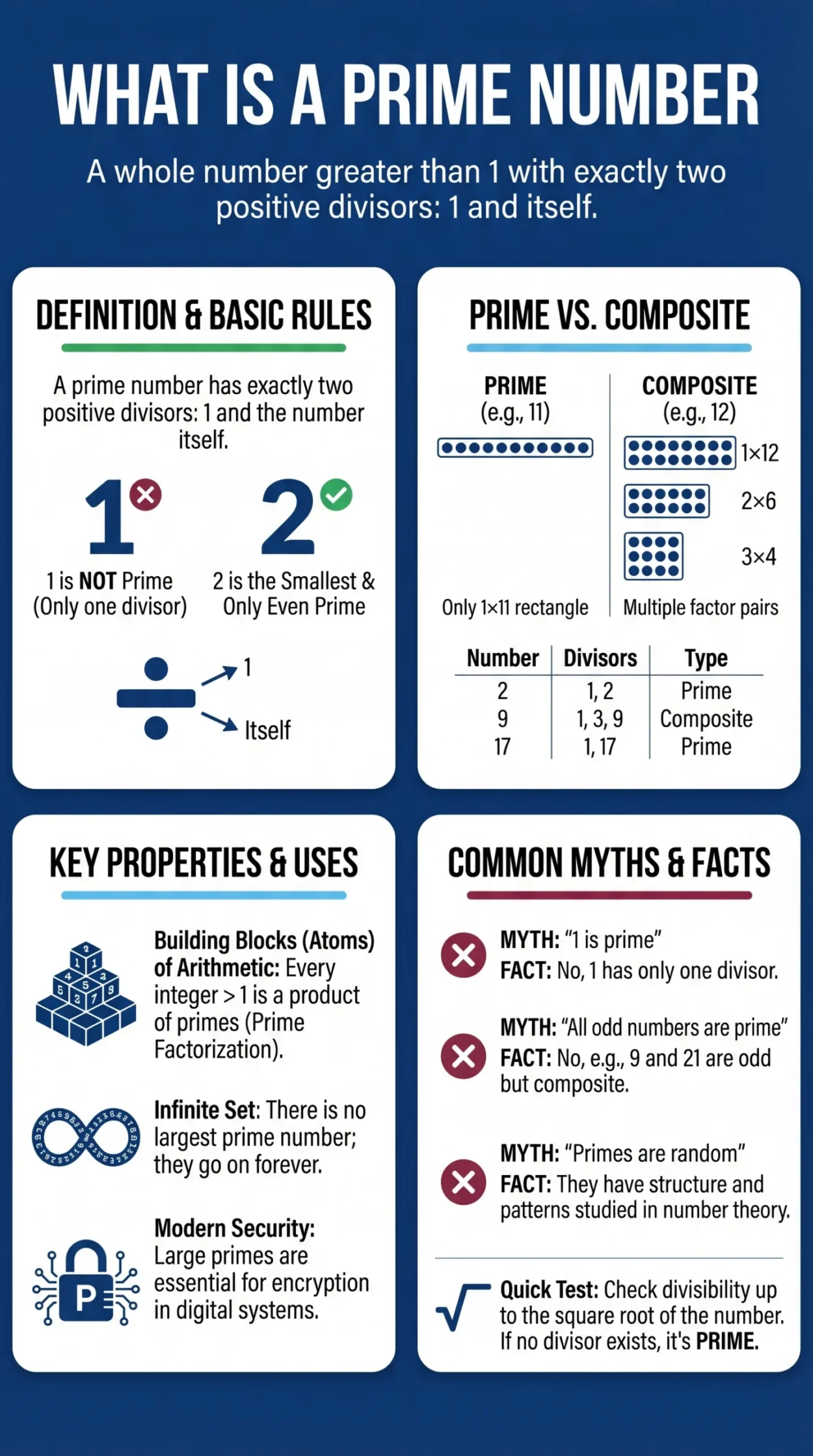 Prime numbers matter because they are the basic pieces of whole numbers. When a number is not prime, it can be broken into prime factors. That simple idea connects prime numbers to divisibility, factorization, number patterns, and even modern encryption.
Prime numbers matter because they are the basic pieces of whole numbers. When a number is not prime, it can be broken into prime factors. That simple idea connects prime numbers to divisibility, factorization, number patterns, and even modern encryption.Prime number and tool connection: A page like Prime Number Checker fits naturally with this topic because primality is really a question about divisors. If no divisor other than 1 and the number itself exists, the number is prime.
Prime number definition
A prime number is a positive integer greater than 1 with exactly two positive divisors. Those divisors are always 1 and the number itself.This definition is precise, and it also explains why prime numbers stand apart from other integers. Every whole number greater than 1 falls into one of two groups:- Prime numbers: exactly two positive divisors
- Composite numbers: more than two positive divisors
Why 1 is not a prime number
This is one of the most common points of confusion. The number 1 is not prime because it has only one positive divisor: 1.A prime number must have two positive divisors. Since 1 does not meet that rule, it is excluded. It is also not composite. That makes 1 a special case.Important: saying “a prime number is divisible by 1 and itself” is only safe when you also say greater than 1. Without that part, the definition becomes incomplete.Why 2 is special
The number 2 is the smallest prime number, and it is also the only even prime number.Every other even number is divisible by 2, so it must have at least three positive divisors: 1, 2, and itself. That makes every even number greater than 2 composite.How prime numbers work
A useful way to think about primes is through exact division. If a number can be divided evenly by any whole number other than 1 and itself, it stops being prime.Take 13. You can divide 13 by 1 and 13 with no remainder. But 2, 3, 4, 5, and the rest do not divide it evenly. So 13 is prime.Now take 15. It is divisible by 1 and 15, but also by 3 and 5. That means 15 has extra divisors. So 15 is composite.Prime vs composite
Prime and composite are opposite ideas for integers greater than 1. This is where many short pages stop too early, but the distinction matters because it shapes how factorization works.| Number | Positive divisors | Type | Reason |
|---|---|---|---|
| 1 | 1 | Neither | It has only one positive divisor |
| 2 | 1, 2 | Prime | It has exactly two positive divisors |
| 9 | 1, 3, 9 | Composite | It has more than two positive divisors |
| 17 | 1, 17 | Prime | No extra divisor exists |
A visual way to understand primes
You can also picture factors as ways to arrange dots into equal rows and columns. A composite number can form a rectangle in more than one way. A prime number cannot. It only makes a 1 by n rectangle.For example, 12 can be arranged as 1×12, 2×6, and 3×4. That shows several factor pairs, so 12 is composite. But 11 only gives 1×11. That is why 11 is prime.Examples of prime numbers
The first few prime numbers are:2, 3, 5, 7, 11, 13, 17, 19, 23, 29Notice what is missing. Not every odd number is prime. Numbers like 9, 15, 21, and 25 are odd, but they are composite because they have extra divisors.Prime numbers from 1 to 20
The prime numbers from 1 to 20 are 2, 3, 5, 7, 11, 13, 17, 19.The numbers 4, 6, 8, 9, 10, 12, 14, 15, 16, 18, and 20 are composite. The number 1 is neither prime nor composite.Why prime numbers matter
Prime numbers are not just a school topic. They sit behind a basic fact of arithmetic: every integer greater than 1 can be written as a product of prime numbers.For example:- 12 = 2 × 2 × 3
- 18 = 2 × 3 × 3
- 35 = 5 × 7
Prime factorization connection
Once you know what a prime number is, prime factorization becomes much easier to understand. A composite number can be broken into smaller and smaller factors until only primes remain.That link is useful for topics such as:- greatest common factor
- least common multiple
- divisibility rules
- coprime numbers
- simplifying fractions