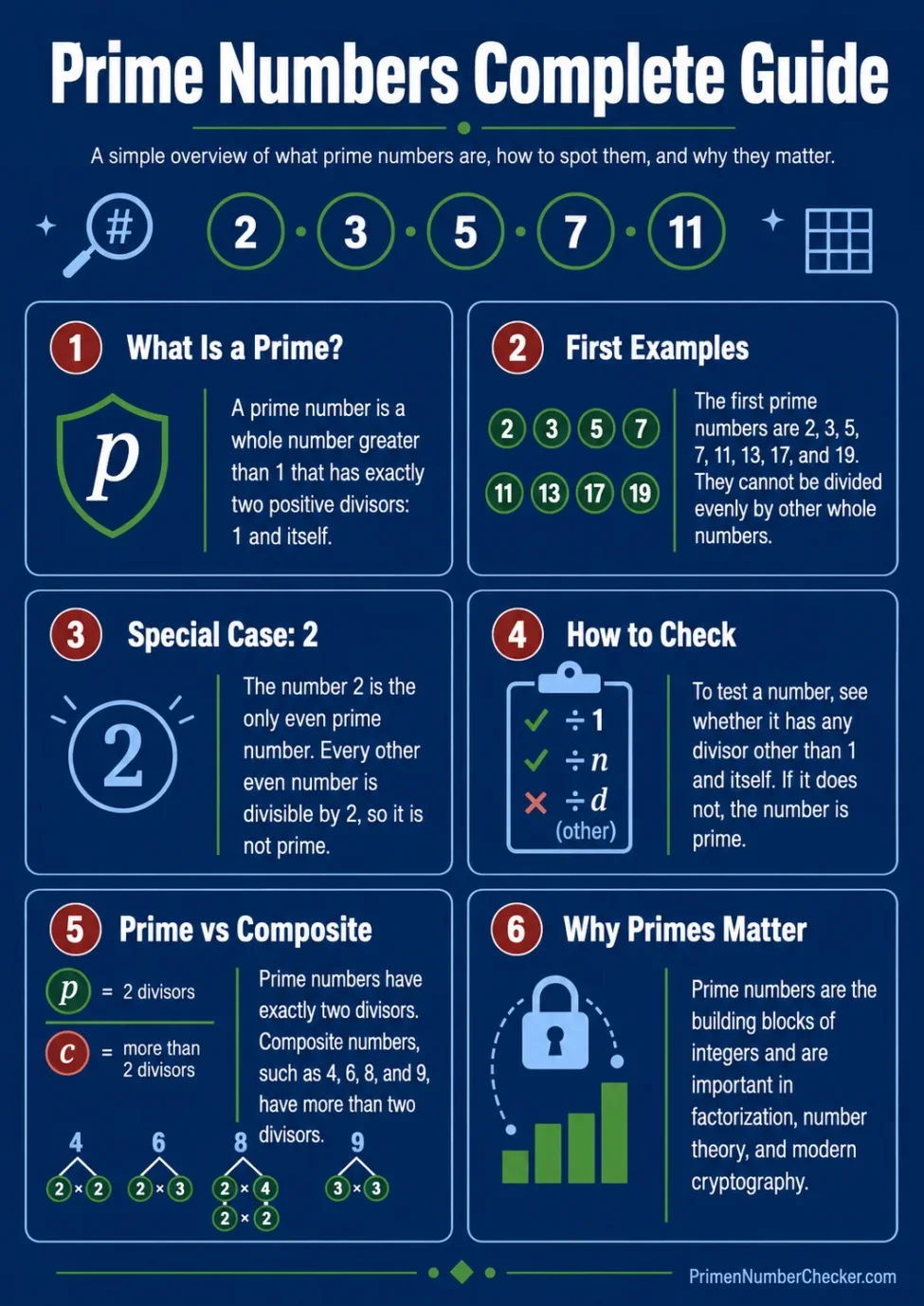
Prime Numbers Complete Guide
A prime number is a whole number greater than 1 that has exactly two positive divisors: 1 and itself. That simple definition gives prime numbers a special role in mathematics. They help us understand divisibility, factorization, patterns in numbers, and many modern systems that depend on large-number arithmetic.
The shortest answer is this: 2, 3, 5, 7, 11, 13, 17, 19 and similar numbers are prime because they cannot be divided evenly by any smaller positive number except 1. Numbers like 4, 6, 8, 9, 10 are not prime because they can be broken into smaller whole-number factors.
Quick check: If you want to test a specific number while reading, use the Prime Number Checker. This guide explains the logic behind the result, so the answer does not feel like a black box.
What Is a Prime Number?
A prime number is a natural number greater than 1 with only two positive divisors. The number must divide evenly by 1 and by itself, and by no other positive whole number.
For example, 7 is prime. Its only positive divisors are 1 and 7. The number 9 is not prime, because 9 can be divided evenly by 3. Once a number has a divisor other than 1 and itself, it becomes composite.
This definition is strict. It does not depend on how large the number looks, whether the number is odd, or whether it appears in a familiar pattern. A number is prime only when its divisors match the rule.
The Mathematical Definition
In standard elementary number theory, a number p is prime when:
p > 1, and the only positive divisors of p are 1 and p.
This definition also explains what prime numbers are not. The number 1 is not prime, because it has only one positive divisor. The number 0 is not prime, because it does not fit the divisor rule for positive natural numbers. Negative integers are not treated as prime in the usual school-level definition used by prime checking tools.
Why Prime Numbers Matter
Prime numbers matter because multiplication can be understood through them. Every whole number greater than 1 is either prime or can be written as a product of prime numbers.
For example:
- 12 = 2 × 2 × 3
- 30 = 2 × 3 × 5
- 84 = 2 × 2 × 3 × 7
These prime factors show the hidden structure of a number. This is why primes are closely connected to factorization, divisibility, least common multiples, and greatest common divisors.
A useful way to think about it is this: composite numbers can be split into smaller whole-number parts, but prime numbers cannot.
Prime Numbers vs Composite Numbers
Prime and composite numbers are separated by one question: Can this number be divided evenly by a positive whole number other than 1 and itself?
| Number Type | Meaning | Examples |
|---|---|---|
| Prime | Has exactly two positive divisors | 2, 3, 5, 7, 11 |
| Composite | Has more than two positive divisors | 4, 6, 8, 9, 10 |
| Neither | Does not fit the prime or composite rule | 0, 1 |
The number 2 deserves special attention. It is the only even prime number. Every other even number can be divided by 2, so every other even number greater than 2 is composite.
First Prime Numbers
The first prime numbers are:
2, 3, 5, 7, 11, 13, 17, 19, 23, 29, 31, 37, 41, 43, 47
These examples show a pattern, but also a warning. Most primes after 2 are odd, yet not every odd number is prime. The number 9 is odd, but 9 = 3 × 3. The number 15 is odd, but 15 = 3 × 5.
So oddness is only a first filter. Primality needs a divisor test.
How to Know If a Number Is Prime
To check whether a number is prime, you test whether it has a divisor between 2 and the square root of the number. You do not need to test every smaller number.
The reason is simple. If a number has two factors, one of them must be less than or equal to its square root. For example, if 91 is composite, its factor pair must show up before or at √91.
Example: √91 is a little more than 9.5. So we only test prime divisors up to 9: 2, 3, 5, 7. Since 91 ÷ 7 = 13, the number 91 is composite.
This square-root rule makes prime checking much faster. It also explains why a checker can test numbers without trying every possible divisor.
Simple Divisibility Clues
Some numbers can be ruled out quickly before using a full prime test. These clues do not prove that a number is prime, but they can prove that a number is not prime.
- If a number greater than 2 is even, it is not prime.
- If the digit sum is divisible by 3, the number is divisible by 3.
- If a number ends in 0 or 5 and is greater than 5, it is divisible by 5.
- If a number has a known smaller factor, it is composite.
These tests help with mental math. Still, a number that passes these clues may need a stronger test. For example, 121 is odd, does not end in 5, and is not divisible by 3. But 121 = 11 × 11, so it is composite.
Why 1 Is Not a Prime Number
Many beginners ask why 1 is not prime. It feels special, and it divides every whole number. But the prime definition requires exactly two positive divisors.
The number 1 has only one positive divisor: itself. That means it does not meet the rule.
There is also a deeper reason. If 1 were prime, prime factorization would no longer be clean. For example, 6 could be written as:
- 2 × 3
- 1 × 2 × 3
- 1 × 1 × 2 × 3
To keep prime factorization exact and useful, 1 is treated as neither prime nor composite.
Prime Factorization
Prime factorization means writing a composite number as a product of prime numbers. It breaks a number into its smallest indivisible multiplication parts.
For example, 72 can be factored like this:
72 = 2 × 2 × 2 × 3 × 3
This can also be written as 2³ × 3². Both forms show the same prime structure.
Prime factorization helps explain why fractions reduce, why common divisors exist, and why some numbers share hidden relationships. When two numbers share the same prime factors, they share divisibility patterns.
The Fundamental Theorem of Arithmetic
The Fundamental Theorem of Arithmetic says that every whole number greater than 1 can be written as a product of prime numbers in one unique way, apart from the order of the factors.
For example:
- 90 = 2 × 3 × 3 × 5
- 90 = 3 × 5 × 2 × 3
The order changes, but the prime factors are the same. This is one reason prime numbers are so important in number theory. They give whole numbers a stable multiplication identity.
Are There Infinitely Many Prime Numbers?
Yes. There are infinitely many prime numbers.
A classic idea from Euclid shows why. Imagine you had a list of all primes. Multiply them together and add 1. The new number would either be prime itself or have a prime divisor not already on the list. Either way, the original list could not contain every prime.
This argument is short, but powerful. It shows that prime numbers never run out, even though they become less frequent on average as numbers grow larger.
Prime Number Patterns
Prime numbers have patterns, but they are not fully predictable by a simple repeating rule. This makes them both useful and difficult.
All primes greater than 3 have a limited remainder pattern
Every prime greater than 3 is one more or one less than a multiple of 6. In other words, primes greater than 3 have the form 6n − 1 or 6n + 1.
But this test only filters candidates. It does not prove primality. For example, 25 = 6 × 4 + 1, but 25 is composite.
Prime gaps change
The gap between two nearby primes is not fixed. For example, the gap between 3 and 5 is 2. The gap between 89 and 97 is 8. These gaps help mathematicians study how primes are spread across the number line.
Some primes appear in pairs
Twin primes are pairs of primes separated by 2, such as 11 and 13, or 17 and 19. These pairs are easy to understand, but their long-term pattern is much harder to prove.
Common Types of Prime Numbers
Once you understand the basic definition, other prime-related terms become easier to read. These terms describe special forms or relationships among primes.
Twin primes
Twin primes are prime pairs that differ by 2. Examples include 3 and 5, 5 and 7, and 29 and 31.
Mersenne primes
A Mersenne prime has the form 2ⁿ − 1. Not every number in this form is prime. For example, 2⁴ − 1 = 15, and 15 is composite.
Coprime numbers
Two numbers are coprime when they share no positive divisor except 1. They do not both need to be prime. For example, 8 and 15 are coprime because they have no shared prime factor.
Probable primes
In large-number testing, a number may pass strong primality tests and be called a probable prime. This term appears more often in advanced computing, where numbers can be very large.
Prime Numbers in Modern Use
Prime numbers are not only classroom objects. They appear in computer science, cryptography, random number methods, hashing ideas, and algorithm design.
In cryptography, large primes help create arithmetic problems that are easy to set up but hard to reverse without the right private information. The practical systems are more complex than “pick a prime,” but the prime-number idea sits close to the math behind them.
In programming, primes also appear in topics such as modular arithmetic, hash table sizing, and fast factorization challenges. The same basic question remains: which numbers can be split, and which cannot?
How Prime Checkers Work
A prime checker takes a number and tests whether it has any divisor other than 1 and itself. A simple checker may use trial division up to the square root. More advanced tools may use faster tests for larger inputs.
The logic usually follows this order:
- Reject numbers less than 2.
- Accept 2 as prime.
- Reject even numbers greater than 2.
- Test possible divisors up to the square root.
- If no divisor is found, the number is prime.
This mirrors the mathematical definition. The tool does not “guess.” It checks whether the divisor rule is true.
Common Mistakes About Prime Numbers
Prime numbers look simple, but a few mistakes appear often.
Mistake 1: Thinking 1 is prime
The number 1 is not prime because it has only one positive divisor. A prime must have exactly two.
Mistake 2: Thinking every odd number is prime
Many odd numbers are composite. For example, 21 = 3 × 7 and 35 = 5 × 7.
Mistake 3: Testing too many divisors
You only need to test divisors up to the square root. After that point, any missing factor pair would already have shown a smaller factor.
Mistake 4: Treating large numbers as prime because they look unfamiliar
Size does not prove primality. A large number can still have a small divisor.
Prime Numbers and Learning Number Theory
Prime numbers are often the first serious step into number theory. They connect simple arithmetic to deeper ideas: divisibility, remainders, modular arithmetic, factorization, proof, and algorithmic testing.
This is why a good prime-number page should do more than say “prime or not prime.” It should explain why the answer is true. A checker gives the result; the concept explains the result.
When both parts work together, the user can test a number and understand the reasoning behind the test.
Prime Number Summary
- A prime number is greater than 1 and has exactly two positive divisors.
- 2 is the only even prime number.
- 1 is neither prime nor composite.
- Composite numbers can be written as products of prime numbers.
- Prime checking usually tests divisors only up to the square root.
- There are infinitely many primes, so the list never ends.
FAQ About Prime Numbers
What is a prime number in simple words?
A prime number is a whole number greater than 1 that can only be divided evenly by 1 and itself. For example, 5 is prime because only 1 and 5 divide it evenly.
Is 1 a prime number?
No. The number 1 is not prime because it has only one positive divisor. A prime number must have exactly two positive divisors.
Is 2 a prime number?
Yes. The number 2 is prime because its only positive divisors are 1 and 2. It is also the only even prime number.
Are all odd numbers prime?
No. Many odd numbers are composite. For example, 9, 15, 21, and 25 are odd, but each has divisors other than 1 and itself.
How do you test if a number is prime?
Test whether the number has any divisor from 2 up to its square root. If no divisor is found and the number is greater than 1, it is prime.
Do prime numbers go on forever?
Yes. There are infinitely many prime numbers. No matter how many primes you list, there will always be another prime beyond the list.